Volvo D5 Turbo Boost Control Valve: Identification and Checks
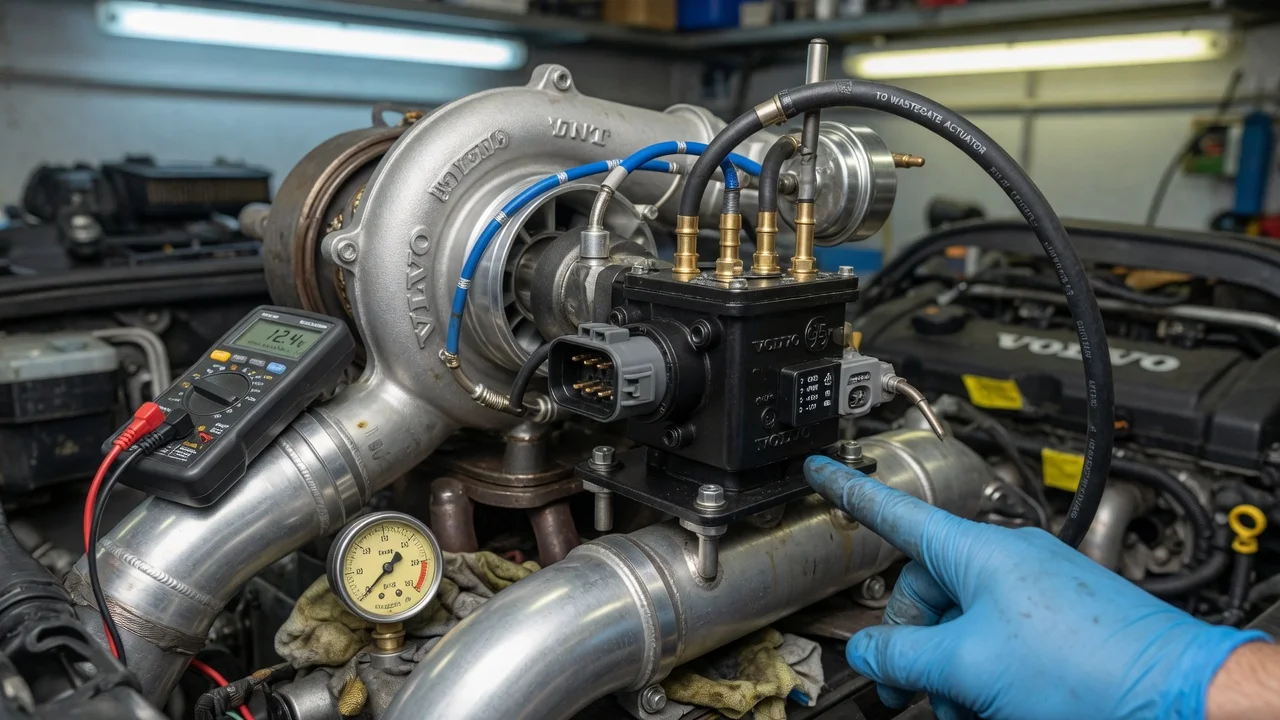
A Volvo D5 that loses power, drops into limp mode or logs a boost fault often gets blamed on the turbo boost control valve. That part can fail, but the same symptoms also come from vacuum leaks, split intake hoses, sticking turbo vanes and sensor faults. Boost control also differs between D5 engine versions, so the exact vehicle configuration matters. This guide explains how to record the symptoms, weigh the likely causes and check them in an order that avoids replacing parts on a guess.
Establish the symptoms
Start by writing down exactly when the problem appears. Note whether it happens under hard acceleration, when overtaking, climbing a hill, towing, or at a steady cruise. Record the approximate engine speed and road speed, whether the engine was cold or fully warm, and whether the fault is constant or intermittent. Note what the car does: a sudden loss of power with a warning message, a surge followed by a cut, a flat spot that never builds full pull, or power that returns after the engine is switched off and restarted. That last pattern is typical of a protective limp mode triggered by the engine control module when measured boost does not match what it requested.
Associated signs narrow things down. Listen for hissing or whistling under load, look for black or blue smoke, and check whether the engine warning lamp is on. Then list recent changes: any work near the intake or turbo, disturbed vacuum lines, intake or EGR cleaning, a new air filter, battery disconnection, or a change in operating conditions such as frequent short trips. Confirm the vehicle configuration from the registration documents or VIN, including model, model year and engine version, and gather the service history. Volvo used different D5 engines and turbo control arrangements over the years, so a check that suits one version may not apply to another.
Distinguish plausible causes
On D5 versions with a vacuum-operated turbo actuator, an electrically controlled solenoid valve regulates the vacuum sent to the actuator, and that sets turbo geometry and boost. Some later versions use an electronic actuator mounted on the turbo instead. A faulty control valve or actuator is supported by an electrical circuit fault code for that component, by boost that never follows the request even with intact hoses, or by an actuator that moves correctly when tested independently but not when the valve is commanded. The case for the valve weakens if the stored code points to a boost deviation rather than a circuit fault, or if the problem appears only at high load.
Competing causes are common. Cracked or loose vacuum hoses, or a weak vacuum supply, starve the actuator and imitate a failed valve. A split intercooler hose or a leaking charge pipe lets boost escape, which is often heard as a hiss and tends to show up mainly under heavy load. Soot can make the variable vanes inside the turbo stick, giving erratic boost that may be worse after long periods of gentle driving. A failed actuator diaphragm, an inaccurate boost pressure sensor, a faulty airflow sensor, or restrictions in the EGR or exhaust aftertreatment on equipped versions can also produce boost-related faults. Oil inside the charge pipes or a noisy turbo points toward the turbocharger itself rather than its control.
Checks in a useful order
Begin with checks any owner can do safely. Read fault codes with a scan tool that can access Volvo-specific modules, not only generic engine codes, and save any freeze-frame data before clearing anything. With the engine off and cool, inspect the vacuum lines around the control valve and turbo for cracks, splits, softened ends and disconnected fittings. Check the electrical connector on the valve or actuator for corrosion, damage or a loose lock. Follow the intercooler hoses and charge pipes, looking for oil film, split rubber or loose clamps. Never reach near the turbo or drive belt with the engine running.
The next stage needs tools and the manufacturer specifications for the exact engine. Live data comparing requested and actual boost during a controlled road test, ideally with an assistant reading the tool, shows whether boost tracks the request or falls away. On vacuum-controlled versions, a hand vacuum pump shows whether the actuator moves smoothly and holds vacuum, and a vacuum gauge confirms supply at the valve. Electrical checks of the valve circuit should be compared against published values rather than guessed numbers. A smoke test finds intake leaks reliably. Electronic actuators, component activation tests and any required calibration after replacement are usually best handled by a qualified technician with suitable diagnostic software.
Interpret the findings
Each result answers a narrower question. A circuit fault code backed by a damaged connector or out-of-specification electrical readings points to wiring or the valve itself. An actuator that holds vacuum and moves freely under a hand pump rules out the diaphragm and gross vane seizure, shifting attention to the valve or its vacuum supply. Good vacuum at the valve inlet but poor vacuum at the actuator during operation implicates the valve. If live data shows boost building correctly and then collapsing at high load, a pressure leak is more likely than a control fault, and a smoke test should be the next step.
Before replacing parts, confirm that the suspected fault explains every recorded symptom. A new valve will not cure a split charge hose, sticking vanes or a misreading pressure sensor, and a deviation code can return immediately if the real cause is elsewhere. After any repair, clear the codes, repeat the same road test that produced the fault, and compare requested and actual boost again. If the fault returns under the same operating conditions, the diagnosis is incomplete and further inspection is needed.
Urgency and next action
Some signs mean the car should not be driven until it is inspected. Stop as soon as it is safe if you notice heavy blue or black smoke, a loud whine or grinding from the turbo area, oil leaking from turbo or intake connections, signs of overboost such as a sharp surge followed by a cut, or engine speed rising without throttle input. Repeated sudden power loss is also a hazard in traffic or when merging. A boost fault without these signs may still allow careful short-distance driving to a workshop, but no fixed safe distance can be promised, because the underlying cause determines the risk.
To speed up the repair, give the technician the VIN, model year and engine version, the saved fault codes and freeze-frame data, and your symptom log with conditions and recent changes. Include the service history and where the car stands in its maintenance schedule, along with the results of any inspection or tests you have already done. This lets the workshop follow the manufacturer procedure for your exact configuration and confirm the cause before ordering a boost control valve or any other part.