Choosing a Vacuum Gauge for Brake Booster Testing
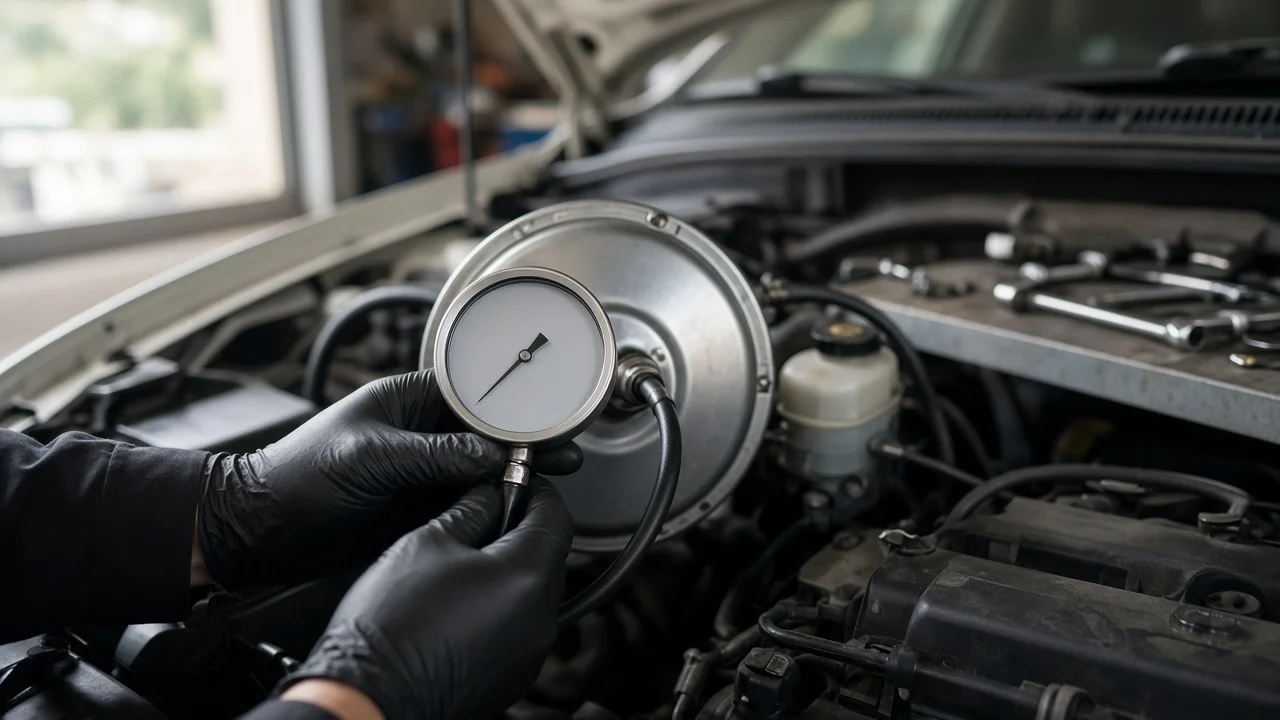
A hard brake pedal, a hiss under the dash or a pedal that firms up quickly after the engine stops can all point to a vacuum supply or booster problem. A vacuum gauge gives you a reading you can compare with the specification in your vehicle's service information. The right gauge depends less on the brand than on how your vehicle produces vacuum and how you will connect the gauge to the booster circuit.
Define the job the product must do
For brake booster testing, a gauge answers three questions. Is enough vacuum reaching the booster with the engine running? Does the check valve hold that vacuum when the source stops? Does the booster itself leak down faster than the service information allows? The first question needs a gauge teed into the supply hose while the engine idles. The other two are easier with a hand vacuum pump that has a built-in gauge, because you can apply vacuum to an isolated valve or booster with the engine off and watch whether the reading holds.
Your practical constraints also shape the choice. If you are checking one suspected fault in a driveway, a simple kit that covers both the running test and the engine-off hold test is usually enough. If you also diagnose intake leaks, valve timing or exhaust restrictions, a gauge that reads steadily and clearly at idle becomes more important. Decide whether you need a single-purpose tool or a general vacuum diagnostic tool before you compare products.
Check compatibility
Start with vehicle fitment, which here means the type of brake assist. Many gasoline engines draw booster vacuum from the intake manifold. Diesel engines and some turbocharged or direct-injection gasoline engines use a mechanical or electric vacuum pump instead. Some vehicles have hydraulic assist driven by power steering pressure, and many hybrids and electric vehicles use electric pumps or electronically controlled brake systems. A vacuum gauge can still help with pump-supplied systems, but it cannot test hydraulic assist or electronic boosters. Confirm the system type in the service information before you buy anything.
Next, check the physical and measurement interfaces. The booster supply hose, the check valve and its grommet set the hose diameters you have to match, so look for a kit with tee fittings and stepped or assorted adapters that seal without forcing or stretching the original hose. The test hose should be rated for vacuum so it does not collapse. The gauge should read in the same units your service information uses, usually inches of mercury or kilopascals, or it should show both. Its scale should cover the full possible vacuum range so a healthy reading does not sit near the end of the dial.
Features that affect the choice
Analog dials need no batteries and show trends well. A slow drop during a hold test is easy to see on a needle. Larger dials with fine graduations are easier to read accurately. Digital gauges show an exact number, often switch units and sometimes hold a minimum or maximum reading, but they need batteries and some refresh too slowly to show rapid changes. Damping is another trade-off. A liquid-filled or restricted gauge steadies the needle for booster supply readings, but needle flutter can help with engine diagnosis. If you plan to use the gauge for both jobs, an adjustable damper is worth having.
A hand vacuum pump with an integrated gauge adds the most to booster testing. It lets you confirm that the check valve passes flow in one direction only and that the booster diaphragm holds vacuum, without running the engine. When judging any listing, separate evidence from marketing. Stated accuracy, usually given as a percentage of full scale, the scale range, the graduation size, a zero-adjust screw and a complete list of included adapters are all useful. Labels such as professional grade or heavy duty tell you nothing unless specifications back them up.
Limitations and ownership costs
Setup affects the result. Take running readings with the engine warm and idling as the service procedure describes, and seal every connection, because a leaking tee will look like a weak vacuum source. Available vacuum falls as altitude rises, so compare your reading with the specification and allow for elevation if the service information provides a correction.
Ownership costs are modest but real. Rubber test hoses harden and crack, small adapters get lost, and the seals in hand pumps wear and eventually need a rebuild kit. Before each use, check that the gauge reads zero when it is open to the air, and adjust or replace it if it does not. A dropped dial gauge can lose calibration without any visible damage. Store the kit in its case, away from heat and solvents.
Know what a vacuum gauge cannot tell you. It does not measure brake pads or brake rotors against their wear limits, check brake fluid condition, show a sticking caliper or detect contaminated friction material. A spongy pedal caused by air in the fluid, or a sinking pedal caused by a master cylinder fault, will not show on a vacuum reading. If the pedal is hard, low or inconsistent, or if the vehicle does not stop properly, stop driving it and have the brakes professionally inspected.
Build a practical shortlist
Use a short checklist for each candidate. Does your vehicle use a vacuum booster, and what supplies the vacuum? Does the gauge read in your service information's units across the full range? Do the included hoses, tees and adapters fit your supply hose and check valve? Do you need a passive gauge, a hand pump with a gauge, or both? Can you read the dial or display easily, and does it have damping that suits your other uses? Is the accuracy stated, and can you adjust the zero? Can you buy replacement hoses and seals?
Write the answers for two or three options side by side. Drop any product that does not list its range, accuracy or included fittings. Then choose the simplest tool that covers your actual job. For a one-time booster and check valve diagnosis, a hand pump kit with a clear gauge usually covers the most tests. If you also do regular engine vacuum work, a well-damped dial gauge with a good adapter set may be the better buy, and you can add a hand pump later.