US car brand emblems
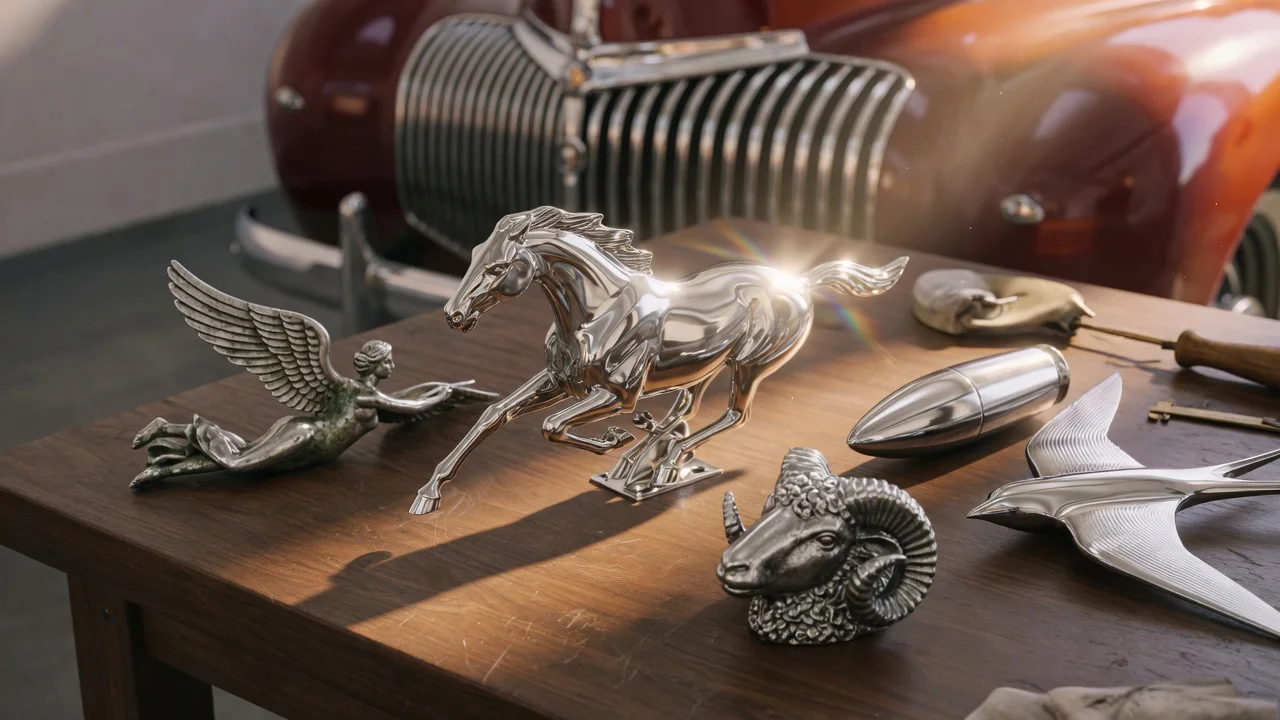
Most current American car brands can be identified by one signature emblem. Ford uses a blue oval, Chevrolet a bowtie, Cadillac a crest, Buick three shields, Lincoln a four-pointed star, Ram a ram's head, and Tesla a stylized T. Jeep, GMC, Chrysler and Dodge rely more on wordmarks or winged or striped badges. Two things change the answer. First, a brand's emblem has often been redesigned over the decades, so the badge on a vehicle depends on its model year. Second, some of the best-known American badges belong to individual models, such as the Mustang pony or the Corvette crossed flags, rather than to the brand.
What counts as a US car brand
This guide covers brands that originated in the United States and are generally sold as American marques. Ownership is not always domestic. Chrysler, Dodge, Jeep and Ram belong to Stellantis, a multinational group formed in 2021, but they are still widely treated as American brands. The guide groups brands by parent company because related brands often share design conventions.
Quick reference: current brand emblems
Brand | Parent company | Emblem in brief; Ford | Ford Motor Company | Blue oval containing the Ford script; Lincoln | Ford Motor Company | Four-pointed star, often framed in a rectangle; Chevrolet | General Motors | Bowtie, usually gold or black; Buick | General Motors | Three shields; Cadillac | General Motors | Stylized crest; GMC | General Motors | Red block letters spelling GMC; Chrysler | Stellantis | Winged badge with the Chrysler name; Dodge | Stellantis | Wordmark, usually with red stripes; the Fratzog has been revived on some models; Jeep | Stellantis | Jeep wordmark; the seven-slot grille also serves as a brand signature; Ram | Stellantis | Ram's head or RAM lettering; Tesla | Tesla | Stylized T; Rivian | Rivian | Geometric emblem paired with a wordmark; Lucid | Lucid Group | Lucid wordmark
Ford Motor Company brands
Ford's Blue Oval is one of the most recognized automotive emblems in the world. An oval shape was associated with the company early in its history, and the blue oval with the flowing Ford script became the familiar badge from the late 1920s, around the Model A. The design has been refined several times since, so the exact shade, script and finish differ by era.
Lincoln, Ford's luxury brand, uses the Lincoln Star, a four-pointed star usually set inside a rectangular frame. On some recent models the star is illuminated or built into the grille pattern, depending on model and trim.
General Motors brands
The Chevrolet bowtie is usually dated to around 1913. Its origin is disputed. One account credits co-founder William Durant with adapting a wallpaper pattern he saw in a hotel, and another points to a design he spotted in a newspaper. The company has never settled the question. Current Chevrolets often carry a gold bowtie, and many trims and appearance packages use a black version.
Buick's tri-shield comes from the ancestral coat of arms associated with founder David Dunbar Buick. A single shield came first, and three shields appeared around the 1960 model year. The three are often said to represent the LeSabre, Invicta and Electra models of that time. In 2022 Buick introduced a redesign that removes the surrounding circle and arranges the three shields in a horizontal line. Older and newer Buicks therefore wear visibly different badges.
Cadillac's crest comes from a coat of arms attributed to Antoine de la Mothe Cadillac, the French explorer credited with founding Detroit. The crest has been simplified over the years. The laurel wreath that long surrounded it was dropped in the mid-2010s, and newer models, especially the electric ones, use flatter and sometimes monochrome versions.
GMC, GM's truck and SUV brand, uses red capital letters spelling GMC. Some trims use different finishes. The GMC Hummer EV carries a HUMMER wordmark instead of the standard GMC badge.
Stellantis brands: Chrysler, Dodge, Jeep and Ram
Chrysler currently uses a winged badge with the Chrysler name. The Pentastar, a five-pointed star made of five triangles, was introduced in the early 1960s as the corporate symbol of the former Chrysler Corporation. It appears on many older vehicles and dealer signs, and it should not be confused with the brand badge on a modern Chrysler.
For many years Dodge vehicles carried a ram's head. When Ram became a separate truck brand around 2010, the ram's head went with it. Dodge then moved to a wordmark, usually shown with two red stripes. Dodge has since revived the Fratzog, a three-pointed emblem from the 1960s and 1970s, on some recent models, including the electric Charger. Which Dodge badge appears depends heavily on model year.
Jeep's main badge is its wordmark. The seven-slot vertical grille is protected as a brand design element and is often treated as Jeep's real visual signature, though it is part of the bodywork rather than an emblem.
Ram trucks use either the ram's head or bold RAM lettering. Many recent trucks put large RAM lettering in the grille, with the ram's head used elsewhere, depending on model and trim.
Newer electric-vehicle brands
Tesla's stylized T is described by the company's chief executive as representing a cross-section of an electric motor. Rivian pairs a geometric emblem with its wordmark. Lucid relies mainly on its wordmark. These brands are young, so their emblems have changed less than those of the older marques.
Emblems of discontinued American brands
Older or used vehicles may carry badges from brands that no longer exist. Common examples:
Pontiac (GM, discontinued around 2010): a red, downward-pointing arrowhead; Oldsmobile (GM, discontinued in 2004): a stylized rocket; Plymouth (Chrysler, discontinued in 2001): a sailing ship based on the Mayflower in earlier eras, later a simplified ship outline; Mercury (Ford, discontinued in 2011): a stylized emblem often read as flowing lines inside a circle; Saturn (GM, discontinued around 2010): a red square with a curved line suggesting a planetary ring
Model emblems that are often mistaken for brand logos
Several famous American badges identify a single model rather than a brand. The Ford Mustang uses a running horse. The Chevrolet Corvette uses crossed flags, one checkered, and the design has changed between generations. The Dodge Viper and some performance trims carry their own insignia. If a vehicle shows one of these badges, look at the grille, steering wheel hub or tailgate to find the brand emblem.
Why the same brand can look different
Emblems vary for several reasons:
Model-year redesigns, such as Buick's 2022 change and Cadillac's removal of the wreath; Trim and appearance packages that swap chrome or gold for black or dark finishes; Illuminated badges offered on some recent models; Aftermarket replacement badges, which may not match the vehicle's original year; Market differences, since some American brands use other names abroad or are not sold in certain regions
Limits of this guide: it does not give exact introduction dates for every redesign, and dates described as approximate should be checked against the manufacturer's own heritage material. To confirm the original badge for a specific vehicle, the most reliable sources are its model year, owner documentation, or a dealer parts lookup by VIN.