Uneven Tire Wear: Patterns, Causes, and Why One Tire Wears Faster
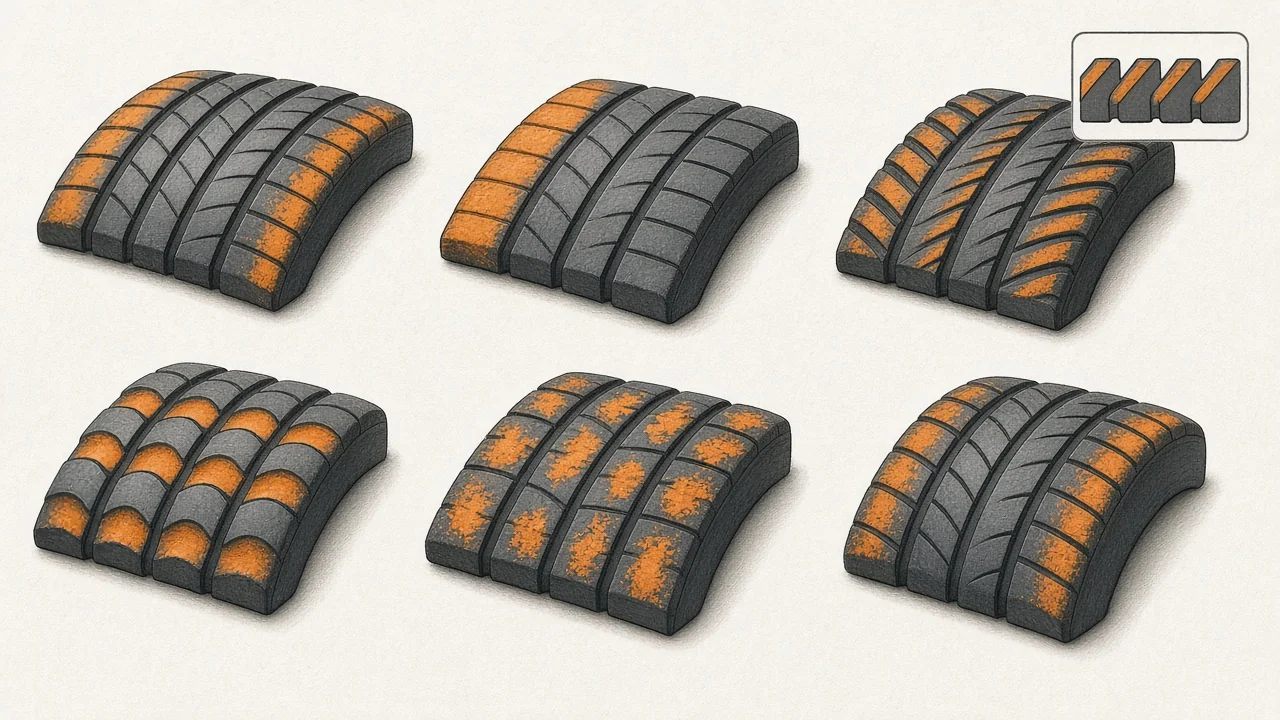
Uneven tire wear is one of the most useful clues a vehicle offers, but it is a clue rather than a verdict. Where tread disappears, across the face or around the circumference, helps narrow down pressure, alignment, suspension, and balance questions. It also helps explain why a single tire or one side of the car can wear out well before the others.
What Uneven Tire Wear Reveals About Tread Loss
Uneven wear means tread is lost irregularly, either across the tire's width from shoulder to shoulder or around its circumference in patches and scallops. A tire on a well-maintained vehicle loses tread gradually and fairly evenly. When one zone works harder, it wears faster. Inflation pressure shapes the footprint, load changes how much the tire flexes, wheel geometry sets the angle at which the tread meets the road, and bouncing or scrubbing adds abrasion in specific spots.
The consequences go beyond appearance. Worn shoulders or scalloped tread leave less effective grooving to channel water in those areas, which can reduce wet traction before the center reaches its limit. Irregular surfaces also create humming, a rougher ride, and sometimes vibration. Because replacement depends on the lowest tread depth rather than the average, uneven wear shortens usable life. Still, a pattern only points toward likely contributors; by itself it cannot identify which part, if any, has failed.
Tire Wear Pattern Chart: Appearance, Possible Causes, and Next Checks
Center wear appears as a middle strip that is noticeably lower than the tire shoulders. It can suggest inflation that was too high for the load and application, so the next check is cold pressure against the placard. Wear on both shoulders is the reverse and can suggest underinflation or excessive load, though neither pattern proves a pressure history. One-sided wear on the inner or outer shoulder may relate to camber or toe, suspension condition, or operating conditions, and it calls for an alignment check plus a suspension inspection.
Feathering is directional wear across tread blocks. Each block is rounded on one edge and sharper on the other, which is often easier to feel than to see when a hand is passed carefully across the tread in both directions. It can suggest sideways scrubbing associated with toe alignment. Cupping shows up as repeated scalloped dips around the circumference, while patchy wear is localized, irregular tread loss. Both call for evaluating damping, wheel balance, wheel or tire irregularities, and possible braking events such as a skid.
How to Record Tread Wear Safely
Start with the vehicle parked securely on level ground, transmission in park or in gear, parking brake set, and engine off. Do not lift the vehicle or reach underneath it; examine only tread you can reach safely from the side. Using a tread-depth gauge, measure in the main circumferential grooves at the inner, middle, and outer positions. Write down the tire location and the exact measurement position for each reading so later comparisons mean something.
One set of readings is not enough, because cupping, patches, and flat spots vary around the circumference. Measure at several accessible points, and leave any sections you cannot reach for a professional inspection. Record cold pressure against the door placard or applicable manufacturer guidance, along with mileage, rotation history, and clear photographs of each tread face. Keep in mind that today's pressure reading describes the tire as it is now; it does not establish what the pressure was over past months.
Tracing the Causes Behind Irregular Wear
Inflation and load determine how the contact patch forms and how much the casing flexes. Too little pressure for the load lets the shoulders carry more of the work and adds heat from flexing, while too much can concentrate contact toward the center. The maximum pressure molded on the sidewall is a limit for the tire, not the routine target for your vehicle. The right cold pressure comes from the vehicle placard or owner's manual, which account for the vehicle's weight and intended load.
Toe describes whether tires point inward or outward relative to each other, and excessive toe can make them scrub; camber is inward or outward tilt that loads one shoulder more. Readings need interpretation because worn steering or suspension parts can let settings shift under load. Weak damping, loose components, imbalance, and wheel or tire irregularities also disturb tire contact, and professional testing is needed to separate them. Cornering, braking, rough roads, impacts, and rotation history can contribute too, but no single habit should be assumed as the cause.
What Wear Patterns and Driving Symptoms Can Tell You
Tires rarely show one tidy pattern. A tire can have a worn outer shoulder and feathered blocks at the same time, or cupping layered over center wear, because several influences often act together. Wear also outlasts its cause: a tire that ran low for months or sat on a misaligned corner keeps that shape after the problem is corrected and may keep making noise. A fresh alignment report and an irregular tire can both accurately describe the same vehicle.
Symptoms add useful questions. Humming that changes with speed, vibration in a certain speed range, a pull, or an off-center steering wheel can relate to tire wear, but also to bearings, brakes, road crown, or internal tire construction. Feathering does not reveal a specific toe measurement, and cupping does not prove a shock or strut has failed. Wear location, pressure records, when symptoms began, and any pothole or curb impact help a shop choose tests without you attempting aggressive road tests yourself.
Why One Tire or One Side of the Car Wears Faster
A single tire wearing faster usually points to something local. A slow leak from a puncture, valve, or bead leaves that tire running below its neighbors. A bent part or corner-specific alignment problem changes its angle to the road, and a worn or damaged component may let the wheel move more than it should. A wheel or tire irregularity, such as an out-of-round condition or an internal belt problem, can also create localized wear that the other three tires never show.
Axle duty matters as well. Front tires handle steering loads on most vehicles, drive tires carry acceleration forces, and braking shifts weight forward, so wear varies by axle depending on layout and use. Before blaming a position, confirm each tire's age, installation mileage, previous positions, and rotation history, since wear may have developed elsewhere. For wear concentrated on one side, a technician compares all four tires' records with alignment measurements and component inspections to find what differs on that side.
When Tire Wear Requires Professional Attention
Some findings call for immediate action rather than a scheduled visit. Exposed cords, a bulge in the sidewall or tread, signs of tread separation, or a tire that loses pressure rapidly mean the tire should not be driven on; arrange roadside assistance or a tow. Severe vibration or a sudden handling change while driving is a reason to slow down, stop where it is safe, and have the vehicle assessed, because a failing tire or component may be involved.
A professional evaluation follows the findings: measuring remaining tread, checking for damage and the source of any pressure loss, and inspecting alignment, balance, and steering and suspension condition as the evidence requires. Correcting the cause stops further irregular wear but cannot restore tread already lost, and rotation spreads wear rather than repairing damage. Whether a tire stays in service depends on its condition and remaining depth, along with manufacturer requirements for matching tires, which can be stricter on some all-wheel-drive vehicles.