Uneven Brake Pad Wear: Causes and Diagnosis
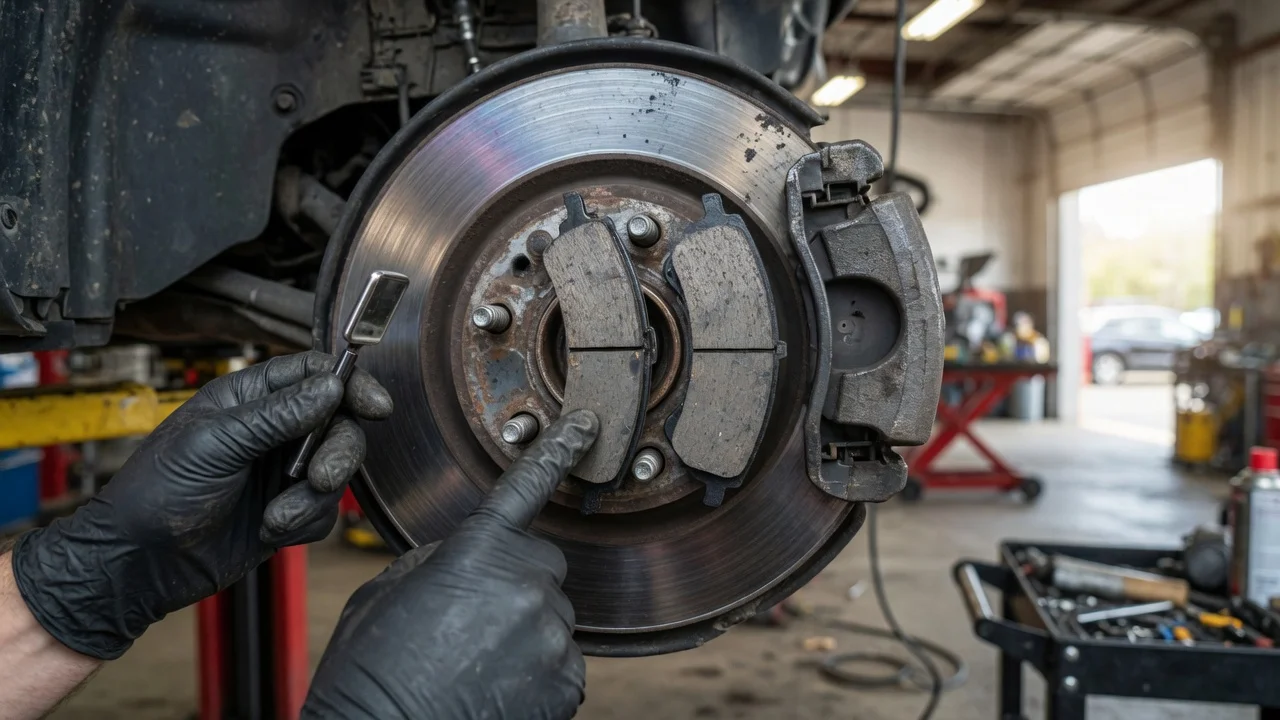
What uneven brake pad wear means
Uneven brake pad wear means the friction material is not being consumed at a similar rate across a pair of pads, across the length of one pad, or from one wheel to the matching wheel on the same axle. It is a symptom of a mechanical, hydraulic or alignment problem at that corner, not a normal result of ordinary braking. Pads that wear together, remaining roughly the same thickness on the inner and outer faces and along each pad, point to a system that is applying and releasing as designed. Pads that do not should be treated as evidence to inspect the caliper, hardware, rotor and related parts before those pads are simply replaced.
The finding applies to disc-brake corners with a sliding or fixed caliper and a pair of pads. Exact remaining-thickness limits, wear-indicator design and whether a given axle uses a sliding single-piston caliper or a multi-piston fixed caliper vary by vehicle, model year, generation and brake package. Manufacturer service information for that vehicle is the specification that decides replacement thickness and hardware service. Front pads often wear faster than rear pads because of brake bias; that axle-to-axle difference is a different question from inner-versus-outer or left-versus-right unevenness on the same axle.
Wear patterns and what they indicate
Measure remaining friction material on the inner pad and the outer pad of the same caliper, and at both ends of each pad. Compare those readings with the matching wheel on the same axle. The pattern is the first diagnostic clue. A fault code, warning lamp or noise is a reason to inspect; it is not by itself proof that a particular part has failed.
Inner pad much thinner than the outer pad on the same wheel: the caliper piston may not be retracting, or the caliper may not be sliding on its guide pins, so one face carries most of the clamp load. Outer pad much thinner than the inner pad: slide pins, boots or the caliper bracket are often binding so the caliper body cannot centre over the rotor. Tapered wear along the length of a pad (one end thinner than the other): the pad is not sitting square in the bracket, commonly from corroded abutments, missing or flattened anti-rattle clips, a bent bracket, or pins that let the caliper cock under load. One wheel worn far more than the opposite wheel on the same axle: that caliper may be dragging after release, a flexible hose may be restricting return flow, or that corner may have a hydraulic or mechanical bind the other side does not. Even inner and outer wear that is simply very fast: driving style, load, towing or a brake that drags on both faces; this pattern still needs a release check, but it is less specific than inner-versus-outer or tapered wear. Rear pads worn far more than the fronts, or one rear pad worn to the backing plate: inspect the parking-brake mechanism, rear slide pins and any drum-in-hat or integrated parking-brake hardware, which can hold a pad against the rotor after the pedal is released.
Causes at the caliper and hardware
Most inner-versus-outer and tapered patterns trace to the caliper not applying or releasing in a straight line. On a typical sliding caliper, the piston pushes the inner pad while the caliper body slides on lubricated guide pins to pull the outer pad in. If the piston, the pins or the pad abutments stick, one pad works harder than the other. Fixed multi-piston calipers do not slide; uneven wear there more often points to a sticking piston on one side of the rotor, contaminated pad faces or a rotor that is not running true.
Seized or slow caliper piston: corrosion under a torn piston boot, old fluid, or a piston that does not retract fully keeps the inner pad in contact with the rotor after the pedal is released. Dry, rusted or bent guide pins, or torn pin boots: the caliper cannot slide, so clamp force is biased to one pad. Pins should move freely by hand with the correct high-temperature brake lubricant specified for that hardware; rubber grease or general-purpose oil is not a substitute. Corroded caliper bracket abutments and worn pad clips or shims: the pad cannot slide in the bracket as thickness changes, which produces taper and can lock a pad against the rotor. Collapsed or internally restricted flexible brake hose: pressure can apply the caliper but not return, so that corner drags. The hose may look intact from the outside. Pad material or installation mismatch: mixing compounds, omitting shims, or fitting a pad that does not sit fully against the abutments can wear one face or one end first. This is an assembly error, not a design feature.
Rotor, hub and suspension contributions
The pad only wears evenly if the disc runs true, the hub locates the disc, and the knuckle holds the caliper square. A pad pattern that repeats after new hardware is fitted often means the rotor, hub or suspension was left out of the first inspection.
Rotor thickness variation, a rust ridge at the outer edge, heavy scoring, or a disc that does not sit flush on the hub: the pad contacts high spots and can taper or glaze on one end. Hub face rust that prevents the disc from seating is a common source of runout after a pad and rotor job. Worn hub bearing: play lets the disc tilt under load, which can wipe one edge of the pad and may appear with growl, heat or play at the wheel. Worn ball joints, control-arm bushings or a bent knuckle: the caliper and disc no longer share a common plane, so wear becomes diagonal or one-sided. This is more likely when the same corner also has tyre wear or a pull that is present without braking. Contamination: oil, grease or brake fluid on the friction face can glaze or eat one pad. A wet boot, a leaking caliper, or grease flung from a hub or CV joint is the source to find, not only the stained pad.
What to check next
Work from the observed wear pattern to the parts that can produce that pattern. Confirm the fault on the system that is actually fitted: sliding versus fixed caliper, presence of an electronic parking brake, and whether the rear brake is a disc with an integrated parking brake. Do not treat a stored brake or ABS code as proof that a pad, caliper or sensor has failed; use the code as a prompt to inspect that circuit and the mechanical state of the corner.
Record remaining pad thickness inner and outer, both ends of each pad, and the same measurements on the opposite wheel. Note heat colour on the disc, a blue or black hot spot, and whether the wheel, caliper or disc is hotter on one corner after a short drive and a stop. With the wheel off, check that pads slide in the bracket with finger pressure, that clips are present and springy, and that abutment ledges are free of rust scale. Binding here matches tapered wear. On a sliding caliper, remove the guide pins, inspect boots for tears, and confirm the pins are straight and move smoothly. Stiff pins match inner-versus-outer wear. Check piston boot condition and, where service procedure allows, piston movement and retraction. A piston that will not return is consistent with a dragging inner pad and a hot disc. Inspect the flexible hose for cracks, bulges and dampness, and consider a restriction if that corner remains applied after the pedal is released. Measure or at least inspect rotor faces for grooves, a lip, rust, and whether the disc sits fully on a clean hub. Check wheel-bearing play with the vehicle safely supported. Road behaviour that belongs in the same diagnosis: a pull to one side under braking, a pedal that feels high and the vehicle still drags, a burning smell, or a vibration that rises with speed after a recent pad replacement.
When to stop driving and when professional diagnosis is required
Uneven wear discovered at a scheduled inspection can often be investigated in the workshop without an emergency stop, provided remaining material is still above the vehicle’s minimum and the brake still feels normal. The conditions below mean the corner may not be able to stop the vehicle as designed, or continued driving may destroy the disc and the caliper.
Friction material worn to the backing plate, or metal-to-metal contact on the disc: stop use of the vehicle until that corner is repaired. Continued driving can score the rotor beyond refinish limits and overheat the caliper. A large left-to-right thickness difference with a pull, a burning smell, smoke at a wheel, or a disc too hot to approach after ordinary driving: treat the brake as dragging. Do not continue a journey that relies on that axle. Brake fluid at the caliper, hose, or around a piston boot: fluid loss reduces reserve in the hydraulic system. The vehicle should not be driven until the leak is found and the system is restored. A spongy pedal, a pedal that sinks, or a brake warning lamp together with uneven pads: the wear and the hydraulic symptom need diagnosis before further use. Electronic parking-brake or pad-wear warning after a seized rear mechanism: do not force the parking brake repeatedly; the motor or cables can be damaged and the rear pads may stay applied. Any inspection that needs a brake-hose isolation test, a parking-brake calibration, ABS hydraulic diagnosis, or hub and knuckle measurement beyond a visual check: those steps belong with a technician who has the vehicle’s service information and the means to support the vehicle safely.
Repair that matches the cause
Replacing pads alone does not correct a sticking caliper, dry pins, a restricted hose or a disc that is not running true. The same wear pattern will return, often quickly. Service both sides of an axle when pads are replaced so friction and disc condition stay matched, and replace hardware clips and pin boots that are corroded, flattened or torn. Brake fluid that is dark or has not been changed on the vehicle’s schedule is a separate maintenance item; contaminated fluid can contribute to a sticking piston but is not, by itself, proof of which part failed.
After the binding part is freed or replaced, confirm that the caliper slides or that each piston moves and retracts, that the pads sit square, and that the disc is within thickness and runout limits for that vehicle. A short test drive should then show a straight stop, no residual heat at one wheel, and no pull. If the original pattern was inner-versus-outer wear and the pins and piston now move freely, the diagnosis is supported. If taper or one-sided wear returns immediately, widen the inspection to the hub face, bearing play and knuckle rather than fitting another set of pads.