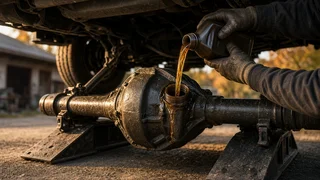
Understanding gear oil weights

Choosing the right gear oil often comes down to understanding the numbers on the bottle. For drivers and technicians, these viscosity ratings are not arbitrary labels; they describe how the fluid flows at different temperatures and how well it maintains a protective film between loaded teeth. Understanding gear oil weights helps you match a lubricant to the axle, manual transmission, or transfer case and avoid noisy operation or early wear from an incorrect fill.
Essential answer
Gear oil weight is a viscosity grade that indicates the oil’s resistance to flow. Heavier grades such as 90 or 140 are thicker and develop a stronger hydrodynamic cushion under high pressure, while lighter grades such as 70 or 75 flow more readily during cold starts. Because gearboxes and differentials operate with sliding and rolling contact under extreme load, the chosen weight must balance cold-temperature shift effort against high-temperature film strength.
A multi-grade fluid such as 75W-90 behaves like a winter-rated oil when cold and a 90-grade oil at operating temperature. This dual behavior matters because a differential that sits overnight in freezing weather still needs immediate lubrication, while the same unit may run hot after sustained highway driving. The fill quantity and level check also matter with gear oil selection, since an incorrect level can reduce heat rejection and make the proper viscosity less effective even when the lubricant itself matches the equipment specification.