U0146 and U0147: Understanding Gateway Communication Faults
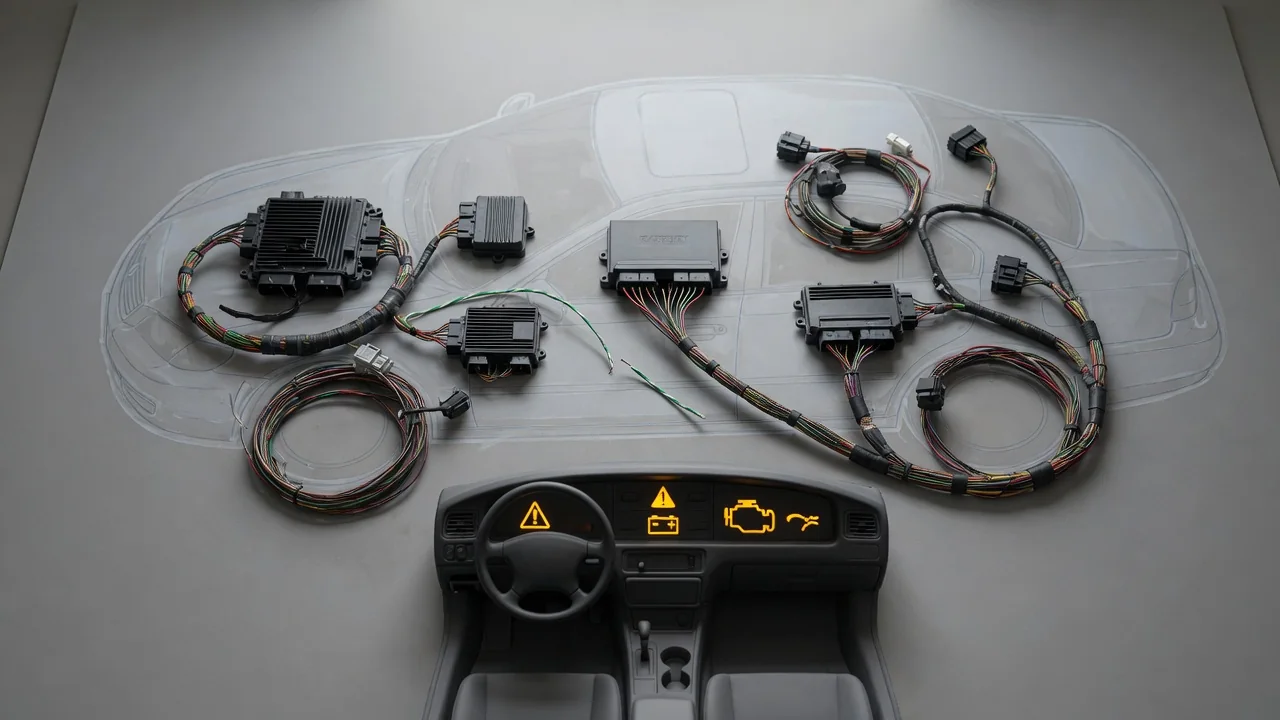
U0146 and U0147 are diagnostic trouble codes that typically point to lost communication involving a gateway on the vehicle communication network. A gateway module routes messages between networks such as CAN bus segments, so a single interruption can scatter warnings and additional codes. Interpreting either code requires vehicle-specific service information, because gateway names and identifiers vary by manufacturer. A lost-communication report is evidence to investigate, not proof that the gateway itself has failed.
Verify What U0146 and U0147 Mean for the Vehicle
Before treating U0146 or U0147 as a failed gateway, confirm the exact code description in the service information for that vehicle's year, make, model, and configuration. Manufacturers do not use one universal gateway designation for these identifiers, so the same code number can refer to different modules or network roles from one architecture to another. Reading the vehicle-specific definition first prevents chasing the wrong control unit or assuming a part name that does not apply to the car in front of you.
Record which module reported each diagnostic trouble code, whether the status is current or stored, and any available freeze-frame or fault context before clearing anything. A lost-communication report means a controller expected to hear from a gateway and did not receive the expected traffic; it does not by itself prove the gateway module has failed. Power, ground, wiring, another network node, or an intermittent communication fault can produce the same complaint. Preserve that reporting trail so later testing can follow the actual path of the failure.
How the Gateway Connects Vehicle Networks
A gateway module sits at the junction of vehicle communication networks and routes selected messages from one bus to another. On many vehicles that work includes translating traffic between CAN bus segments that operate at different speeds or serve different functions, though the exact responsibilities depend on the architecture. Body, powertrain, chassis, and infotainment controllers often do not share a single network; they rely on the gateway to pass the data each one needs. When that routing stops, modules continue to run locally but lose the information they expected from other domains.
An interruption at the gateway can therefore prevent several modules from receiving messages they use for displays, lighting, climate, stability, or powertrain coordination. Each controller that times out may set its own lost-communication code and illuminate a warning, creating a cascade that looks like a cluster of failed parts. Multiple diagnostic trouble codes and dashboard messages from one communication problem do not establish that every reporting module is faulty. The reporting modules are often working as designed by announcing that expected network traffic never arrived.
Symptoms and Warning Patterns to Record
Drivers may see several warning lamps at once, lose functions that depend on shared network data, notice intermittent electrical behavior, or have difficulty starting, but none of those patterns is inevitable with U0146 or U0147. Some vehicles show only stored codes and no obvious driving complaint. Record when symptoms appear, especially during starting, after recent battery or accessory work, or following water exposure around carpets, connectors, or the area of the gateway. Timing notes help a technician decide whether the issue tracks cranking voltage, a disturbed connector, or moisture on the vehicle communication network.
Symptoms alone cannot identify the failed component or confirm which communication path is interrupted. A dark cluster, a missing climate display, or a no-start condition can share the same lost-communication origin as a brief flicker that returns after a restart. If braking, steering assist, or another essential vehicle function appears impaired, stop in a safe location and arrange assistance rather than continuing to drive while networks are unstable. Treat the remaining observations as a timeline for diagnosis, not as a parts list.
Faults That Can Interrupt Gateway Communication
Low system voltage, an interrupted feed to the gateway, or a poor module power and ground path can drop the controller off the network even when the hardware is intact. Unstable supply during cranking or charging can also produce an intermittent communication fault that sets U0146 or U0147 and then recovers. Those electrical conditions require confirmation with vehicle-specific diagrams rather than assumption. Wiring damage, stretched or corroded connectors, and moisture intrusion on CAN bus lines or at the gateway connector can equally prevent messages from being sent or received.
Another module that is shorting a network, or aftermarket equipment tied into the vehicle communication network, can interfere with traffic without being the original design intent of the code. Neither possibility should be treated as the cause on a particular vehicle until testing shows it. Gateway hardware failure or a software fault remains possible, but those explanations belong after power, grounds, connectors, and network integrity have been checked. Replacing the gateway first simply because U0146 or U0147 appeared skips the conditions that most often silence a healthy module.
Safe Observations Before Professional Diagnosis
Save the complete scan report and photograph dashboard messages before anyone clears diagnostic trouble codes or resets module settings. Those records preserve which controllers reported U0146 or U0147, which other lost-communication codes accompanied them, and whether the faults were current. A basic code reader may not reach every relevant module on a modern vehicle communication network, so a blank screen on an inexpensive tool is not proof that a controller is offline. A network scan with equipment that can talk to the architecture in use is required before judging which nodes are silent.
Owner checks should stay limited to looking for obvious damage or moisture in readily accessible areas and noting recent battery replacement, accessory installation, or other electrical repair work. Do not probe connectors, disconnect modules, test energized circuits, or work near high-voltage components; those steps belong to a trained technician with the correct procedures. An intermittent communication fault can also disappear after a key cycle, which makes an early photograph of the warnings more useful than a later empty memory. Hand that timeline to the shop rather than attempting network repairs at the roadside.
What Testing Should Establish Before Module Replacement
Professional diagnosis should start with a vehicle-capable network scan that identifies which modules are reachable, which ones reported U0146 or U0147, and how wide the communication loss is. That map distinguishes a silent gateway from a local wiring break that only one controller notices. Using the correct wiring diagrams and diagnostic procedures, a technician then verifies gateway module power and ground and checks network integrity on the affected CAN bus or other vehicle communication network. Until those supplies and circuits are confirmed, a new module would inherit the same interruption.
Intermittent communication faults often require reproducing the recorded conditions, cranking, a wet road, a bump, or a particular accessory load, while monitoring whether traffic to and from the gateway drops. Replacement is justified only when testing supports a failed gateway and the surrounding electrical and network conditions have been ruled in or out. Confirm any vehicle-specific programming or configuration the replacement may need, then rescan and perform functional checks so remaining diagnostic trouble codes and restored features can be verified. Codes that return after a confirmed repair still need interpretation rather than another parts swap.