Types of Turbochargers: Single, Twin, Sequential and Hybrid Setups
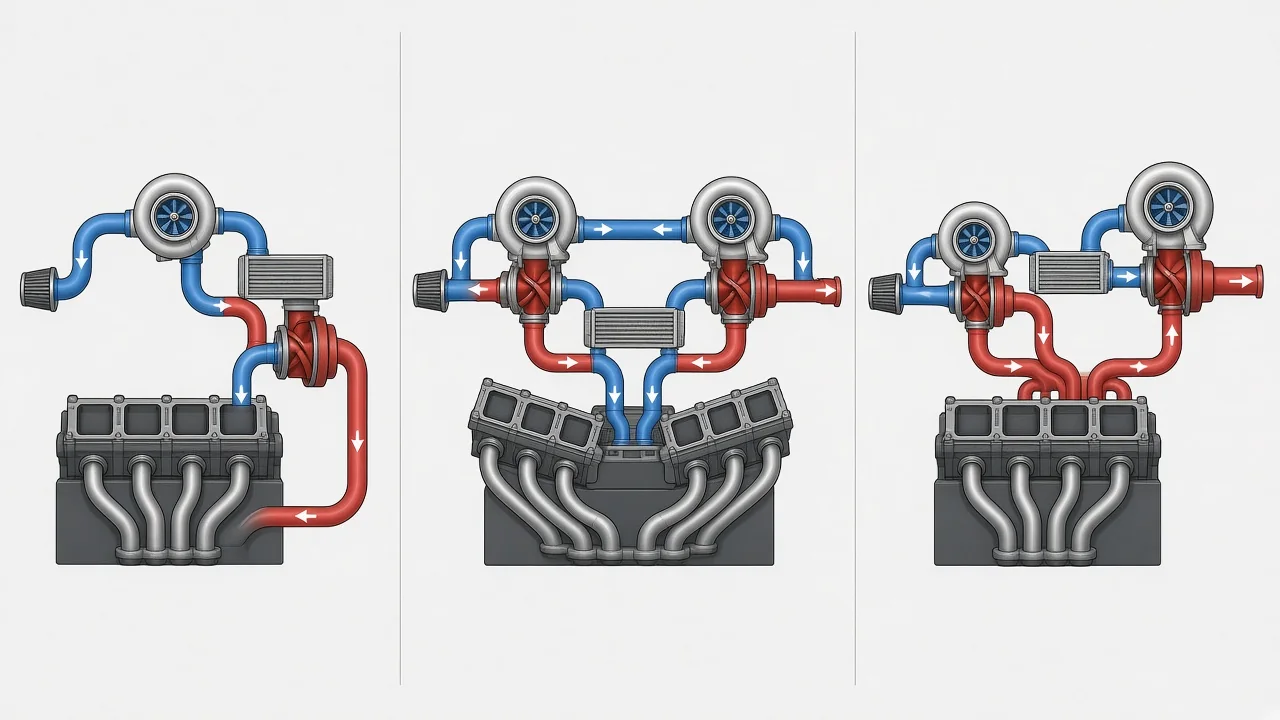
Production cars use several turbocharger types, from one exhaust-driven turbine and compressor wheel to twin-turbocharger layouts, sequential staging, and hybrid turbocharger assemblies. A type of turbocharger names hardware count, operating sequence, or mixed components rather than a guaranteed power or economy result. Comparing types of turbocharger, including a twin turbocharger, is useful when factory language, badges, and aftermarket catalogs use overlapping labels.
What Turbocharger Type Names Actually Describe
A turbocharger converts leftover exhaust energy into pressurized intake air. Exhaust gas spins an exhaust-driven turbine on a shared shaft with a compressor wheel. That compressor raises intake density, and the engine then meters more air and fuel for a given displacement. Boost pressure is the result of that compression, often followed by charge-air cooling before the intake manifold. The same energy path applies whether the engine uses one unit or several, so configuration names describe how that hardware is arranged rather than a different physical principle.
Turbocharger types are grouped by how many units are fitted, whether they operate together or in stages, housing design, and internal construction. Those labels can apply together: a single unit can use a twin-scroll housing, and a twin-turbocharger system can still include variable turbine geometry on one or both units. Twin-scroll and variable-geometry terms describe how exhaust pulses or turbine flow are managed; they do not establish turbo count. Names such as twin turbocharger or sequential also cannot, by themselves, establish power output, fuel economy, or throttle response, because sizing, calibration, and charge-air cooling still govern delivery.
Single-Turbo Setups and Their Production-Car Uses
A single-turbo setup uses one exhaust-driven turbocharger to supply compressed air to the engine. Production gasoline and diesel applications commonly rely on that arrangement to support torque and power from a given displacement without adding a second rotating assembly. Exhaust is collected into the turbine housing, the compressor wheel feeds the intake path, and engine calibration then commands the boost pressure the hardware can sustain. The same basic layout appears across many engine families, so the presence of one turbocharger is a hardware count, not a statement about intended vehicle class.
How quickly boost pressure arrives still depends on turbo sizing, exhaust routing, and calibration rather than on the word single. A physically large compressor wheel can move more air at high load, while a smaller turbine may spool earlier; neither outcome is promised by the configuration name. Where the application supports it, that one unit can incorporate twin-scroll passages that separate exhaust pulses, or variable turbine geometry that changes effective turbine flow with operating conditions. Those features remain housing and internal-construction choices on a single turbo, not a change to turbo count.
Twin-Turbo Systems With Parallel Operation
Twin turbocharger and twin-turbocharger both describe a system that contains two turbochargers; they do not, by themselves, explain how those units share work. Parallel turbocharging is the arrangement in which both turbochargers serve the engine during normal boosted operation, each contributing compressor flow rather than waiting for a later stage. Some layouts assign one turbocharger to each cylinder bank, which is common on V-configuration engines, while inline engines may still split exhaust into two turbines. Exhaust and intake routing then follow the engine design, so bank-to-bank plumbing is a packaging choice, not a separate type name.
Sharing engine airflow across two units can keep each compressor wheel in a useful operating range as total air demand rises, which is why parallel layouts appear when engines need substantial charge flow. That split supports intended torque and power delivery only after calibration, wastegate or bypass control, and charge-air cooling match the hardware. Two smaller assemblies do not automatically produce a particular throttle feel, nor do they guarantee higher output than a carefully sized single turbo. Confirming parallel operation still requires factory documentation of how both turbines are fed and how both compressors rejoin the intake.
Sequential Turbocharging Across the Engine's Operating Range
Sequential turbocharging brings turbochargers into operation in stages as engine conditions change, rather than keeping both units fully in the charge path from the first onset of boost. At lower engine speeds, routing may favor a smaller or primary turbocharger so the exhaust-driven turbine can accelerate with less mass flow. As load and speed rise, valves open additional exhaust and intake paths so a second turbocharger contributes airflow. Controlled valves and bypass routing manage that transition, because an abrupt change in turbine feed or compressor discharge can disturb boost pressure if the stages are not blended.
The purpose of staged operation is to support boost response when exhaust energy is limited, then meet airflow demand at higher loads without forcing one compressor wheel to cover the entire map. Sequential describes that operating strategy; it does not automatically establish the physical sizes of the two units, nor does it mean the compressors are stacked in a series compression path. Some sequential systems keep the units on separate exhaust branches and blend their compressor outlets, while other staged designs can feed one compressor into another. Factory diagrams are required to tell those arrangements apart.
What the Hybrid Turbocharger Label Can Mean
Hybrid turbocharger commonly refers to an assembly that combines selected housings, compressor wheels, turbines, or other components that did not originally ship as a matched factory pair. In aftermarket catalogs that mix is often sold as a hybrid turbocharger intended to change airflow capacity relative to a stock unit. The label is not a standardized configuration name like single, twin turbocharger, or sequential turbocharging, so the supplier technical description must be checked for which housing, wheel, and bearing parts are actually combined. Fitment, durability, and output cannot be assumed from the word hybrid alone.
An electrically assisted turbocharger is a different idea: an electric motor can assist the turbo shaft so the compressor wheel does not rely only on exhaust energy during transients. That equipment is not established by a hybrid vehicle powertrain, which mixes electric drive with an internal-combustion engine and may still use a conventional exhaust-driven turbocharger. In production-car discussion, keep those terms separate from aftermarket hybrid units, which are mixed mechanical assemblies rather than a universal factory setup. A catalog hybrid turbocharger should be treated as a parts description until manufacturer documentation confirms what is installed.
How to Confirm the Setup on a Particular Car
Confirming the installed configuration starts with the exact engine designation, model year, market, and factory technical documentation rather than with a badge or brochure phrase. Marketing names may mention boost, twin-scroll housing, or a twin turbocharger without stating turbo count, scroll design, and operating sequence together. Parallel turbocharging and sequential turbocharging can both be described loosely as twin systems, so the service information that shows turbine feed, compressor outlets, and control valves is the reliable record. Owner manuals and under-hood labels then identify approved fuel, oil, and maintenance requirements for that application without implying universal specifications or service intervals.
Unusual noise, smoke, or reduced power cannot identify which turbocharger types are fitted, and those symptoms also do not prove a turbocharger has failed. A fault code is evidence to interpret against vehicle-specific information; manufacturer-dependent codes still require confirmation on that engine before any part is condemned. Persistent symptoms belong with professional testing that can separate boost leaks, control-valve faults, and rotating-assembly damage. Avoid inspecting or disassembling hot exhaust-driven components. Configuration questions should return to factory diagrams, not to driving impressions or aftermarket hybrid turbocharger listings that may not match the car.