Types of EV Batteries: Chemistries and What a Traction Battery Is
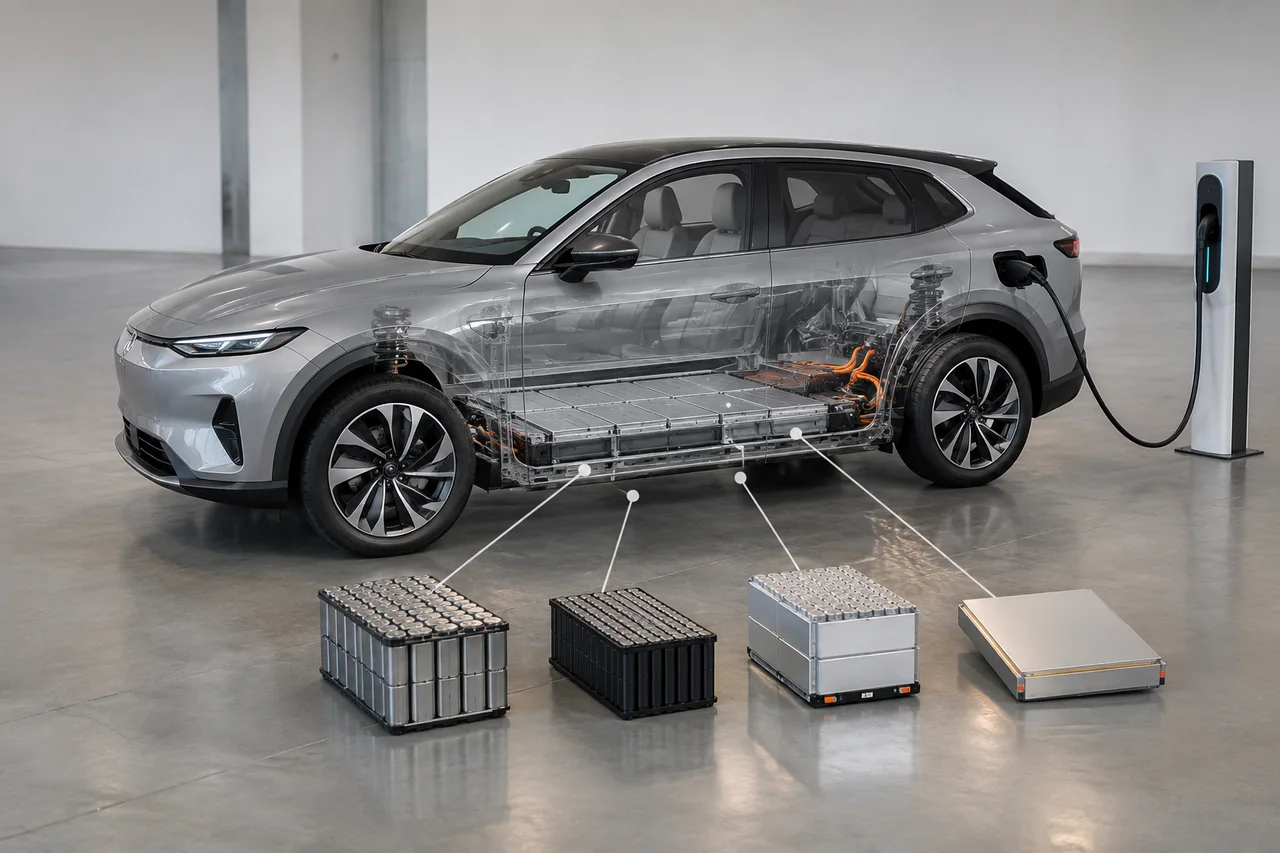
Every EV needs a high-voltage energy source for propulsion, but the term “ev battery type” covers a wide field of lithium-ion chemistries and pack designs. Understanding what a traction battery is and how cathode materials like NMC, NCA, and LFP differ helps owners interpret specifications, charging behavior, and service needs without relying on marketing labels or brand assumptions.
What an EV Traction Battery Does
A traction battery is the rechargeable energy storage system that supplies electricity specifically for vehicle propulsion. Unlike the auxiliary 12-volt battery that powers lights, infotainment, and control modules, this high-voltage pack drives the electric motor through an inverter. The ev traction battery is not a single part but an assembly of many individual cells, often grouped into modules and enclosed in a crash-resistant housing.
Within the pack, a battery management system monitors cell voltages, temperatures, and state of charge, while a thermal management system circulates coolant or refrigerant to keep cells within a safe operating window. Because these systems shape real-world performance, chemistry alone cannot establish a vehicle’s range, charging speed, or longevity. Two EVs with the same cathode chemistry can behave very differently due to pack design, software, and cooling strategy.
How EV Battery Type Names Work
Lithium-ion is the battery family used in nearly all production EV traction packs; within that family, cathode chemistry names such as NMC, LFP, and NCA describe the active materials that store and release lithium ions. Cylindrical, prismatic, and pouch are entirely separate cell formats that describe the physical shape and packaging, not the chemistry. A cylindrical cell can use NMC, NCA, or LFP cathodes depending on the manufacturer.
Among ev battery types, NMC and LFP are widely used in production vehicles, while NCA has production applications primarily from certain manufacturers. Solid-state refers to the electrolyte technology—a solid electrolyte instead of the liquid or gel used in conventional lithium-ion cells—and does not specify a cathode chemistry. A solid-state cell could use NMC, LFP, or other electrode materials, so the term alone reveals little about performance.
NMC and NCA: Understanding Nickel-Based Chemistry Names
NMC expands to nickel manganese cobalt, and NCA stands for nickel cobalt aluminum. These labels identify families of cathode materials, but actual formulations vary significantly between cell suppliers. One NMC cell might use a ratio of 8:1:1 nickel to manganese to cobalt, while another uses 5:3:2, affecting energy density, thermal stability, and cost. Therefore, seeing “NMC” on a spec sheet does not define exact pack characteristics.
Both NMC and NCA store substantial energy in a compact, relatively lightweight form, and both require careful temperature control and active battery management to operate safely and durably. However, neither chemistry label is sufficient to predict a particular pack’s capacity, charging speed, or service life. Those outcomes depend on electrode thickness, electrolyte additives, cell format, cooling design, and the software limits set by the vehicle manufacturer.
LFP: What Lithium Iron Phosphate Means for Owners
LFP, or lithium iron phosphate, is a lithium-ion cathode chemistry that does not use nickel or cobalt in the cathode active material. This distinction matters for supply chain and cost discussions, but it does not mean the battery pack is free of all nickel or cobalt—foils, connectors, and electronics may still contain trace amounts. Owners should not interpret LFP as inherently “safer” or “simpler” without considering the whole pack design.
In everyday operation, LFP packs tolerate a wider state-of-charge window without accelerated degradation, but temperature and vehicle controls still matter. Cold-weather charging can be slower, and the battery management system may limit power until the pack warms up. There is no universal rule to charge every LFP pack to 100%; some manufacturers recommend it for cell balancing, while others advise lower daily limits. Always follow vehicle-specific charging guidance, and remember that any EV traction battery stores hazardous energy requiring professional service.
Solid-State Batteries: Technology and Availability
A solid-state battery replaces the liquid or polymer electrolyte with a solid electrolyte that transports lithium ions between the anode and cathode. This change can enable higher energy density and improved thermal stability in laboratory settings, but solid-state designs can use different electrode materials—lithium metal, silicon, NMC, LFP, and others—so it is not one fixed chemistry. Manufacturing, durability, and vehicle integration still require demonstrated results at automotive scale.
Research targets, prototypes, and announced plans must be separated from confirmed production availability. A supplier may report a breakthrough in cycle life or fast charging, but that does not mean a pack is ready for mass production or that advertised range, charging, or safety goals translate into guaranteed owner benefits. Without a production vehicle and independent validation, solid-state remains an evolving technology rather than a current ev battery type option.
How to Identify the Battery Chemistry in a Volvo EV
For a Volvo EV, the brand name alone cannot establish battery chemistry. Different models, model years, markets, and battery versions may use NMC, LFP, or other chemistries depending on supply agreements and pack revisions. A listed capacity such as “69 kWh lithium-ion” does not identify the cathode material. To determine the battery type for a specific ev vehicle battery, begin with official Volvo specifications and the owner’s manual.
If documentation is unclear, seek VIN-specific confirmation from Volvo support or a qualified service provider. The VIN can identify the exact battery part number and software configuration. Do not open the pack or handle high-voltage components; identification should remain limited to paperwork and accessible vehicle information. A qualified technician can safely access service data to confirm the installed chemistry without unnecessary risk.