Turbocharger and Supercharger Bypass Valve: How to Identify the Component
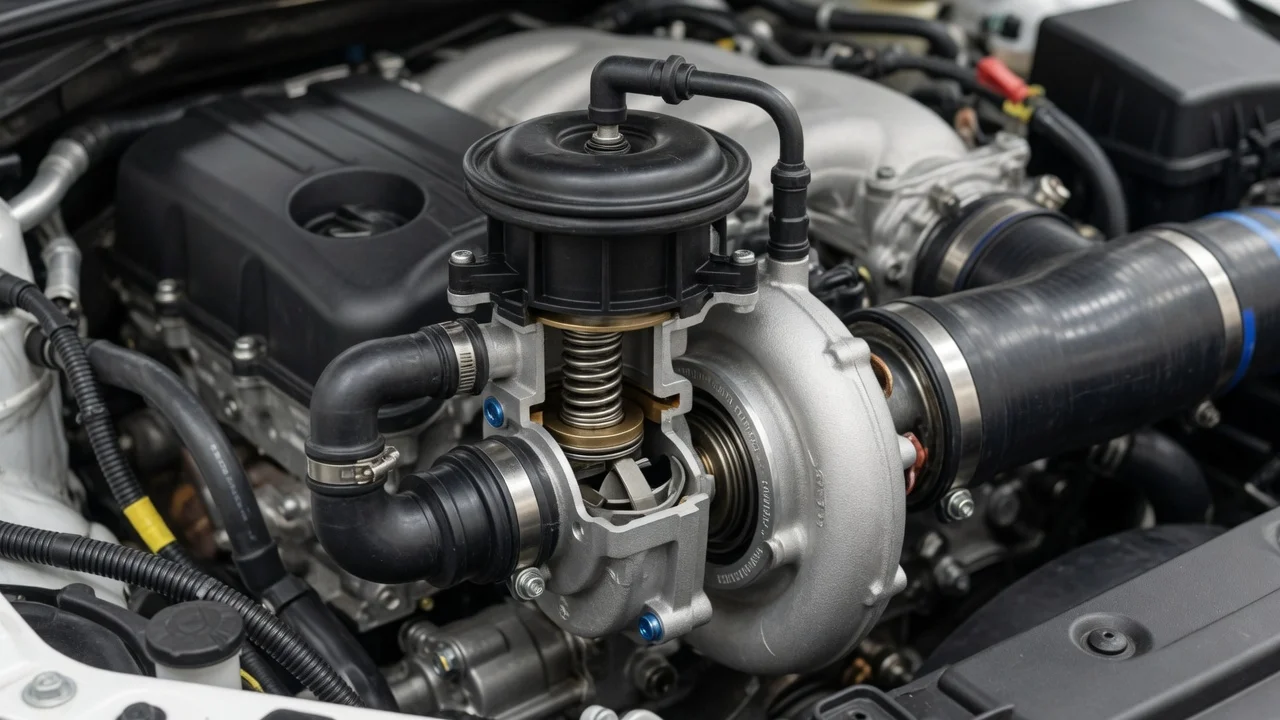
Engines with forced induction usually have a valve that releases or recirculates compressed air when the engine does not need it. Owners see it called a bypass valve, diverter valve, recirculation valve or blow-off valve, and the terms differ between turbocharged and supercharged engines. This guide explains what the component does, how to recognize it on your engine and what you can sensibly check before buying parts.
What the bypass valve is
A turbocharger or supercharger bypass valve sits on the intake side of the forced induction system, where air has already been compressed. It opens to relieve or redirect boost pressure when the throttle closes or when the engine is running at light load. On a turbocharged engine it is typically mounted on the piping between the compressor outlet and the throttle body, or built into the compressor housing, and it usually routes air back to the compressor inlet. On a supercharged engine it is commonly mounted on or near the blower and connects the outlet side back to the inlet side.
It is not the wastegate. A wastegate is on the exhaust side of a turbocharger and controls how much exhaust gas drives the turbine, which limits turbo speed. The bypass valve handles air after compression. Mixing up the two is a common reason owners order the wrong part. Whether your engine uses a bypass valve, what the parts catalog calls it and exactly where it sits all depend on the vehicle configuration, so the factory service information for your engine is the final reference.
How it works on turbo and supercharged engines
On a turbocharged engine, lifting off the throttle under boost closes the throttle plate while the turbo is still spinning and pushing air. That trapped pressure can push back against the compressor wheel and cause compressor surge, often heard as a fluttering sound and hard on the turbo over time. The bypass valve opens at that moment, triggered either by manifold vacuum acting on a diaphragm or piston, or by the engine computer energizing a solenoid. A recirculating design returns the air upstream of the compressor. A venting design, usually called a blow-off valve, releases it to the atmosphere. On engines that measure intake air with a mass airflow sensor, recirculation is the usual factory approach because that air has already been counted by the engine management system.
A belt-driven positive-displacement supercharger moves air whenever the engine turns. At idle and steady cruise, with the throttle mostly closed, forcing that air against the throttle would waste power and add heat. The bypass valve opens at light load so air can circulate around the rotors, reducing the drag the blower places on the engine, and it closes as you open the throttle so boost can build. Many designs use a vacuum actuator linked to a butterfly plate, while others are electronically controlled. Centrifugal superchargers behave more like a turbocharger in this respect and generally use a valve that relieves pressure when the throttle closes.
What changes the answer for your vehicle
The actuation method matters most for identification. A mechanical valve normally has a small vacuum or boost reference hose connected to it. An electronically controlled valve has an electrical connector and can set diagnostic trouble codes when its circuit or operation is out of range. Some engines combine both, with a solenoid controlling vacuum to a separate actuator.
Integration also varies. On some turbochargers the valve is built into the compressor housing, and on some superchargers it is part of the inlet or throttle body housing. Depending on the manufacturer, it may be sold as a separate part, as a repair kit for the diaphragm, or only as part of a larger assembly. Twin-turbo engines may have more than one valve. Modified vehicles add another variable: an aftermarket blow-off valve may have replaced the original part, which is where service history and records from previous owners become useful.
Naming in parts catalogs is inconsistent, so searching by the exact model, engine code and production date, or by VIN where a catalog supports it, is more reliable than searching by a generic name.
How to locate and check the valve
Start with documents rather than tools: the owner's manual, service history, a parts diagram for your exact vehicle and the factory service information. Then do a visual inspection with the engine off and cool. On a turbocharged engine, follow the intake path from the compressor outlet through the intercooler piping toward the throttle body. Look for a small round or cylindrical component with a hose that runs back to the intake ahead of the turbo, plus either a thin vacuum line or an electrical connector. On a supercharged engine, look around the blower housing and throttle body for an actuator with a rod or linkage and a vacuum hose.
Basic checks an owner can do include looking for cracked, collapsed or disconnected vacuum hoses, loose clamps, oil soaking around the valve and a damaged or corroded connector. Listening can help too: a steady hiss at idle may point to a leak, and loud fluttering when you lift off the throttle on a turbocharged engine can suggest the valve is not opening. An OBD-II scanner can show stored codes. A code related to boost pressure or the bypass valve circuit points toward the system but does not prove the valve itself failed, since wiring, hoses, sensors and other boost leaks can produce the same result. Avoid pressurizing the intake or removing components unless you have the correct procedure and tools.
Symptoms that can point toward the bypass valve
A valve that leaks or sticks open can behave like a boost leak, with reduced power under acceleration, slower boost build and possibly a rough or unstable idle if a torn diaphragm also creates a vacuum leak. A valve that sticks closed on a turbocharged engine can cause surge noise on throttle lift. On a supercharged engine, a valve that fails to open at light load can leave the blower working when it should not, which may show up as extra heat or reduced efficiency at cruise. None of these symptoms is unique to the bypass valve, so note the operating conditions when they appear, such as engine temperature, load, speed and whether they follow throttle lift-off. That detail makes diagnosis much faster.
Limitations and when to get help
This is a general explanation, not a procedure for a specific engine. Test methods, actuator specifications, torque values and replacement parts depend on the manufacturer specifications for your exact configuration. There is no universal replacement interval for a bypass valve. Replace it based on a confirmed diagnosis unless your maintenance schedule says otherwise.
Professional help is the sensible next step when codes return after basic checks, when the valve is integrated into the turbocharger or supercharger, when the vehicle has tuning or aftermarket induction parts, or when diagnosis requires smoke testing, boost leak testing or live scan data. Bring the technician your notes on symptoms, the conditions when they occur, any stored codes and the service history. That information helps separate a failed valve from a split hose, a sensor fault or a problem elsewhere in the boost system.