Turbo Oil and Coolant Lines: Cooling, Oil Changes, and Leak Symptoms
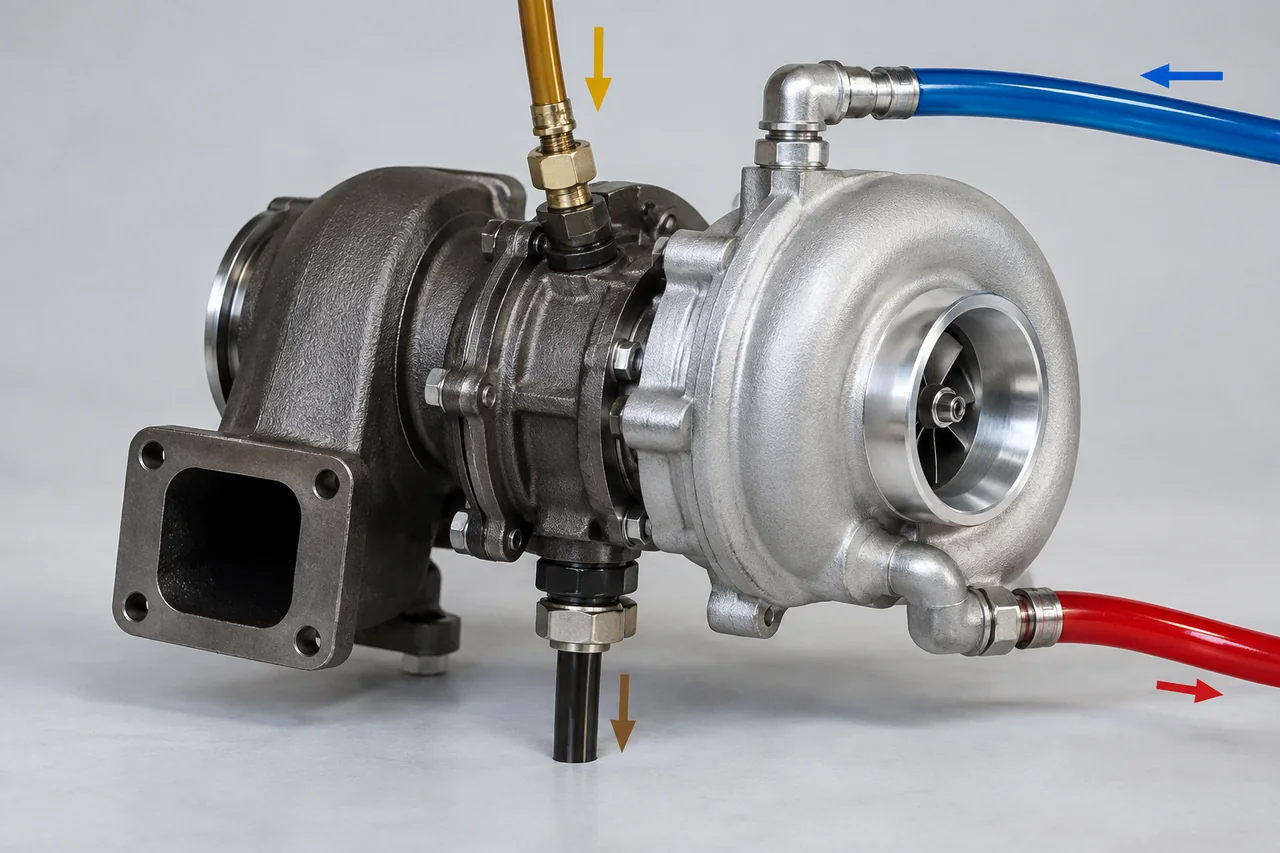
A water cooled turbocharger depends on engine oil and engine coolant to survive the heat of exhaust-driven spinning. Oil reaches the turbo bearings through an oil feed line and leaves through an oil return line, while a turbocharger coolant line may carry coolant through the turbo center housing. Understanding how lubrication, coolant circulation, and oil changes interact helps you interpret leak symptoms without assuming a part has already failed.
How Oil Lubricates and Carries Heat Away From Turbo Bearings
Pressurized engine oil typically leaves the lubrication circuit and travels through the oil feed line into the turbo center housing, where it supports the turbo bearings that allow the shaft to spin. After the oil has done that work, it drains through the oil return line back toward the engine. Oil is doing two jobs at once: it forms a film that reduces metal-to-metal contact, and it carries heat away from the bearing area. Not every turbocharger uses the same bearing arrangement, so service information for the specific vehicle still matters.
A restricted oil feed line can starve the bearings of both film strength and cooling flow, while contaminated oil can leave abrasive particles or oil deposits in housing passages. Impaired drainage through the oil return line is equally disruptive, because oil that cannot leave the center housing can build pressure, leak past seals, or overheat in place. Smoke, noise, or oil wetness around the turbo can appear with any of those problems, and with unrelated engine faults. Symptoms point to a need for diagnosis; they do not by themselves identify which line, bearing, or oil condition is at fault.
What Water Cooling Does Inside a Turbocharger
A water-cooled turbocharger routes engine coolant through passages in the turbo center housing so the housing does not retain all of the exhaust heat. The turbocharger coolant line typically connects those passages to the engine cooling circuit, allowing coolant circulation while the engine is running. Water cooling normally uses the vehicle's specified coolant mixture rather than plain water. Coolant flow does not replace lubricating oil; the turbo bearings still depend on the oil film even when the housing is water cooled.
Heat soak is the rise in turbo temperature after the engine stops, when exhaust heat remains stored in the turbine housing and is no longer carried away by moving exhaust gas and oil. On some vehicles, an electric pump or residual flow keeps coolant moving through the center housing after shutdown; on others, circulation ends when the engine stops. That difference is a design choice, not a universal rule. Water cooling reduces the thermal load on oil remaining in the housing, but it does not remove the need for intact coolant lines and a healthy cooling system.
What the Term Air-Cooled Turbocharger Means
The term air-cooled turbocharger can describe a turbo without engine-coolant connections on the center housing. An air cooled turbocharger of that type still needs confirmation in vehicle service information, because manufacturers do not all use the same wording. Lubricating oil remains the primary internal coolant for the bearings. Heat also leaves the housing by conduction into nearby metal and by transfer to surrounding underhood air, a slower path than dedicated coolant passages provide, and one that depends more heavily on oil condition after a hot shutdown.
An air-cooled intercooler is a different part of the intake path. It cools compressed intake air after the compressor, usually with airflow through a heat exchanger, and that job does not establish how the turbo's center housing is cooled. A vehicle can use an air-cooled intercooler with a water-cooled turbocharger, or with a turbo that has no coolant lines at all. Mixing those terms leads to the wrong inspection: looking for a missing turbocharger coolant line when the housing was never designed to carry coolant, or overlooking housing heat because the intercooler looks intact.
Coolant Line Leaks and Safe Checks
Possible signs of a turbocharger coolant line problem include dried residue, drips, a sweet odor, or a falling reservoir level, but none of those signs by itself proves the turbo housing or a particular hose has failed. Coolant leaks can originate at hoses, rigid pipes, connections, or seals, and leaked fluid often travels along a pipe or heat shield before it drips, so the wet spot is not always the source. Finding the leak requires inspection of those parts rather than replacing the nearest stained component.
Owner checks should stay limited to accessible observations with the engine fully cool: looking for residue, checking the reservoir against the cold marks, and noting odor or dampness around visible lines. Never open a hot cooling system; pressure and steam can cause serious burns, and a cap or hose that looks intact can still release scalding coolant. Persistent coolant loss, an unexplained drop that returns after topping up, or an overheating warning is a reason to stop safely, shut the engine off, and arrange professional diagnosis rather than keep driving to wait it out.
Why Prescribed Oil Changes Matter for Turbo Life
Degraded or contaminated oil loses film strength and can form oil deposits in the narrow passages that feed the turbo bearings. Those deposits restrict flow even when the oil pump itself is healthy, and varnish or sludge in the oil feed line has the same effect as a partial blockage. Follow the vehicle's required oil specification, filter requirements, and maintenance schedule, including any severe-use guidance for short trips, towing, or high heat. A turbocharger oil change is not usually a separate service; the turbo generally receives fresh oil when the engine oil and filter are changed on schedule.
Fresh oil cannot repair bearing damage that has already occurred, and it will not clear every restriction in a collapsed, kinked, or internally coked line. Additives marketed for turbo cleaning, and improvised flushing of the center housing, are not substitutes for finding why flow was poor or why the oil was contaminated. If oil analysis, metal in the filter, or shaft play already points to distress, the turbo needs professional inspection rather than another oil change as a cure. Timely changes reduce the chance of those deposits forming; they are maintenance, not a repair method.
Oil Line Symptoms That Need Professional Testing
Visible oil wetness around the turbo, a burning-oil smell, smoke from the exhaust or underhood, or repeated oil loss are reasons for inspection, yet each of those symptoms can originate at valve-cover gaskets, the PCV path, or other engine leaks. Feed-line restrictions, oil return line problems, and crankcase ventilation faults require different checks and cannot be distinguished reliably from smoke alone. Blue or gray exhaust smoke can appear when oil reaches the turbine or compressor, but that still does not tell you whether supply, drainage, or ventilation is the reason oil is in the wrong place.
A technician can evaluate oil supply at the feed, drainage through the return, crankcase ventilation, and the mechanical condition of the turbo without treating smoke as a parts list. Those tests belong in a shop; they are not do-it-yourself jobs on a hot engine or on pressurized oil lines. An oil-pressure warning, heavy smoke, or an active leak onto exhaust or other hot components is a reason to stop safely and shut the engine off. Continuing to drive in that condition can turn a line leak into a fire risk or allow a starved bearing to fail completely.