Turbo Boost Control: How the System Regulates Boost
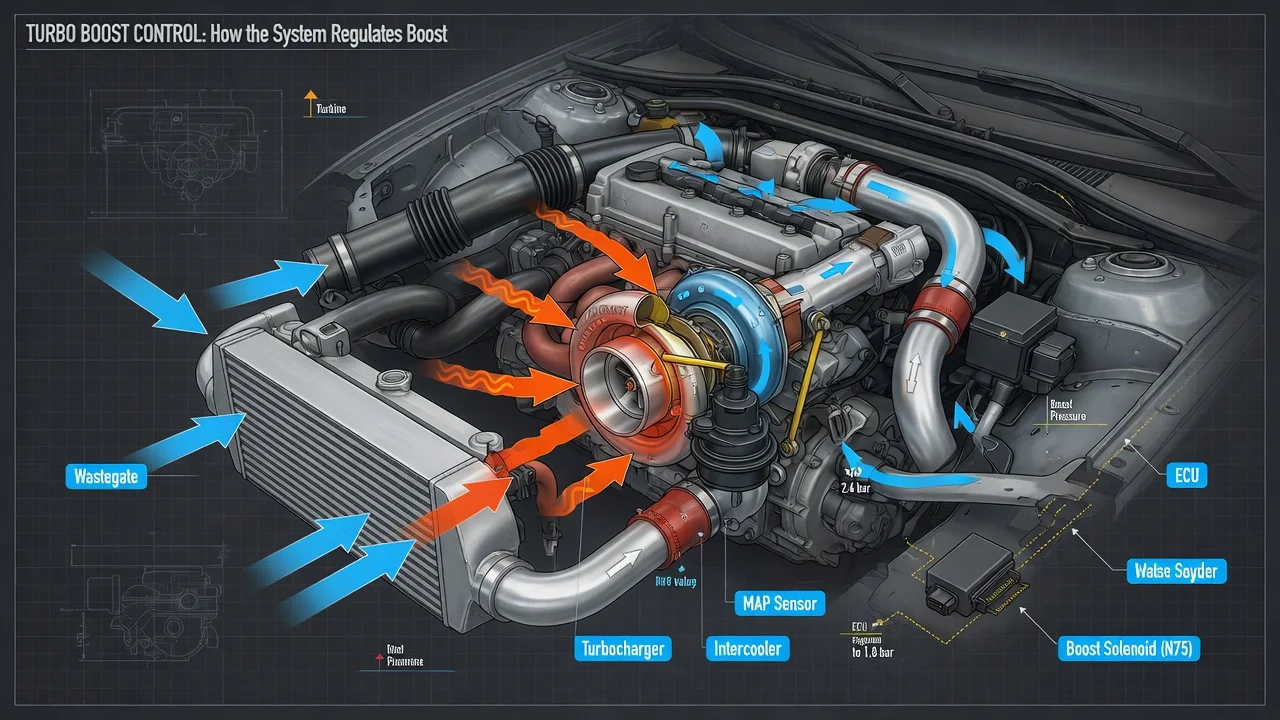
A turbocharger can produce far more pressure than an engine safely needs, so every turbocharged engine relies on a control system that decides how much boost to allow at any moment. Knowing how turbo boost control works helps owners make sense of symptoms such as sluggish acceleration, sudden power cuts or warning lights. It also makes conversations with a technician more productive. This guide explains how the system regulates boost and what an owner can reasonably check.
The short answer
Boost is regulated by controlling how much exhaust energy reaches the turbine wheel. On most gasoline engines a wastegate does this job. It is a valve that lets some exhaust bypass the turbine once the desired pressure is reached. Many diesels, and some gasoline engines, use variable turbine geometry instead. These turbos change the angle of vanes around the turbine to speed it up or slow it down. In modern vehicles the engine control module sets a target boost level. It then adjusts the wastegate or vanes continuously, using pressure sensor feedback to hold that target. The hardware, target values and limits depend on the specific engine. The manufacturer specifications for your vehicle configuration are the only reliable reference for numbers.
How the boost control loop works
Exhaust gas drives the turbine, and the turbine spins the compressor that pushes air into the intake. Without control, turbine speed and boost would keep climbing with engine load. A wastegate prevents this by opening a bypass path around the turbine. Older and simpler designs use a spring-loaded pneumatic actuator connected to intake pressure. When boost overcomes the spring, the actuator opens the wastegate. Electronically managed systems add a boost control solenoid that bleeds or redirects the pressure signal going to the actuator. This lets the engine computer hold the wastegate closed longer or open it sooner. Some newer engines use an electric wastegate actuator driven directly by the control module, which can position the valve precisely regardless of pressure. An internal wastegate is built into the turbo housing, while an external one is mounted separately on the exhaust side.
Variable geometry turbochargers work differently. A ring of movable vanes sits around the turbine wheel. Closing the vanes narrows the passage, which speeds up exhaust flow and builds boost quickly at low engine speeds. Opening them reduces turbine drive when exhaust flow is high. A vacuum or electric actuator moves the vanes under computer control. Because the mechanism sits in the hot exhaust stream, soot and carbon buildup can make the vanes stick. Sticking vanes are a common source of boost faults on diesel engines.
In both designs the control module works in a closed loop. It calculates a boost target from inputs such as accelerator position, engine speed, load and intake air temperature. It then compares that target with the reading from a manifold or boost pressure sensor. If actual boost runs low, it commands the wastegate closed or the vanes tighter. If boost overshoots, it does the opposite. When the difference persists beyond the limits programmed for that engine, the module typically stores a diagnostic trouble code. It may also reduce power to protect the engine. A bypass or diverter valve is often confused with boost control, but it serves a separate purpose. It vents pressure when the throttle closes so the compressor is not pushing against a shut throttle.
What changes how boost is regulated
Engine design is the biggest variable. Several common layouts regulate boost through different hardware and strategies: a small gasoline engine with an internal wastegate, a twin-turbo V6, a sequential setup and a diesel with variable vanes. Even two versions of the same engine can be calibrated differently for different models, transmissions or markets, so information from another vehicle may not apply. Factory boost targets are not a single fixed figure. They vary with conditions and are set by the manufacturer's calibration.
Operating conditions change the target from moment to moment. The control module may reduce boost or ignition timing in response to hot intake air, high engine temperature, detected knock or lower-octane fuel. At high altitude the air is thinner, so the turbo has to work harder to reach the same absolute pressure. Some systems compensate for this, while others limit boost to protect the turbocharger. Some vehicles also limit torque in certain gears or when traction is poor. Aftermarket tuning, boost controllers or modified intake and exhaust parts change the calibration or the hardware's behavior. These modifications can also make factory diagnostic expectations unreliable.
What the owner can do
Start by noting what the vehicle is doing and when. Useful observations include: • weak acceleration that appears only under load; • a sudden loss of power followed by a warning light; • surging or pulsing under steady throttle; • new whistling or hissing sounds; • any change that followed recent work; Also write down the conditions when the problem occurs: outside temperature, engine temperature, altitude, speed and whether it repeats. These details often narrow the cause faster than a description of the symptom alone.
A basic code reader can show whether stored codes point to underboost, overboost, a pressure sensor, or a wastegate or vane actuator circuit. Treat a code as a starting point for inspection, not a verdict. With the engine off and cool, a visual inspection can reveal cracked or disconnected vacuum lines, loose intercooler hoses and clamps, oil-soaked charge pipes, or damaged electrical connectors at the solenoid or actuator. Leaks in the pressurized intake path are a frequent cause of low boost and are often easier to find than a turbo failure. A scan tool that displays live data lets a technician compare desired and actual boost. That comparison is the most direct way to see whether the control system is keeping up.
Routine care also matters. The turbocharger depends on clean oil, so follow the maintenance schedule for oil and filter changes. Keep the air filter in good condition. On diesels, frequent short trips can contribute to the carbon buildup that affects variable vanes. Keep records of repairs and replaced parts, because a clear service history helps a technician spot patterns and avoid repeating work.
Limitations and when to get professional help
This explanation covers how boost control systems generally work. It does not give the exact strategy, target pressures or fault thresholds for any particular engine. Those values come from the manufacturer specifications and service information for your exact vehicle configuration. They cannot be reliably inferred from a general guide or from another model. Some systems also require a scan tool to command actuators, run calibration routines or relearn wastegate positions after a repair.
Seek professional diagnosis if any of these occur: • the vehicle enters reduced-power mode; • the check engine light flashes; • you hear metallic noises from the turbo; • you notice blue or heavy smoke; • you find oil leaking from turbo connections; Overboost in particular can damage an engine, so repeated power cuts should not be ignored. Bring your notes on symptoms and conditions, any stored codes and recent service records. That way the inspection can start from facts rather than guesswork.