Turbo Boost Control Module: Identification and Function
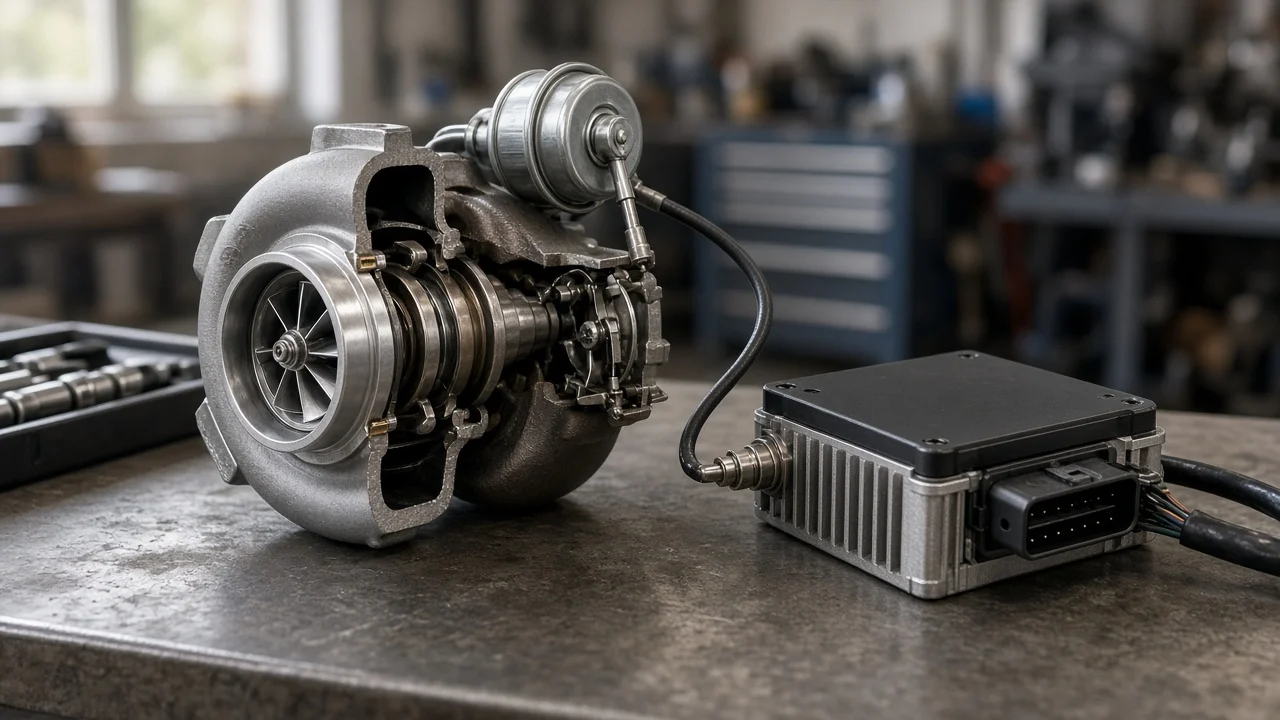
A turbo boost control module is the part of a turbocharged engine's control system that decides how much boost pressure the turbocharger may produce, or carries out that decision. Depending on the vehicle, this job may sit inside the main engine computer, in a separate solenoid, or in an electronic actuator bolted to the turbo. This guide explains which arrangement your vehicle may use, what the component does, and what an owner can sensibly check.
The short answer
Most modern turbocharged cars and trucks have no single box labeled boost control module. The engine control module, often called the ECM or PCM, calculates a target boost pressure and commands an output device to reach it. That device is usually a boost control solenoid that regulates vacuum or pressure to a wastegate actuator, or an electronic actuator that moves the wastegate or variable vanes directly. Some electronic actuators contain their own circuit board and position sensor, so parts catalogs and technicians may call that assembly a turbo control module or turbo actuator module. Aftermarket boost controllers are a separate category: add-on devices that override or adjust factory boost and are not part of the original design.
Which part counts as the module therefore depends on the exact vehicle configuration. The function is the same everywhere: keep boost close to the target the engine needs, prevent overboost that could damage the engine or turbocharger, and report faults so the engine computer can reduce power if control is lost.
How boost control works
A turbocharger is driven by exhaust gas. Left uncontrolled, it would keep building pressure as engine speed and load rise. Boost is limited by sending some exhaust around the turbine through a wastegate or, on variable geometry turbochargers common on diesels, by changing the angle of vanes around the turbine to alter how exhaust strikes it. The engine computer reads inputs such as engine speed, accelerator position, intake air temperature, barometric pressure and the boost or manifold pressure sensor. From these it sets a target and continuously compares it with measured pressure.
If actual boost is low, the computer commands the solenoid or actuator to close the wastegate or vanes further; if boost is high, it opens them. On pneumatic systems the solenoid is pulsed rapidly, and the ratio of on time to off time sets how much vacuum or pressure reaches the actuator diaphragm. On electronic actuators a small motor moves the linkage while a built-in position sensor reports where it actually is. When the result drifts too far from the command, the computer stores a diagnostic trouble code and may switch to a reduced power mode, commonly called limp mode.
What changes the answer
Several details decide which component you are dealing with and how it behaves. Gasoline engines with a conventional turbo usually use a wastegate, controlled either by a solenoid and pressure actuator or by an electric wastegate actuator. Many diesel engines use variable geometry turbochargers, and the actuator may be vacuum operated, using vacuum from an engine-driven pump, or electronic with integrated control electronics. Twin turbo and sequential setups can have more than one actuator plus additional valves.
Model year, engine code and market can change the part fitted to otherwise similar vehicles, and parts that look identical may carry different software or calibration. Operating conditions matter too: high altitude, very hot intake air, a clogged air filter or a restricted exhaust can lower boost without any fault in the control hardware. Earlier modifications, such as an engine tune or an aftermarket boost controller, also change what normal looks like and should be recorded in the service history before anyone diagnoses the system.
Identifying the component on your vehicle
Start with service information for your exact vehicle, matched by VIN where possible, rather than generic diagrams. Under the hood, a boost control solenoid is typically a small valve with an electrical connector and two or three small hoses, mounted near the turbo, on the intake or on an inner fender. An electronic actuator is a larger housing bolted to or near the turbocharger, with a connector and a rod or lever linked to the wastegate or vane mechanism. A purely pneumatic actuator is a round canister with a hose and a rod but no electrical connector of its own.
Part numbers printed or stamped on the housing are the most reliable way to confirm what is installed. Be cautious with names: catalogs and forums use terms such as boost solenoid, wastegate solenoid, turbo actuator and boost control module loosely, and two listings with the same name can describe different parts.
What the owner can do
Typical signs of a boost control problem include reduced power, a warning light, sudden limp mode under acceleration, or surging. Reading stored codes with an OBD-II scan tool is a reasonable first step. Generic codes that point toward this system include P0299 for underboost, P0234 for overboost, P0045 for a boost control circuit fault and P2563 for a boost control position sensor range or performance problem, although manufacturers also use their own codes and descriptions.
With the engine off and cool, a visual inspection can reveal cracked or disconnected vacuum hoses, a loose or corroded connector, oil contamination or a damaged actuator linkage. A split intake hose or loose intercooler clamp can trigger underboost codes that resemble a control fault, so check the pressure side of the intake as well. Write down codes before clearing them, and note when the symptom appears, such as after a cold start, when hot, or at full throttle, because that context helps a technician.
Avoid replacing parts based only on a code name. Many electronic actuators require a calibration or learning procedure with a capable scan tool after installation, and some need their end positions set. Follow the manufacturer specifications and maintenance schedule for your vehicle; there is no universal replacement interval for these components.
Limitations and next step
A code shows which reading was out of range, not necessarily which part failed. Underboost can come from leaks, a sticking wastegate, carbon-fouled variable vanes, a failing sensor, wiring damage or a worn turbocharger. Confirming the cause usually takes live data comparing commanded and actual boost, actuator position and sensor values, plus pressure or vacuum testing. That level of diagnosis needs vehicle-specific procedures and equipment most owners do not have.
If the vehicle repeatedly enters limp mode, sets an overboost code, develops new turbo noises or smokes, limit driving and arrange a professional inspection promptly, since uncontrolled boost can damage the engine and turbocharger. Bring the codes, your notes and the service history to a qualified technician or dealer, and check whether warranty or emissions coverage applies before modifying or replacing parts.