Truck Tire Tread Depth: Measurement and Replacement Requirements
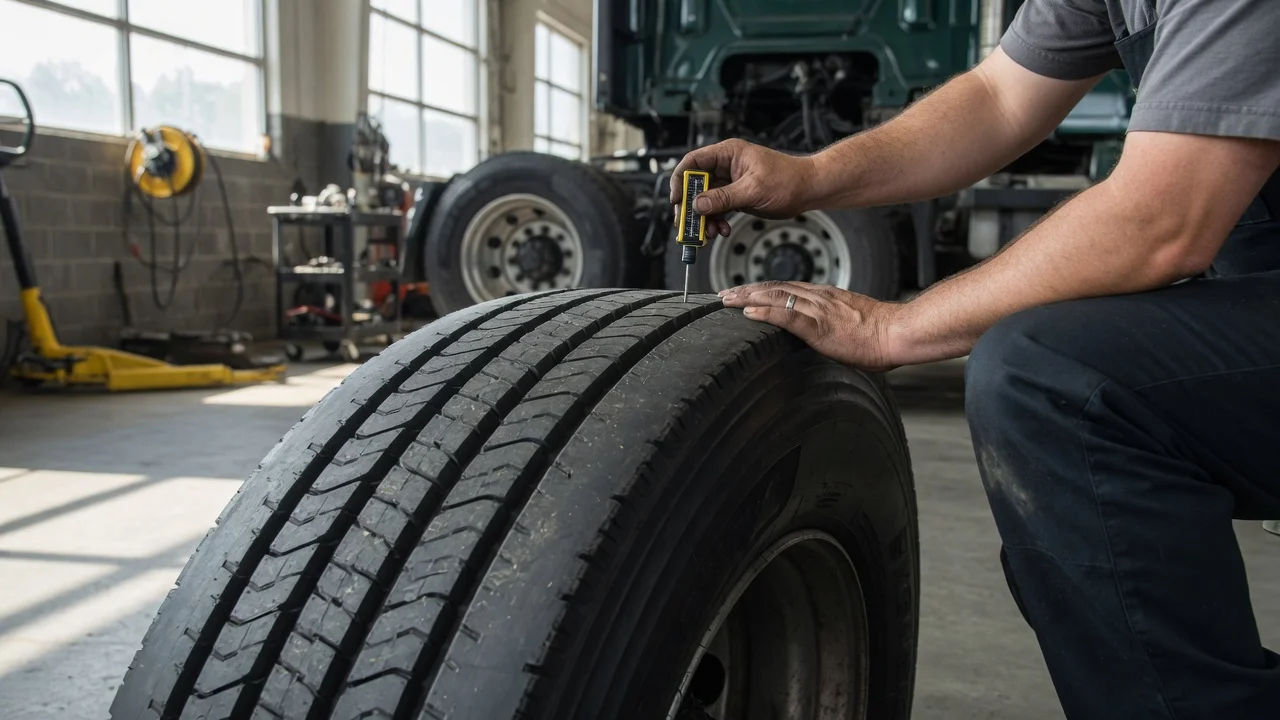
Check the measurement
Tread depth should be checked in the major tread grooves, not on the raised ribs or tread blocks. A tread depth gauge gives the most consistent result. Press the gauge base flat against the tread surface, extend the probe into the groove until it contacts the bottom, and record the reading. Repeat the check at several points across the tire and around its circumference, including the inner, center, and outer grooves on each tire.
Taking several measurements matters because tire wear is rarely perfectly even. Differences between the sides or between adjacent ribs can point to a tire condition issue that is separate from simple mileage wear. If the readings vary noticeably, use the lowest reliable measurement as the basis for replacement planning and record the uneven wear pattern before rotating or servicing the tires.
Explain the units
Passenger and light truck tire tread depth is commonly stated in 32nds of an inch in the United States. A new highway tire may start well above 10/32 inch, while many wear indicators are reached around 2/32 inch. Readings such as 6/32, 4/32, or 3/32 inch refer to the remaining depth in the main grooves.
Millimeters are equally valid and are often used on tire labels or in service information from manufacturers. Useful conversions include 2/32 inch being equal to about 1.6 mm, 4/32 inch to about 3.2 mm, and 6/32 inch to about 4.8 mm. Keeping both units clear helps avoid confusion when comparing a gauge reading with a vehicle placard, repair manual, or tire manufacturer recommendation.
Compare readings with actual requirements
Wear bars are molded across the bottom of the main tread grooves. When the surrounding tread surface becomes level with these raised bars, the tire has reached the wear indicator depth designated by the tire maker. The bars are a useful visual cue, but they do not by themselves prove that the tire will perform acceptably in every condition.
A legal minimum tread depth is a compliance threshold, not a promise of full wet grip or safe traction. Current local requirements can differ, and vehicle or tire manufacturer recommendations may call for replacement before the legal minimum. For passenger cars and many light trucks, a common minimum is 2/32 inch, but some manufacturers and tire industry organizations suggest replacing tires earlier when regular wet or winter driving is expected.
Account for driving conditions
Remaining tread depth affects how well a tire can move water away from the contact patch. As the tread grooves become shallow, wet grip can decline even when the tire is still above the legal minimum. Drivers who operate frequently in heavy rain, standing water, snow, or ice should place more importance on deeper remaining grooves and may need to replace tires earlier than drivers who use the vehicle mainly in dry conditions.
Winter performance is also not controlled by tread depth alone. Rubber compound, tire design, temperature, road surface, and load all affect traction. This article does not provide universal safe-depth thresholds or stopping-distance figures because actual stopping performance depends on vehicle condition, tire model, load, speed, and road surface. When in doubt, consult the tire manufacturer's application information for the specific tire and use condition.
Make a replacement decision
Base a replacement decision on the lowest tread depth found, not on an average or on the best-looking groove. If one area is at the threshold, the tire is at the threshold for that position. Damage such as cuts, cracks, bulges, exposed cords, or sidewall deformation can require replacement even when plenty of tread remains. Age-related deterioration can have the same effect, which is why tire condition cannot be established by depth alone.
Uneven wear should be investigated rather than ignored. A tire worn heavily on one shoulder, in the center, or in patchy spots may indicate alignment, inflation, suspension, or balance problems. Replacing only the worn tire may not solve the underlying issue, and the same wear pattern can return. Review the service history and have the relevant chassis or tire condition inspected when the wear pattern is not consistent with normal use.
The final decision depends on the specific vehicle application, the tire manufacturer's guidance, local rules for road use, and the conditions the driver expects to face. A tire at the legal minimum may still need earlier replacement for wet or winter use, while a tire with strong tread may be unserviceable because of damage or age. Regular measurement by a consistent method provides the facts needed to make that judgment.