Truck Tire Tread Depth: How to Assess Measurements for Different Axle Positions
The essential answer
Truck tire tread depth is the remaining depth of a tire’s major grooves. You measure it with a tread depth gauge, then judge each tire against the limit that belongs to its axle. On U.S. commercial motor vehicles in interstate commerce, federal equipment rules require at least 4/32 inch (about 3.2 mm) of tread in a major groove on the front tires of a truck or truck tractor, and at least 2/32 inch (about 1.6 mm) on every other tire, including drive, trailer, tag, pusher and lift-axle positions. Measure at any point on a major tread groove; the shallowest valid reading is the one that counts. Those figures are legal minima for that jurisdiction and vehicle class. A carrier pull point, a tire manufacturer’s remaining-depth instruction, a state or provincial rule, or a non-U.S. standard can require more depth. This guide does not include a specific truck model, tire brand or operating region, so confirm the documented limit for the vehicle in front of you before you treat a reading as a pass.
Why axle position changes the limit
Steer tires on the front of the power unit point the truck and carry a large share of braking. Remaining groove depth at those contact patches is the main path for water evacuation, which is why the U.S. federal floor is higher there. Drive tires transmit torque and often run as duals; traction still depends on groove volume, and the U.S. federal floor for those positions is 2/32 inch. Trailer, tag, pusher and lift-axle tires are primarily load-carrying. When a lift axle is on the ground in service, assess it as an on-ground axle. A dual pair is only as serviceable as its shallowest tire: measure the inner and outer tire separately.
The 4/32 inch federal figure is written for the front wheels of a bus, truck or truck tractor. A steerable trailer or converter-dolly axle may fall under the 2/32 inch “other tires” federal floor. Inspection programs and carrier policies often still treat any steering tire more conservatively. Confirm the rule that applies to that axle in the jurisdiction where the vehicle is operated and inspected.
What you need before you start
A firm, level, off-traffic place to park, with the parking brake applied and wheel chocks in place. Personal protective equipment suited to a wheel-end inspection, including eye protection and gloves. A calibrated tread depth gauge graduated in 32nds of an inch or in millimetres. A calibrated inflation gauge, and the inflation specification from the vehicle placard, owner information or fleet spec for that axle. A way to identify and record wheel position (steer, drive axle number, trailer axle number, inner or outer dual, lift/tag/pusher). A flashlight for inner duals. The legal, manufacturer and carrier depth limits that apply to this truck. If those documents are not available, record the readings and hold the vehicle until a qualified person supplies the limit.
Steps to assess tread depth
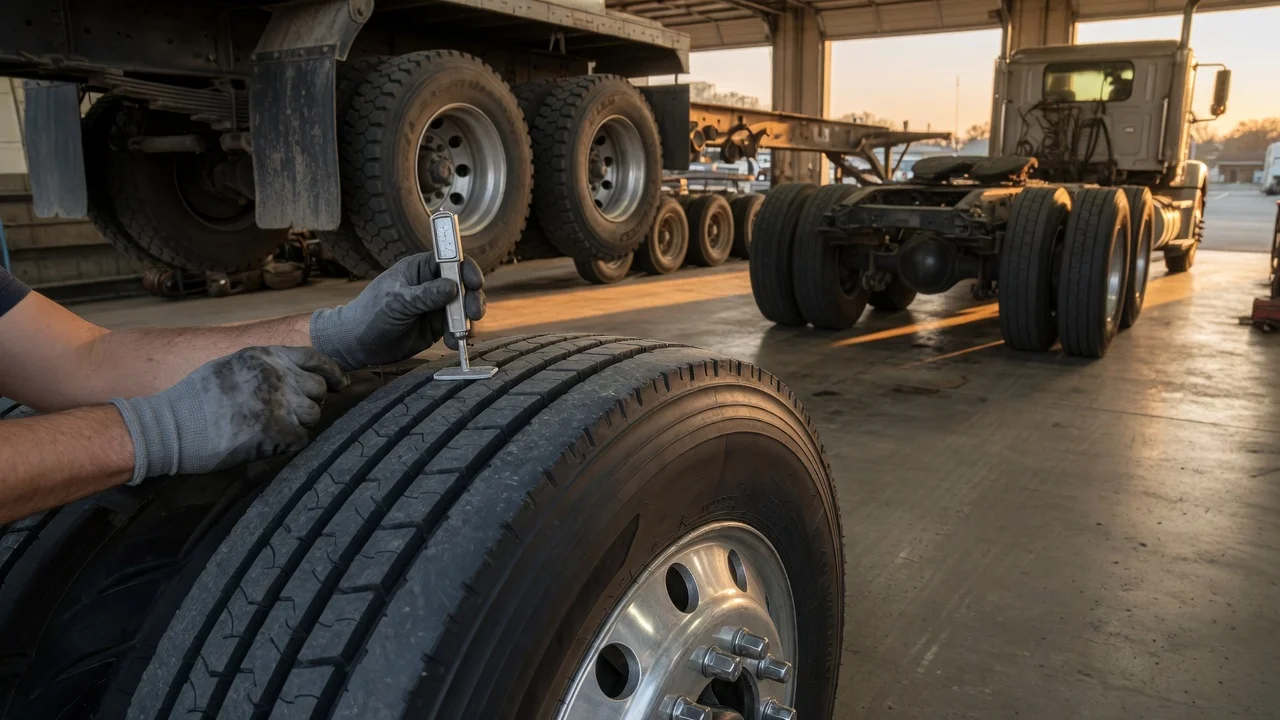
Secure the vehicle. Park on firm, level ground, apply the parking brake, chock a wheel you are not about to roll, shut the engine off and keep bystanders clear. If the truck is on a live lane, a slope or soft ground, stop and move it to a safe inspection site before you put any part of your body near the wheels. Allow hot brakes, drums and wheel ends to cool enough to work beside them. Dual wheels can pinch; keep hands out of the gap between duals except for the gauge probe. Map every on-ground wheel: steer left and right, each drive axle and side, inner or outer dual, each trailer axle, and any tag, pusher or lift axle that is down. Do a visual pass first. Exposed body ply or belt, a bulge, a cut that reaches the cord, a tire that is flat or off the rim, or an audible leak are stop conditions. Take that wheel out of service and have a qualified tire technician handle demounting. Continue depth checks only on tires that are still structurally intact. Check inflation against the documented spec for that axle with a calibrated gauge. A depth number on an underinflated tire is still a valid depth number; the inflation fault still needs correction before the truck returns to service. Measure each tire with the tread depth gauge in the major circumferential grooves: outer ribs, center grooves and inner ribs, at two or more locations around the circumference. Seat the shoulders of the gauge on the tread ribs and drop the probe to the groove bottom. Skip sipes, tie bars, humps, fillets, stone ejectors and the molded wear-indicator bars themselves. On an inner dual, work from a standing or kneeling position beside the wheel. Do not place any part of your body under an unsupported chassis, and do not loosen lugs or jack the axle unless you are qualified and the axle is on proper stands. Record the shallowest valid major-groove reading, the wheel position and whether the tire is inner or outer. Keep units consistent. One thirty-second of an inch is about 0.8 mm; convert only so that the reading and the limit use the same unit. Compare each recorded depth with the limit for that axle position. For a U.S. interstate commercial truck or truck tractor, when no stricter document applies, a front tire fails under 4/32 inch and any other tire fails under 2/32 inch. A dual set fails if either tire is under the limit for that axle. Completion check: every on-ground tire has a position identity, a shallowest major-groove depth, a unit (32nds or mm) and a pass/fail against the documented limit for that axle. Any failed tire, any exposed cord and any unexplained irregular wear is flagged for removal or shop diagnosis before the truck returns to service.
Wear-indicator bars on many truck tires become flush with the rib at about 2/32 inch. A steer tire can already be below the 4/32 inch federal floor while those bars are still recessed. A gauge reading in a major groove is required on every steer position, and it is the reliable method on every other position as well.
U.S. federal minima by axle position
Axle position Role U.S. federal CMV minimum in a major groove; Front tires of a truck or truck tractor (steer) Steering and a large share of braking 4/32 in (about 3.2 mm); Drive Torque and traction; often duals 2/32 in (about 1.6 mm); Trailer Load carrying, free rolling 2/32 in (about 1.6 mm); Tag, pusher or lift axle when on the ground Extra load or axle-weight control 2/32 in (about 1.6 mm)
These are out-of-service legal floors for U.S. interstate commercial vehicles, drawn from federal equipment rules that require measurement in a major tread groove and forbid measuring on tie bars, humps or fillets. Fleet pull points are often set higher so a tire can be moved to a less demanding axle or sent for retread while usable rubber remains. Those pull points, and any tire-maker remaining-depth tables, were not supplied for this article and must be read from the carrier’s tire policy and the tire manufacturer’s instructions for that casing.
Duals, matching and irregular wear
Measure both tires of a dual pair. Pair remaining depth and overall diameter according to the tire manufacturer’s matching guidance; a mismatched inner and outer dual will scrub and can take the shallower tire below the legal floor sooner. A high center reading with a low shoulder, or one dual much shallower than its mate, is a wear-pattern finding as well as a depth finding. Outer-shoulder wear on a steer tire commonly points to inflation, toe or damper issues. A drive dual that is low only on the inner tire commonly points to inflation or mating. Irregular wear does not change the legal depth number. It does change whether that tire should stay in that position. Alignment, suspension and wheel-end diagnosis is qualified shop work when the cause is not obvious from a visual and inflation check.
Work that requires a qualified technician
Stop the roadside or yard inspection and hand the vehicle to a qualified tire or shop technician for demounting, inner-dual removal, wheel-end disassembly, recap or repair decisions, and any jacking of an axle. Do not put a failed steer tire back on the front axle on the basis of remaining life elsewhere on the casing. Placement of a used or retreaded tire on a given axle must follow the tire maker’s instructions and the rules for that vehicle class; U.S. federal rules, for example, restrict recapped and regrooved tires on the front wheels of a bus.
Limits of this guidance
Numeric legal floors in this article are the U.S. federal commercial-vehicle figures for trucks and truck tractors in interstate commerce. They may not match a particular state’s inspection program, Canadian practice, EU or UK goods-vehicle rules, off-highway use, or a bus. Winter-service or mountain routes can require more remaining depth for traction; no single extra millimetre figure is supplied here. Always compare your readings with the rules of the jurisdiction where the vehicle is operated and inspected, the vehicle manufacturer’s operator information for that model year and axle layout, the tire manufacturer’s load, speed, retread and remaining-depth instructions, and the carrier’s written tire policy. If those documents differ, follow the stricter documented limit and the qualified technician’s decision on removal.