Trickle Chargers and Battery Maintainers: Keeping a Stored Car Battery Charged
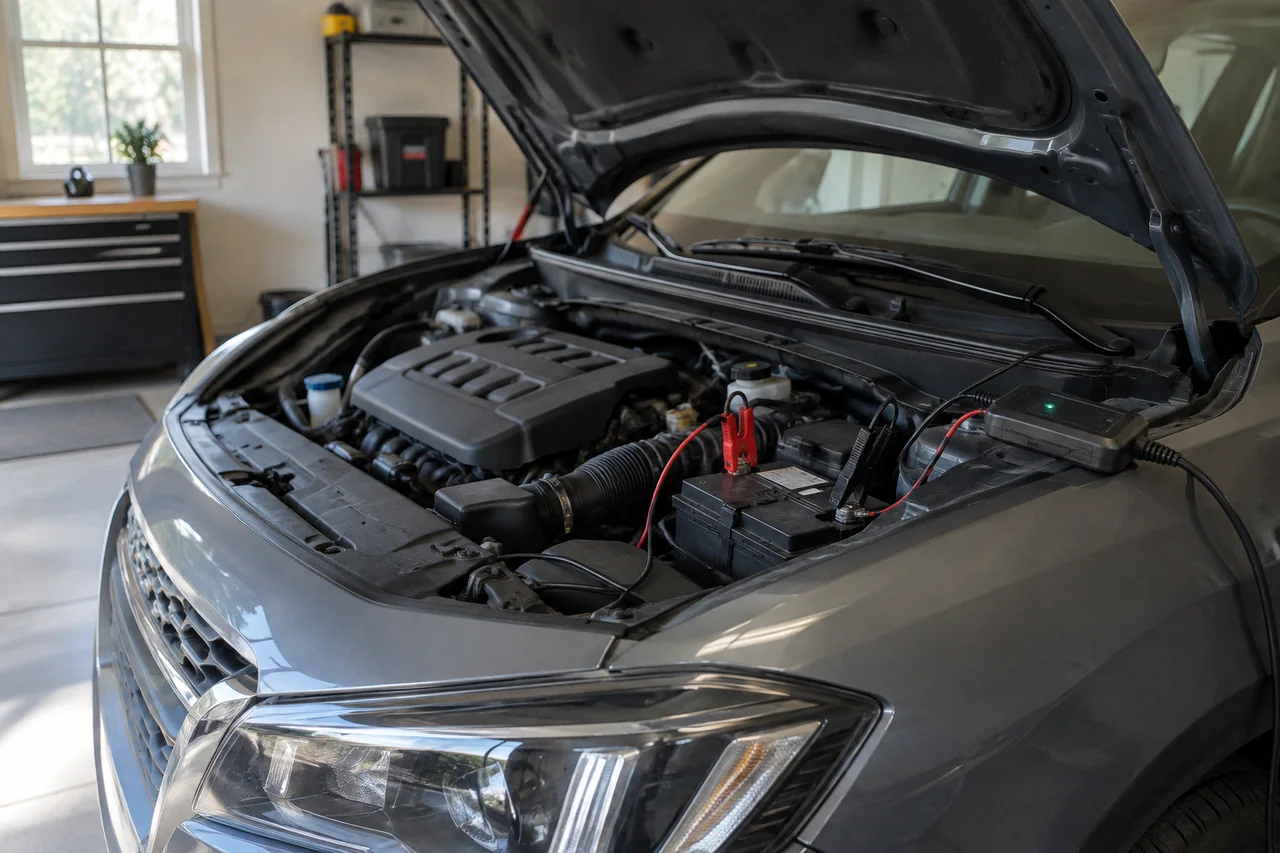
A car that sits for weeks can greet you with a weak crank or no start at all, even when nothing is wrong with the car itself. A trickle charger or smart battery maintainer can prevent that by keeping a stored battery topped up. To get real protection from one, you need to know how these devices work, when they help, and how to use them safely.
What a Trickle Charger Actually Does to a Car Battery
A battery trickle charger for a car supplies a small, steady current instead of a heavy charging output. Its job is to offset losses that happen whether the car is driven or not. One loss is the battery's own chemical self-discharge. The other is the constant parasitic draw from clocks, alarm systems, keyless entry receivers and control modules that stay awake with the ignition off. It holds a battery where it already is. It is not meant to rescue one that has gone flat.
Older constant-current trickle chargers push the same current regardless of the battery's state, which is why they need supervision. Modern multi-stage smart chargers measure voltage and charge in phases. Once the battery is full, they drop to a float or maintenance mode that reduces or pauses current. Many units sold as car battery chargers simply include a low-amp trickle setting, so the label and manual tell you what that mode actually does. Because the current is small, expect progress over hours or days, and use this mode only on a battery that is already near full charge.
When a Stored or Rarely Driven Car Needs a Battery Maintainer
A maintainer earns its keep whenever a car sits longer than its battery can comfortably handle. Seasonal storage of a convertible or classic is the obvious case. A second car driven a few times a month, a commuter that only makes short trips, and newer vehicles with many always-on modules also benefit. Short trips are easy to overlook: starting the engine takes a real bite out of the battery, and a few minutes of driving may not give the alternator enough time to replace it.
The deeper reason is sulfation. A lead-acid battery left partially discharged for weeks forms sulfate crystals on its plates that reduce usable capacity. A maintainer prevents this by keeping the battery near full without overcharging. It cannot revive a worn-out or internally damaged battery, and it does not replace occasional driving or a proper load test. A practical rule: if the car regularly sits for more than a couple of weeks and is parked where you have safe power and airflow, a maintainer is worth using. Many drivers call any of these units a battery tender.
Choosing the Right Maintainer for Your Battery Type and Parking Situation
Start with battery chemistry. Flooded lead-acid, AGM, enhanced flooded and lithium starter batteries each need a compatible charging profile, and the wrong profile can undercharge or stress the battery. Check the battery label and the charger's manual to confirm a matching mode. Next, decide how you will connect. Spring clamps suit occasional use. A ring-terminal harness with a quick-connect lead is tidier for a car that is stored again and again. A 12-volt socket adapter only works if that socket stays live with the ignition off, and that varies by vehicle.
Useful features include reverse-polarity protection, spark-proof leads, a weather rating if the car is parked outdoors, and an indicator that clearly shows charging versus maintaining. The owner's manual may also name specific charging points. This matters most when the battery is in the trunk or under a seat and the manufacturer provides remote posts in the engine bay. Amperage matters less than many shoppers assume. A higher rating mainly shortens the time to top up after the voltage drops, so a low-amp maintainer is enough for a battery that starts out healthy and charged.
How to Connect a Trickle Charger or Maintainer Safely
The charger's manual and the vehicle owner's manual always come first. General guidance like this is only a checklist of what to confirm. Before handling the leads, switch the ignition off and keep the charger unplugged from the wall. Work in a ventilated space away from smoking, sparks and open flame, because charging a lead-acid battery can release flammable hydrogen. Check that the battery and terminals are clean, dry and undamaged. A battery that is bulging, leaking, cracked or smells of sulfur should not be charged at all and needs professional inspection.
Most manufacturers use a similar order when you trickle charge a car battery. The positive lead goes on first, to the positive terminal or remote positive post. Then the negative lead goes to the ground point the vehicle manual recommends, which may be a bare metal chassis point rather than the negative post itself. Plug in and switch on the charger only after both connections are secure. You should then see a charging light or a mode confirmation. If an error light appears right away or nothing happens, stop and reread the manual rather than wiggling the clamps until something lights up.
How Long a Car Battery Can Stay on a Trickle Charger
How long a battery can stay connected depends on the type of charger. A smart maintainer is designed to stay attached for weeks or months, because it drops into float mode and only adds current when the voltage falls. An unregulated trickle charger keeps pushing current no matter what. Left on indefinitely, it can slowly overcharge the battery, boiling off electrolyte in flooded types and stressing sealed ones. The charger's own documentation should tell you whether it can stay on overnight or over a holiday weekend. If it does not mention automatic maintenance, assume it needs supervision.
Overcharging usually gives warning signs you can notice without tools: a battery case that feels warm, a rotten-egg smell, or a charger that never leaves its charging phase. If you notice any of these, unplug the charger, disconnect the leads and find the cause. Even with a smart unit, check the indicator every week or two and make sure the clamps or harness have not loosened or corroded. If a battery keeps dropping out of float mode, or loses charge quickly once the charger is removed, it has probably lost capacity. Have it load tested rather than leaving it connected longer.
Signs the Maintainer Is Not Enough and When to Have the Battery Tested
Some symptoms continue even when a maintainer is doing its job. Examples include slow cranking after a single night off the charger, dashboard warnings at startup, or a charger that reports a fault or refuses to enter maintenance mode. Keep in mind what the lights on a home charger actually measure. A full light confirms surface voltage. It does not show whether the battery can deliver cranking current under load. A battery can read full and still fail when the starter demands real power, especially in cold weather.
A professional battery and charging-system test usually combines a load or conductance test of the battery with a check of alternator output. Do this before buying a replacement, because a weak alternator can make a good battery look bad. If a healthy battery keeps draining in storage, the car may have an excessive parasitic draw. That is a separate diagnosis for a technician with the right equipment. A good storage routine is simple: confirm the battery is healthy, connect the maintainer correctly, check it regularly, and test the battery again before returning the car to regular use.