Transmission Relearn Cost: What Determines the Service Price
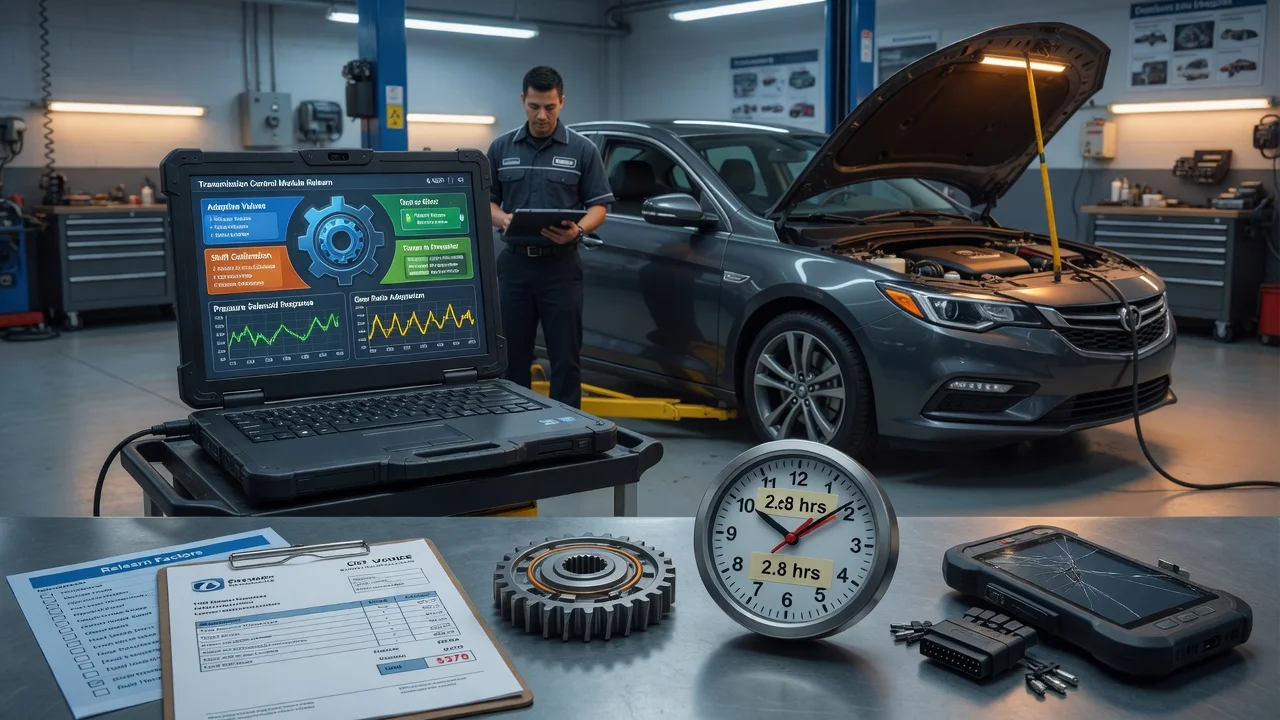
A transmission relearn resets or rebuilds the shift adaptations stored in the transmission control module. Those adaptations let the unit manage clutch fill and shift timing correctly. The price varies more than many owners expect because the procedure depends on the transmission type, the tools required and the reason the relearn is needed. This guide explains what a quote should cover, what moves the price, and how to compare offers without paying for the wrong job.
What the estimate includes
A relearn quote usually covers several steps. The shop connects a scan tool, confirms the vehicle identification and software level, clears or resets the stored adaptive values, and runs the learning procedure. Depending on the unit, that procedure may be a guided routine done with the vehicle stationary, a set of controlled driving conditions, or both. A thorough shop checks fluid level and temperature first. Many routines will not start, or will learn incorrect values, if the fluid is low or outside the specified range.
Keep a standalone relearn separate from a relearn bundled into larger work. A valve body, solenoid pack, control module or complete transmission replacement usually ends with a relearn. In that case the relearn is often part of the installation labor and may not appear as its own line. A low quote for a relearn only is not comparable to a total that also includes a diagnostic fee, a fluid correction or a programming step. Ask whether the figure is the full out-the-door amount or only a partial labor charge.
What changes the cost
The biggest variable is the transmission and how it is controlled. Some units adapt passively during normal driving and need little more than a reset and a road test. Others need a dealer-level or professional scan tool with bidirectional functions, a specific fluid temperature window and a scripted sequence that can take considerable shop time. Dual-clutch and continuously variable designs often have their own clutch or ratio calibration routines, which differ from those of conventional planetary automatics.
Programming is a separate cost driver. A new or used control module may need software loaded and configured for the exact vehicle before any relearn can run. Some manufacturers charge subscription or per-session access fees for this, and shops pass those fees on. Fitment matters here as well: a module or valve body from a different build or calibration may never learn correctly. Labor rates vary by region and by type of facility. Dealers, independent transmission shops and general repair shops also bill diagnostic and programming time differently.
The reason for the visit also changes the scope. A relearn after a battery disconnect or a fluid service is a narrow job. A relearn requested because of harsh or delayed shifts is a larger one. The shop must first read diagnostic codes and review live data, then decide whether a relearn is even the right step.
Compare like-for-like options
When a shift complaint brings you in, the repair options form a ladder. The first step is a relearn alone. The next is a fluid correction using the correct fluid specification, followed by a relearn. Beyond that comes replacing a component such as a solenoid, valve body or module, with programming and adaptation. The last step is a rebuilt or replacement transmission. Each step up adds parts and labor, and usually a relearn of its own. Compare quotes only at the same step, because a relearn-only price will always look cheaper than a repair that fixes a mechanical or hydraulic fault.
A symptom such as a flare, slip or firm engagement does not by itself prove that a part has failed. Worn clutches, low or incorrect fluid, a wiring fault or outdated software can all produce similar shift behavior, and a relearn cannot correct mechanical wear. Ask each shop what evidence supports its recommendation and what it expects the relearn to change. Compare the warranty terms too. Find out whether the relearn is guaranteed, whether a repeat visit is covered if the complaint returns, and whether the shop will honor work done elsewhere.
Read an itemized quote
A useful quote identifies the vehicle by year, model, engine and transmission. It lists each charge separately: diagnostic time, scan-tool or programming fees, fluid and any filter, the relearn procedure itself and the road test. It should also state two things. First, whether the shop will verify the fluid level at the specified temperature. Second, whether a software update is included or quoted only if one is available.
Look for exclusions and conditional charges. Common ones include: • extra labor if the routine fails to complete; • a fluid top-off billed separately; • manufacturer access fees added after the fact; • additional diagnosis if codes return; Ask whether the price assumes the vehicle is driven during the procedure. Also ask who pays for the time if traffic or weather prevents finishing it the same day. Request a record of the codes before and after the work so you have something concrete for future visits.
Decide the next step
Before calling shops, gather the details that let them quote accurately: • the exact transmission type or code, if you can find it; • any recent work on the vehicle; • battery or module events that came before the problem; • any warning lights; • a clear description of when the shift problem happens; Your service history also helps, including the last fluid change and which fluid was used. It lets a technician judge whether the fluid specification is correct before adapting anything.
Then ask at least two shops for itemized estimates you can compare, and confirm each has the tool access your vehicle requires. Avoid shortcuts such as clearing codes and hoping the shifts improve, or driving aggressively to force adaptation instead of following the documented procedure. Do not install a used module without confirming that it can be programmed for your vehicle. If a relearn does not change the shift behavior, treat that as diagnostic information rather than a reason to repeat it. Move on to proper testing before committing to larger repairs.