Transmission Oil: What It Is and Which Type Your Vehicle Needs
The short answer
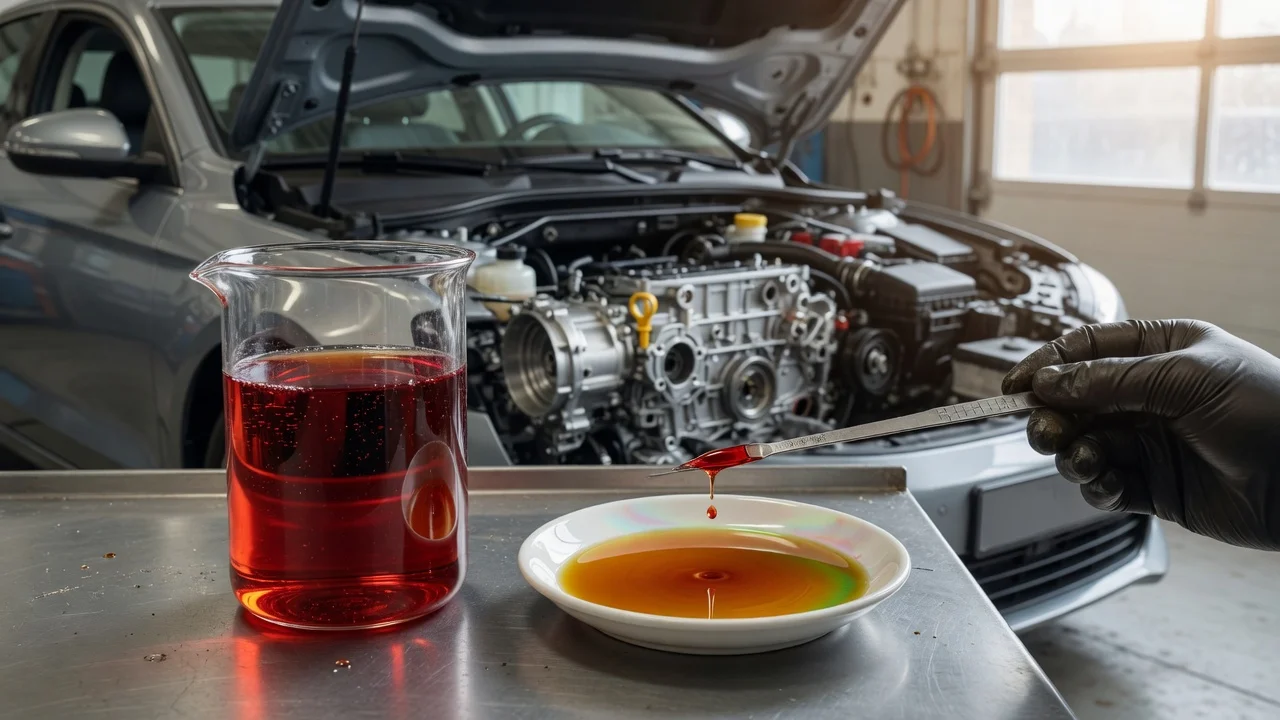
Transmission oil is the lubricant inside a vehicle's gearbox. It reduces friction and wear between gears, bearings and other moving parts, carries heat away from them, and in many automatic designs also transmits hydraulic pressure that makes the transmission shift. There is no single transmission oil that suits every car. The correct fluid depends on the type of transmission fitted and the specification its manufacturer sets, which can differ by model year, generation, powertrain and market even within one model line.
Why the transmission type changes the answer
"Transmission oil" is a broad label covering several fluid families. Each is formulated for a different kind of gearbox, and they are generally not interchangeable.
Transmission type | Usual fluid family | What the fluid mainly does; Manual gearbox | Gear oil, typically rated by an API GL category and an SAE gear viscosity grade such as 75W-90 | Lubricates and protects gear teeth and bearings under high contact pressure; Conventional automatic (torque converter) | Automatic transmission fluid (ATF) built to a maker's specification, such as GM Dexron or Ford Mercon families | Lubricates, cools, acts as hydraulic fluid and controls clutch friction; Continuously variable transmission (CVT) | Dedicated CVT fluid | Provides the specific friction behaviour the belt or chain and pulleys rely on; Dual-clutch transmission (DCT) | Dedicated DCT fluid, or gear oil in some dry-clutch designs | Depends on design; wet-clutch units need fluid suited to clutch engagement
Two of these terms are worth explaining. An API GL rating is an American Petroleum Institute category describing a gear oil's suitability for different load conditions; GL-4 and GL-5 are the most common, and a higher number does not automatically mean better for every gearbox, because some older manual transmissions specify GL-4 specifically. Friction modifiers are additives that control how clutches and bands grip; they are central to ATF, CVT and wet-clutch DCT fluids, which is a key reason these fluids cannot simply be swapped.
The qualification that matters most
The manufacturer's fluid specification for your exact vehicle is the deciding factor. It is normally listed in the owner's manual or service documentation, and sometimes on the dipstick or a label in the engine bay. Two vehicles with the same model name can require different fluids if they have a different gearbox, so the specification should be matched to your model year, engine and transmission rather than to the model name alone.
"Universal" or "multi-vehicle" fluids often state that they are suitable for many specifications. The fluid maker's own approval and compatibility list for your required specification is the claim to check; whether a given multi-vehicle product performs identically to the manufacturer's own fluid in a particular transmission cannot be confirmed from the information available for this guide.
Change intervals and "lifetime" fluid
Service intervals for transmission oil vary widely by manufacturer, transmission design and how the vehicle is used. Some makers describe their automatic transmission fluid as filled for life under normal conditions, while also listing shorter intervals for severe use such as towing, frequent short trips or high heat. No specific intervals were supplied for this guide, so your vehicle's service schedule is the reference to follow.
What this guide cannot tell you
Which fluid a specific make, model or year requires: this needs the vehicle's own documentation. Fill capacities, check procedures or temperatures: these vary by transmission and some sealed units have no dipstick. Comparative performance of particular brands: no test data was supplied, so no ranking is offered.
Next step: find the transmission fluid specification for your exact vehicle, then choose a fluid that explicitly lists that specification. If the vehicle's transmission type or the required specification is unclear, a dealer or qualified technician can confirm it from the vehicle identification number.