Transmission Fluid Types: ATF, CVT, Manual, DCT, Type A and Type F
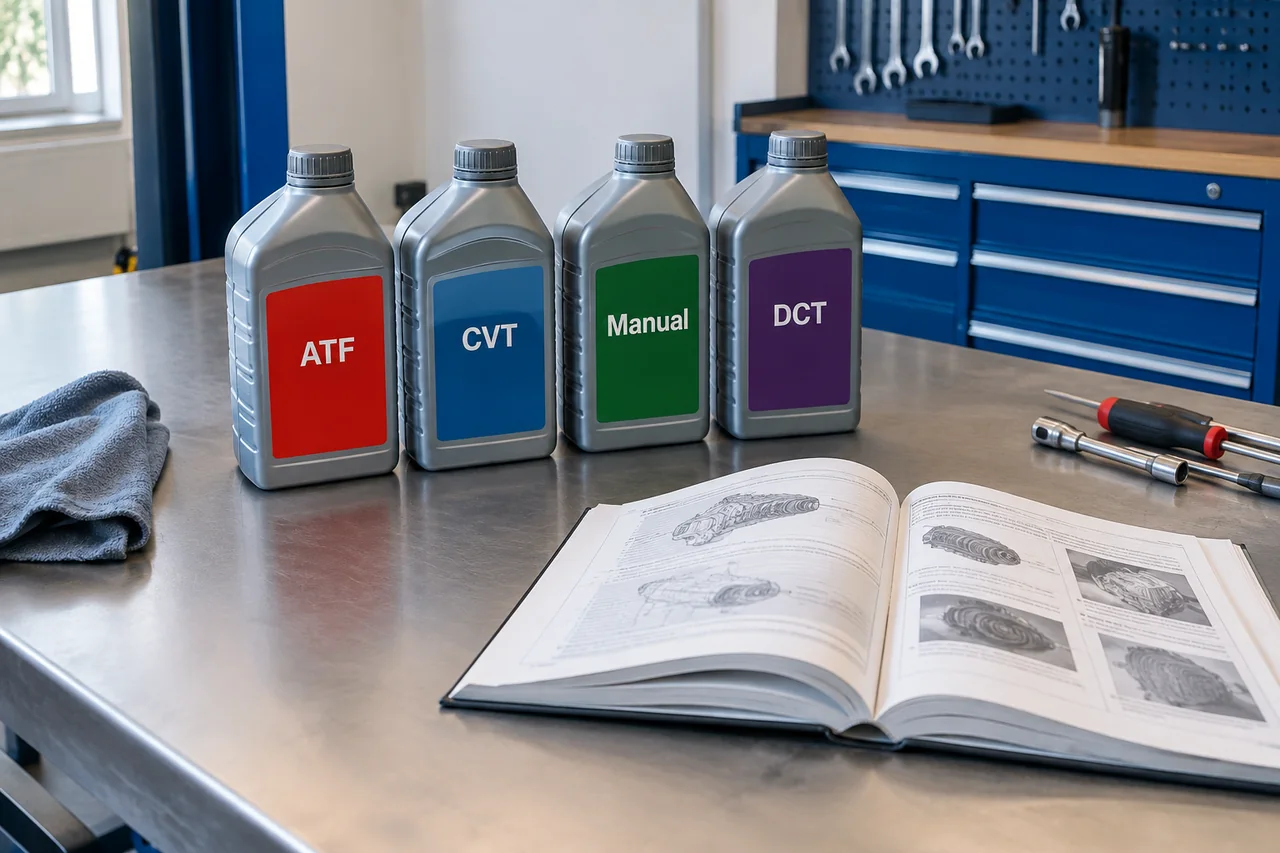
Transmission fluid is not a single product that fits every gearbox. Conventional automatics, continuously variable transmissions, dual-clutch units, and manual gearboxes each rely on fluids engineered for specific mechanical demands, and legacy designations such as Type A and Type F carry their own history. Whether you maintain a daily driver or need transmission fluid for trucks that tow, the exact specification should guide every purchase.
Transmission Fluid Categories and Their Intended Applications
Depending on the design, transmission fluid may do several jobs at once. It lubricates gears and bearings and carries heat away from hard-working components. In an automatic transmission, it also serves as the hydraulic medium that applies clutches and bands on command. It controls friction as well, which matters because clutch packs must grip smoothly without slipping or grabbing. Conventional automatic transmission fluid is blended for this combination of tasks. The formulation a manufacturer specifies reflects how its particular clutch materials, valve body, and torque converter were engineered to behave.
Continuously variable and dual-clutch transmissions add further complexity. A belt or chain CVT depends on precise metal-to-metal friction. A dual-clutch unit may use wet clutches, dry clutches, or a separate gear lubricant, so knowing the transmission type alone does not tell you which product to buy. Manual gearboxes vary as well. Some call for conventional gear oil, others for a dedicated manual transmission fluid, and some were designed to run on ATF. The published specification, not the presence of a clutch pedal, determines the correct lubricant and viscosity.
How to Confirm the Fluid Specification for Your Vehicle
The most reliable starting point is the owner's manual or vehicle-specific service information, which typically names the required fluid specification rather than a generic category. Write that specification down exactly as printed, including any numbers or suffixes. Then confirm which transmission is actually installed. Many vehicles were offered with more than one transmission, and a used vehicle may have a replacement unit that differs from the original. Service records, build information, or identification by a qualified technician can settle the question before you buy any fluid.
Once you know the specification, read the product documentation carefully. A formal manufacturer approval, often shown as a licensed designation, is different from a supplier stating that its fluid is suitable where that specification is required. Fluid color doesn't prove compatibility, because dyes are shared across formulations. Neither does a broad multi-vehicle label, or the fluid already in the transmission, since a previous owner may have used the wrong product. Brand-specific specification families deserve separate treatment, but the principle holds everywhere: the exact specification governs selection. If you're unsure what fluid is in the transmission, get guidance before topping it off.
Legacy Type A Fluid: History and Present-Day Selection
Type A is one of the earliest automatic transmission fluid designations, dating from the period when automatic transmissions were becoming common in passenger cars. It is best understood as a historical reference point rather than a current universal standard. The formulation had to act as a hydraulic fluid for the valve body and servos. It also had to lubricate gears and bearings and provide the friction behavior needed by the clutches and bands in the transmissions that specified it. Those demands shaped later fluid development as transmission designs became more sophisticated.
Requirements changed over time, and later documentation refers to Type A Suffix A, which reflected revised expectations for the fluid. When working on an older vehicle, keep the exact wording found in the original owner's manual or factory service literature, because small differences in designation can matter. Don't assume a modern ATF is automatically appropriate, and don't assume a bottle labeled Type A matches the original requirement. Get documented replacement guidance from the fluid supplier, a restoration specialist, or a transmission rebuilder familiar with the unit.
Legacy Type F Fluid and Its Friction Requirements
Type F is historically associated with certain older automatic transmissions. It should never be treated as a blanket match for a particular make or model year, because specifications varied between units and over time. What distinguishes Type F is its specified friction behavior. Clutches and bands are engineered to engage within a certain friction range, and the fluid influences how quickly they grip and how smoothly torque transfers. A fluid with different friction characteristics can change how engagement feels and, over time, affect how the friction material wears.
Type F is often linked with a firmer shift feel, largely because its friction properties differ from many fluids that followed. That reputation does not make it a shift-enhancing additive or a universal upgrade. Using it where another fluid is specified can cause harsh engagement or other drivability complaints. Before choosing Type F, confirm the original specification from factory documentation. If the transmission has been rebuilt, ask the rebuilder whether the new friction materials or internal changes have their own fluid requirement, and follow that written guidance.
Transmission Fluid Requirements for Trucks
A truck's size, cab configuration, or payload rating does not tell you which fluid its transmission needs. Light-duty pickups, heavy-duty pickups, and commercial trucks may use conventional automatics, automated manuals, or manual gearboxes, and those transmissions do not share one fluid category. Identify the installed unit and its specification first. Towing, hauling, and extended operation in hot conditions raise transmission temperatures, which can speed up fluid breakdown. The vehicle's documentation may define severe-service conditions and give different maintenance guidance for them. Follow that documentation rather than a general rule of thumb.
Trucks also use several separate drivetrain lubricants. The transmission, the transfer case on four-wheel-drive models, and the front and rear differentials each have their own requirement. One may call for ATF while another needs a specific gear oil or a dedicated transfer case fluid, so confirm each one individually. Leaks, a burning smell, slipping, or a temperature warning all justify a professional inspection. However, these signs do not show which fluid is required or prove that the fluid caused the problem. Mechanical, electrical, or cooling faults can produce similar symptoms.
What High Performance Transmission Fluid Claims Mean
High performance transmission fluid is usually marketed on thermal stability, oxidation resistance, viscosity control under heat and shear, and friction durability over a longer service life. Those properties are genuinely important, since heat breaks down fluid and changes how clutches engage. Still, a marketing claim cannot guarantee a particular result in a specific vehicle. A good transmission fluid meets the required specification and lists that application in its documentation. It should also be backed by credible product information, such as approval details or technical data, rather than promotional wording.
Synthetic labeling, racing branding, or a performance claim does not by itself establish compatibility. None of these labels makes it acceptable to mix different fluids in the same transmission. A synthetic product built to the wrong specification is still the wrong fluid. Modified or rebuilt transmissions may use different friction materials, valve body calibrations, or cooling setups, so ask the builder for written fluid guidance. If shift quality is still a concern, professional diagnosis and testing will get further than experimenting with different fluids. Trial-and-error fluid changes can hide an underlying fault or make it harder to diagnose.