Transmission Cooler Flow Direction: Identifying Inlet and Outlet
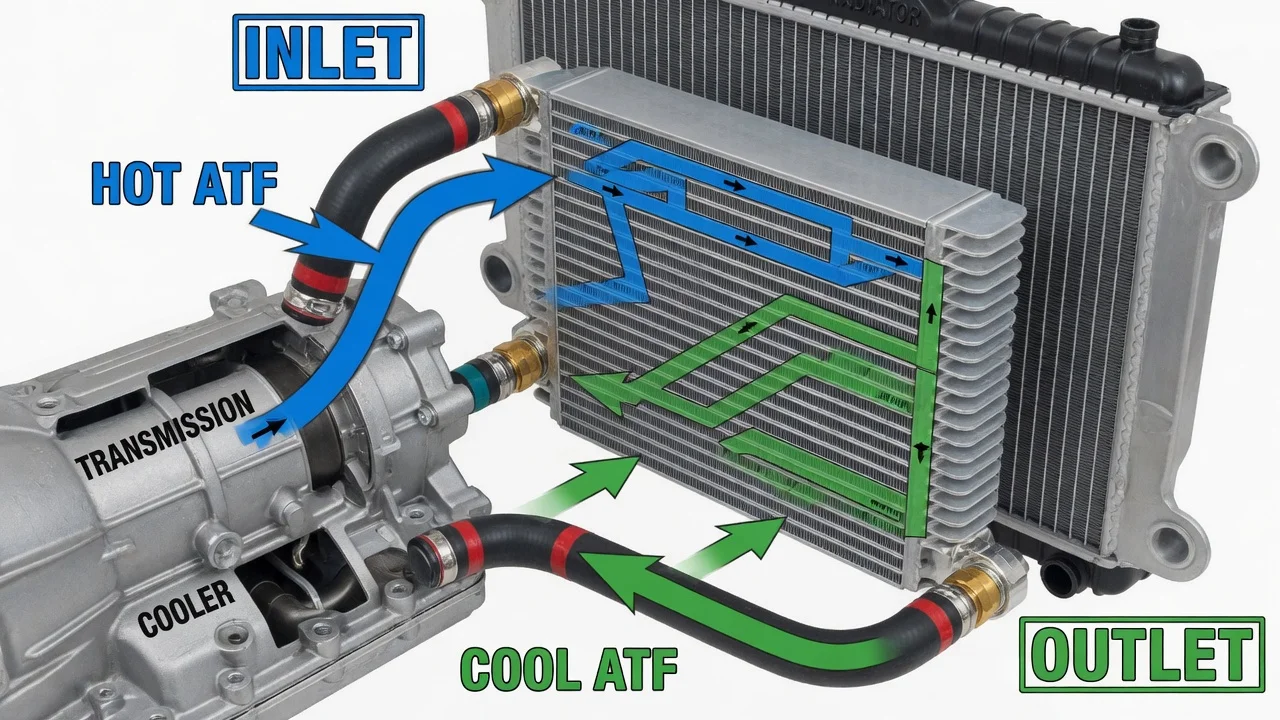
Replacing a cooler line, adding an auxiliary cooler or reconnecting hoses after radiator work all raise the same question: which port is the inlet and which is the outlet? The answer depends on the transmission type and how its cooling circuit is built. This guide explains how to tell the supply line from the return, when flow direction through the cooler matters, and when you need service information for your exact vehicle.
The direct answer
On an automatic transmission, one line carries hot fluid from the transmission to the cooler. This is often called the feed, supply or outlet line. The other line brings cooled fluid back and is called the return or inlet line. Which fitting on the case does which job varies by transmission design. No universal rule, such as 'top is out, bottom is in', holds across makes. Reliable answers come from factory service information for your exact transmission, markings on the case or cooler, or a controlled flow check.
For the cooler itself, many basic tube-and-fin and plate-style auxiliary coolers work with flow in either direction, because they are only a passage through a heat-exchange core. That changes when the cooler has marked ports, an internal bypass, a thermostatic valve or an in-line filter. Those units must be plumbed as marked. When adding an auxiliary cooler, the usual practice is to connect it in series on the return side, after the factory cooler, so fluid passes through both before it goes back to the transmission.
How fluid moves through the cooler circuit
The transmission pump pressurizes fluid whenever the engine runs. Part of that flow goes through the torque converter, where much of the heat is generated, and then out to the cooler circuit. The cooler may be a tank inside the radiator, a separate air-to-oil core in front of the radiator, or a fluid-to-coolant heat exchanger mounted near the transmission. After passing through it, the fluid returns to the case.
On many automatics, the returning fluid does more than refill the pan. It often feeds the lubrication circuit that supplies bushings, bearings and planetary gear sets. A restricted or reversed cooler circuit can therefore cause problems beyond high temperature, because lubrication flow can drop if the return path is wrong or blocked. This is also why the fittings on the case are not necessarily interchangeable, even when they look identical.
What changes the answer for your vehicle
Transmission type is the first variable. Conventional planetary automatics, CVTs and dual-clutch units use different cooling layouts. Some have a thermostatic bypass valve on or near the case that keeps fluid out of the cooler until it reaches operating temperature. On a cold engine, a line that stays cool or shows little flow may simply be bypassed rather than blocked. Most passenger-vehicle manual transmissions have no cooler circuit at all, although some heavy-duty and performance applications do.
Configuration matters next. A truck with a towing package may have both an in-radiator cooler and a factory auxiliary core. Other vehicles use a coolant-to-fluid heat exchanger with no in-radiator section. Quick-connect fittings, in-line filters and check valves each set a direction for the circuit. Aftermarket stacked-plate coolers and remote-mount units with fans or thermostats come with their own port markings and fitment requirements.
Prior work also changes the picture. The service history may show a radiator replacement, an earlier auxiliary cooler install or a transmission swap. In any of those cases, the current routing may not match the factory layout. Trace what is actually on the vehicle rather than assuming it is original.
How to identify the supply and return lines
Start with documentation. The service manual or factory diagram for your transmission usually names the cooler outlet and return ports and shows how the lines are routed. Look for arrows or the words in and out stamped on the cooler, fittings or brackets. Where the lines are not bundled together, tracing each steel line by hand from the case to the cooler often settles the question.
If no documentation is available, a brief flow check can identify the supply line. Do not attempt it if the fluid level is unknown or low. Secure the vehicle in park and disconnect one line at the cooler or radiator. Attach a short hose that leads into a clean container, then have a helper start the engine for only a few seconds. If fluid pumps out steadily, that line is the supply from the transmission. If little or nothing comes out, it is probably the return. Keep the run very short, because the transmission is losing fluid. Afterward, reconnect the line, top off with fluid that meets the correct fluid specification, and check the level using the procedure for your transmission. On units with a thermostatic bypass, a cold test can mislead. Skip this method entirely where the manufacturer specifies a different procedure.
Reconnecting or adding a cooler
When installing an auxiliary cooler, confirm hose and fitting fitment first. Use hose rated for transmission fluid and the temperatures in the circuit, and route lines away from exhaust parts and moving components. The usual approach is to plumb the add-on unit into the return line after the factory cooler. If the cooler has marked ports, follow the markings. If it does not, check its instructions, which may state that direction does not matter. Mount the cooler where the ports and lines are protected and where air can bleed out of the system during filling.
After any cooler work, check for leaks and verify the fluid level hot or cold as specified for your transmission. On the test drive, watch shift behavior and transmission temperature if your vehicle can display it. A reversed or restricted connection may show up as rising fluid temperature. However, high temperature, harsh or delayed shifts, and stored diagnostic codes each have several possible causes. Treat them as reasons to keep checking, not as proof that the cooler or its routing is at fault.
Limitations and next step
This guide covers general principles only. Port locations, bypass valve behavior, fill procedures and fluid types differ between transmissions. They can differ even within one model year, depending on engine and towing package. Without the correct service information, a reversed connection or incorrect fill can cause overheating or reduced lubrication that does not show up right away.
Have a transmission specialist inspect the vehicle if you cannot confirm the routing, if transmission diagnostic codes are stored, if the fluid is dark or smells burnt, or if temperature stays high after the cooler is correctly connected. A specialist can check line pressure and flow, test the bypass valve, and review repair options such as flushing the cooler or replacing one that may hold debris from an internal failure. Bring the service history and details of any parts you installed so they can see what has changed.