Transfer Case Control Module: Identifying the Controller for Shifting Faults
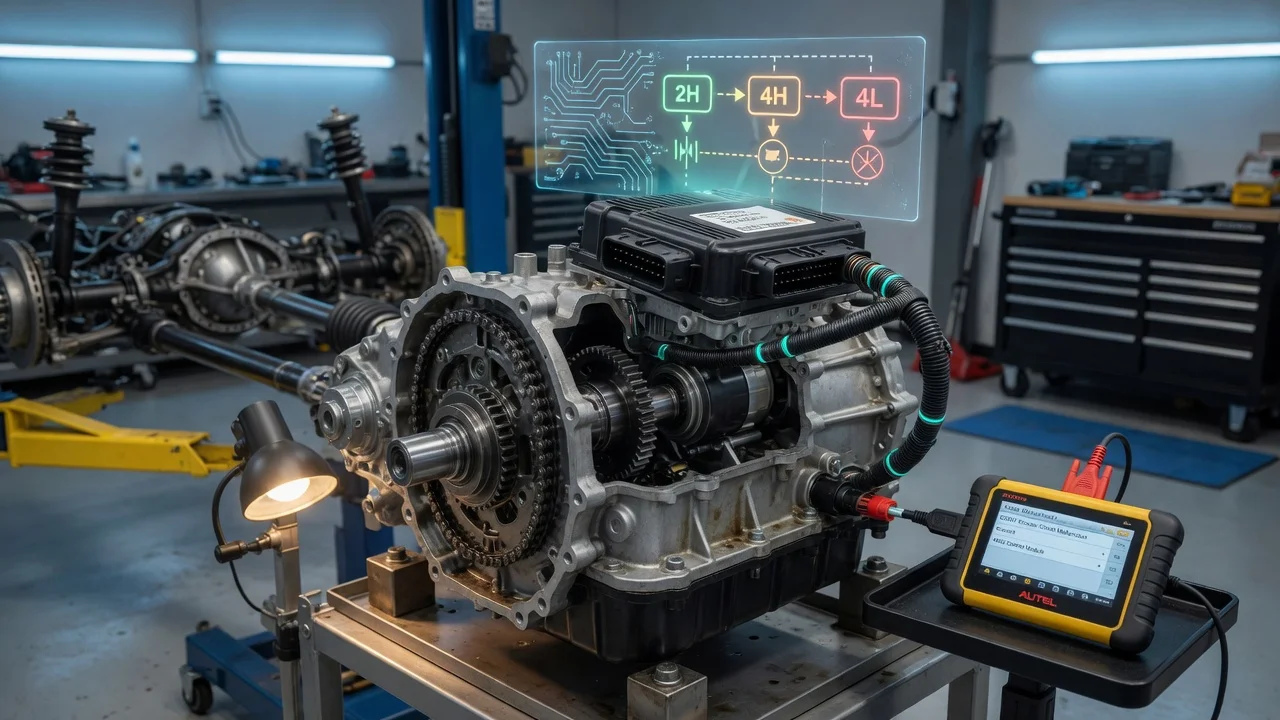
When a four-wheel-drive system refuses to change range, flashes a warning or shifts unpredictably, many owners suspect the transfer case control module first. Sometimes that is correct, but the controller is only one part of an electrical shifting system that also includes switches, sensors, a shift motor and wiring. This guide explains what the module does, how to judge whether it is the likely source of a fault, and when diagnosis needs vehicle-specific service information.
Is the Control Module Behind Your Shifting Fault?
The transfer case control module, often abbreviated TCCM, is the electronic controller that decides when and how an electronically shifted transfer case changes between modes such as two-wheel drive, four-wheel high and four-wheel low. It reads the driver's mode selector and the vehicle's operating data, then commands the motor or actuator that physically moves the shift mechanism. A shifting fault can start in the module, but it can just as easily come from the selector switch, the shift motor, a position sensor, a connector, a fuse, low system voltage or a mechanical problem inside the transfer case itself.
In practical terms, the module becomes a strong suspect when it cannot communicate with a capable scan tool, when it stores trouble codes the manufacturer defines as internal controller faults, or when power, ground, input signals and the actuator circuit all test good but the commanded shift still does not happen. A failed controller is a conclusion reached after testing, not a starting assumption. Replacing it without that evidence often leaves the original fault in place and adds the cost of an unnecessary part.
How the Transfer Case Controller Manages a Shift
A typical electronic shift begins when the driver turns a knob or presses a button. The module checks whether conditions allow the requested change. Depending on the design, it may look at vehicle speed, transmission gear position, brake status and whether the engine is running. Shifts into or out of low range commonly require the vehicle to be stopped or moving slowly with the transmission in neutral, but the exact procedure differs between vehicles and is described in the owner's manual. If conditions are met, the module powers the shift motor and watches a position sensor or encoder, stopping the motor once the mechanism reaches the target position. On some systems it also controls front axle engagement or a clutch used for automatic four-wheel-drive modes, and it reports status to the dashboard indicator.
The module shares data with other controllers over the vehicle network. If it loses information it relies on, such as vehicle speed, it may deliberately refuse to shift as a protective measure. It also runs self-checks and stores diagnostic trouble codes when a signal falls outside its expected range. This means a refusal to shift, or a flashing indicator, can be the module working exactly as designed in response to a problem elsewhere.
What Changes the Diagnosis
Vehicle configuration matters first. Transfer cases shifted by a floor lever do not use a shift motor in the same way, and some designs build the transfer case function into another controller rather than using a separate module. Full-time and automatic systems may manage a clutch instead of a simple range shift. Module location also varies; it may be under the dash, beneath a seat or near the transfer case, so the correct service information is needed even to find it. Replacement modules on many vehicles require programming or configuration to match the vehicle before they work correctly.
Operating conditions and service history change the picture as well. Water exposure, road salt and corrosion can affect connectors and wiring near the drivetrain. Weak batteries or charging problems can cause erratic electronic behavior. Some systems compare front and rear speed signals, so mismatched tire sizes can trigger faults or block engagement. Mechanical resistance from internal wear or incorrect fluid can stall the shift motor, which the module then reports as a fault. Recent battery replacement, electrical accessory installation, collision repair or drivetrain work are all worth noting.
The symptom pattern is a useful clue. A fault that affects every mode points in a different direction than one that affects only low range, and an intermittent problem that appears in wet or cold weather suggests wiring or connectors more than a controller.
What You Can Check Before Paying for a Module
Start by recording exactly what happens: which mode you requested, whether the indicator flashes or stays lit, any warning messages, and the conditions at the time, such as temperature, recent rain, or whether the vehicle was moving. Then repeat the shift using the precise procedure in the owner's manual, because many apparent failures come from shifting outside the allowed conditions. Check battery condition and charging, and inspect the relevant fuses using the manual's fuse diagram.
Next, have the system scanned with a tool that can communicate with the four-wheel-drive or transfer case module. Basic code readers often see only engine codes and miss this controller entirely. Write down all stored codes before anything is cleared. With the engine off and the vehicle secured, a careful visual inspection of accessible connectors and wiring near the transfer case can reveal damage, corrosion or loose plugs. Avoid unplugging modules or connectors with the ignition on unless the service procedure calls for it.
Keep transfer case fluid service in line with the manufacturer's maintenance schedule for your vehicle rather than a generic interval. If a module is eventually needed, confirm the correct part for your exact vehicle and whether it requires programming. A used controller from another vehicle may not work without setup, even when it looks identical.
Limits of Home Diagnosis and When to Get Help
Pinpoint testing requires wiring diagrams, connector pin information, expected values from manufacturer specifications and often a scan tool that can command the shift motor and read encoder position. Without those resources, separating a controller fault from a motor, sensor or wiring problem is largely guesswork. Seek professional help promptly if the vehicle shifts into an unexpected mode, becomes stuck in low range, makes grinding or clunking noises during a shift, or will not leave neutral. On many vehicles a transfer case in neutral disconnects the transmission's park position from the wheels, so secure the vehicle with the parking brake and do not leave it parked on a slope.
For the next step, bring the shop your symptom notes, any stored codes and relevant service history. Ask whether technical service bulletins or recalls apply to your vehicle, and confirm whether a replacement module needs programming before approving the repair. A dealer or a four-wheel-drive specialist with the correct diagnostic equipment is usually the most direct route to a confident diagnosis.