Trailer Coupler Types and Latches: A Practical Guide
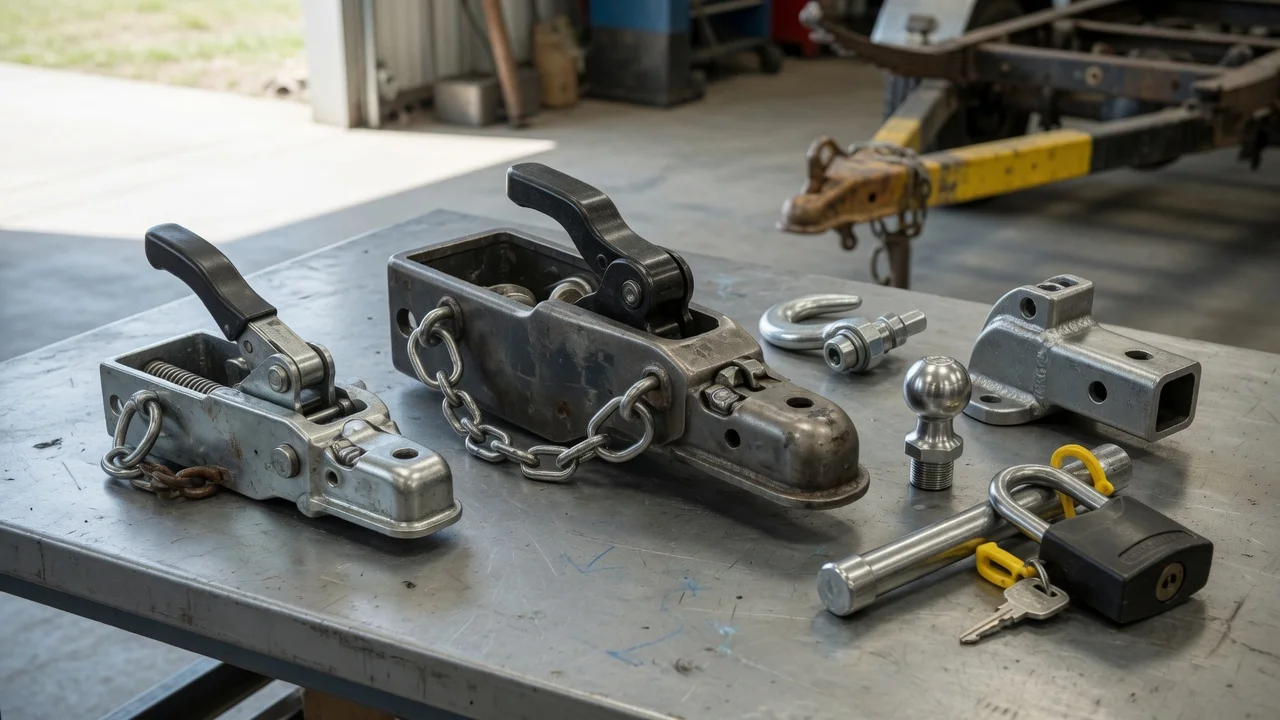
What a Trailer Coupler Latch Does
The coupler latch is the locking mechanism that keeps the trailer coupler seated on the hitch ball. In normal use, the coupler drops over the ball, and the latch closes around or under the ball to prevent the trailer from separating during towing. A properly adjusted latch should hold the coupler against the ball with minimal vertical play while still allowing the coupler to pivot for turns and road angle changes.
Common Coupler Types
Most light-duty and medium-duty trailers use either an A-frame coupler or a straight-tongue coupler. The latch style is usually the same across both; the difference is how the coupler mounts to the trailer frame.
A-frame coupler: Bolts or welds to the two angled frame rails that meet at the tongue. Straight-tongue coupler: Slides over or bolts to a single square or rectangular tongue tube. Pintle ring and lunette: Used on heavier equipment and military-style trailers; it does not use a ball coupler latch.
Main Latch Styles
Trailer coupler latches fall into a few broad categories. Their availability depends on trailer weight class, coupler brand, and market.
Latch style|Typical use|How it locks; Hand-wheel latch|Light to medium trailers|A threaded hand wheel tightens a jaw or clamp under the ball; Lever latch|Light to medium trailers|An over-center lever pulls a locking jaw or strap into place; Trigger latch|Small utility and boat trailers|A spring-loaded trigger snaps under the ball and is released by lifting the trigger; Screw-type latch|Older or utility couplers|A bolt or screw is turned to close the clamp around the ball
How to Check the Latch Before Towing
After dropping the coupler onto the ball, close the latch and confirm that the locking jaw or clamp is fully seated beneath the ball. If the coupler has a secondary safety pin or clip, install it. Lift upward on the tongue with the trailer jack to confirm the coupler does not pop off the ball. A small amount of vertical movement is normal with many couplers, but any movement that allows the ball to clear the latch is not safe.
Adjustment and Wear
Many lever and trigger latches have an adjustment nut under the coupler. If the latch becomes loose, the nut can be tightened so the jaw clamps the ball more firmly. If the latch will not close, the coupler may be the wrong size for the ball, the ball may be worn, or the latch may be damaged. Common passenger trailer balls are 1-7/8 inch and 2 inch; the coupler size must match the ball size.
Safety Requirements
A working coupler latch is only one part of the hitching system. Crossed safety chains and a breakaway system, where required, remain essential. In many jurisdictions, trailers above a set weight require safety chains or a breakaway brake activation system, but rules vary by region and trailer type. The coupler latch itself is not a substitute for those secondary restraints.
Choosing a Replacement Coupler
When replacing a coupler, match the ball diameter, the trailer tongue width or tube size, and the weight rating of the existing coupler. Couplers are marked with a class or capacity, such as Class I or Class II, but those markings are not universal across every brand or market. A replacement coupler should meet or exceed the trailer's gross trailer weight rating.