Toyota Tundra Rear Axle Bearing Replacement: Check the Procedure for Your Year
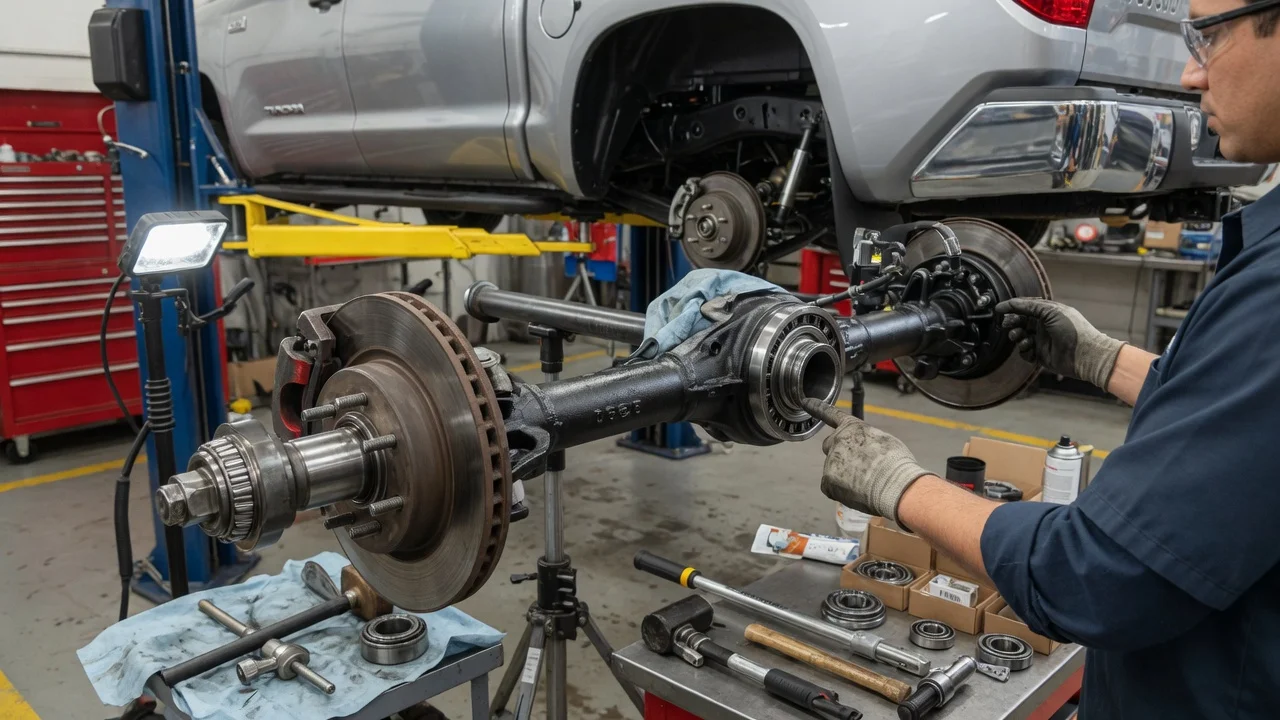
A worn rear axle bearing on a Toyota Tundra usually shows up as a growl or hum from the back of the truck. Tires, the differential and the brakes can make similar noises. Before ordering parts, confirm that the bearing is actually at fault. Then find the exact procedure for your model year, axle and drivetrain, because a 2000 Tundra and a 2007 Tundra have different brake hardware and service steps.
Establish the symptoms
Start by writing down when the noise or vibration appears. A failing rear wheel bearing usually makes a hum, rumble or grinding sound that rises with road speed rather than engine speed. The sound often changes when the truck leans into a curve, because the load shifts from one side to the other. Also note whether the noise changes on acceleration, while coasting or under braking, and whether it gets worse with a loaded bed or a trailer. Record recent work too: a tire rotation, new tires, brake service or a deep water crossing can all change what you hear.
Look for related signs as well. These include gear oil dampness on the inside of a rear wheel or backing plate, oil-soaked brake shoes or pads, grabbing or pulling to one side when braking, an ABS or traction warning light, or a knock felt through the rear of the truck. Also write down the vehicle configuration: year, cab and bed, two- or four-wheel drive, engine, and any identification on the axle housing. Add the service history, including the last differential fluid change. These details decide which parts fit and which repair procedure applies.
Distinguish plausible causes
Tire noise is the most common lookalike. Cupped or unevenly worn tread, aggressive off-road tires and some road surfaces can all produce a hum that seems to come from the axle. Tire noise often changes or moves to a different corner after the tires are rotated. Bearing noise stays with the axle position and tends to change with side load in turns. If the noise started right after new tires were fitted or a rotation was done, suspect the tires first.
The differential is the next candidate. Worn pinion bearings or ring and pinion wear usually cause a whine that changes between throttle and coast. A worn carrier bearing can make a steady drone that is hard to tell apart from a wheel bearing. Dragging brake pads or shoes, a dust shield touching the rotor or drum, and driveshaft joints can also cause noise or vibration from the rear. A leaking axle seal can come with a failing bearing, but it can also happen by itself. Oil on the brakes therefore proves a leak, not a bad bearing.
Checks in a useful order
Begin with checks that need no tools. Park on level ground and look behind each rear wheel for wet gear oil, then inspect the tires for cupping or uneven wear. On a quiet, empty road, drive at a steady speed with the windows down and the radio off, and note how the sound responds to gentle weaving, light acceleration and coasting. If tire noise is a possibility, rotate the tires and repeat the same drive. This is a cheap way to rule tires in or out.
The next checks need equipment and care. Support the rear axle securely on jack stands, never on a jack alone, so that both wheels are off the ground. Spin each wheel by hand and feel for roughness or grinding. Rock each tire top to bottom and side to side to check for play. A mechanic's stethoscope or a clip-on chassis microphone on a road test can help locate the noisy corner. Check the differential fluid level and condition, and look at the drain plug magnet for metal particles. Measuring axle shaft end play requires a dial indicator and the manufacturer specifications for your exact axle. Pressing a bearing off and on a shaft requires a hydraulic press and the correct adapters. Many owners leave that step to a technician or machine shop.
Interpret the findings
Roughness felt when you spin a wheel by hand, with the brakes not dragging, strongly suggests a worn bearing. Noise that moves with the tires after a rotation points away from the bearing. Some semi-floating axles normally have a small amount of end play, so compare any measured movement against the factory figure instead of judging by feel. Gear oil on the backing plate confirms a seal leak but not a failed bearing. However, a worn bearing can let the shaft move enough to damage the seal, so the seal is normally replaced along with the bearing.
Noise that gets louder in one direction of turn often points to the bearing on the side carrying more load. Confirm the side with a hand spin or a stethoscope before taking anything apart. Metal particles in the differential fluid suggest the differential is also involved, and that needs its own diagnosis. Once the shaft is out, inspect the bearing journal and seal surface. A scored or worn shaft may need replacing rather than just receiving a new bearing.
Match the procedure to your Tundra
The general job is the same across years: remove the wheel and brake components, release the axle shaft retainer, pull the shaft, then press the old bearing off and the new one on. The details differ by generation. First-generation trucks, including a 2000 Tundra, use rear drum brakes. On many of these trucks, removing the shaft means disconnecting brake hardware, and the brakes must then be bled and adjusted after reassembly. The second generation, beginning with the 2007 Tundra, uses rear disc brakes. On those trucks the caliper and rotor come off first, and the parking brake assembly and the wheel speed sensor wiring must be handled carefully.
Within each generation, the drivetrain and axle can vary by engine and configuration, so order bearings, seals and retainers by VIN rather than by year alone. A pressed-on bearing retainer collar is typically replaced, not reused. Follow the factory repair manual for your exact year and axle to get the removal sequence, press procedure, fastener torque and fluid requirements. Do not borrow figures from another model year or a generic guide.
Urgency and next action
Stop driving and arrange a tow if any of these occur: grinding that is getting louder quickly, visible wheel wobble, play you can feel by hand, a burning smell or heat from one rear wheel, or braking affected by oil-soaked shoes or pads. On a semi-floating axle, a badly failed bearing or retainer can let the shaft shift. That affects wheel position and brake operation. No inspection can tell you how many miles a noisy bearing has left, so do not plan around a supposed safe distance.
When you book the repair, bring the following: year, VIN, drivetrain, engine, your symptom notes, the test results you gathered, and the relevant service history. Ask for a quote covering the bearing, seal, retainer and any required gaskets or O-rings. The quote should also cover brake parts if they are contaminated with oil and a differential fluid top-up afterward. Having this information ready lets the shop confirm the diagnosis quickly and use the right procedure for your truck's year.