Toyota Transmission Speed Sensor Identification
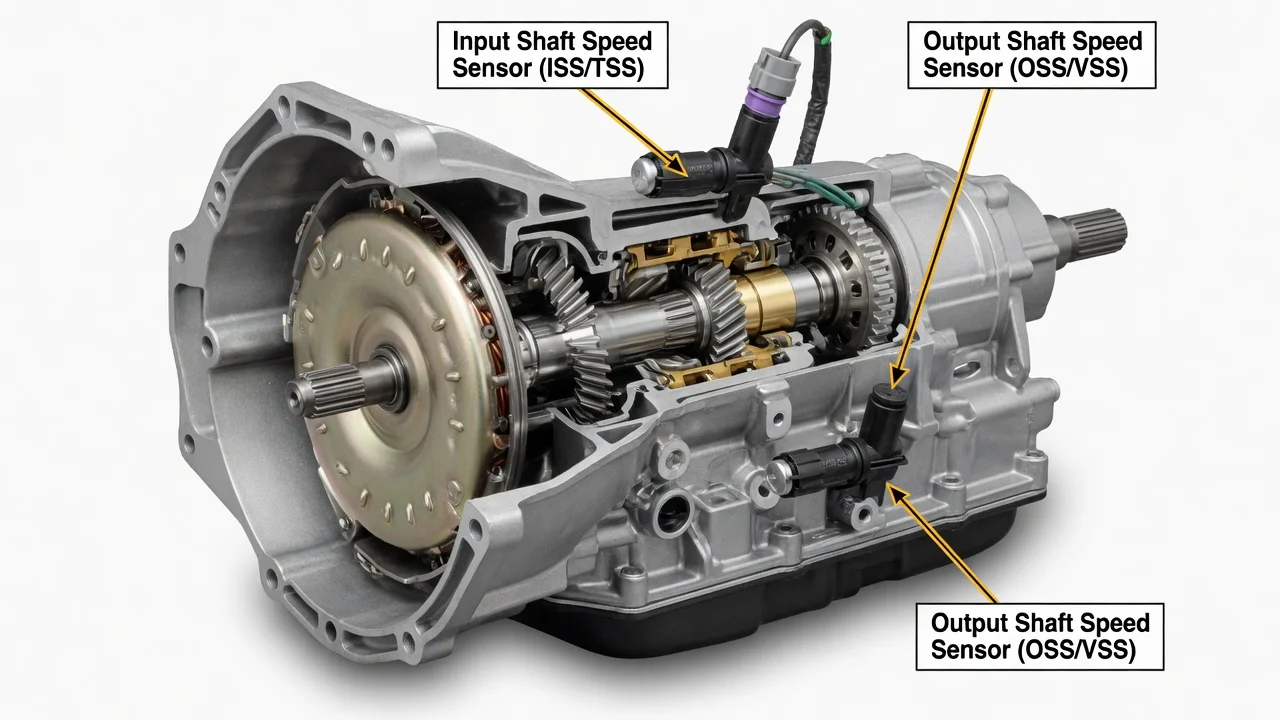
When a Toyota sets a transmission code or starts shifting oddly, the speed sensors are often among the first parts mentioned. Identifying the right one is harder than it sounds. Depending on the transmission type, your vehicle may have an input sensor, an output sensor, a separate vehicle speed sensor, or none of these in the familiar form. This guide explains how to work out which sensor you have and how to confirm a fault before buying parts.
Which speed sensor does your Toyota use?
Most electronically controlled Toyota automatic transmissions use two transmission speed sensors. The input or turbine speed sensor, often labeled NT in Toyota service information, reads how fast the input shaft turns. The output or counter gear speed sensor, often labeled SP2, reads the rotation leaving the gearset. The transmission control logic compares the two to time shifts and detect slipping. Older models may also have a separate vehicle speed sensor that drives the speedometer, while many newer vehicles take road speed from the ABS wheel speed sensors instead.
The reliable way to identify yours is to start from the vehicle, not the symptom. Confirm the model, year, engine and transmission designation, then look up the sensor by VIN in a parts catalog or service manual. Two vehicles of the same model and year can carry different transmissions, and their sensors, connectors and mounting locations may differ. A diagnostic code that names a circuit tells you which signal the computer considers faulty, not that the sensor itself has failed.
How the sensors work
Each sensor sits next to a toothed rotor or gear inside or on the transmission case. As the teeth pass, the sensor produces a pulsed signal whose frequency rises with rotational speed. Older designs typically use a magnetic pickup that generates its own alternating voltage. Many later units use active sensors, such as Hall-effect or magnetoresistive types, which need supply voltage from the control module and output a cleaner square-wave signal. The design matters when testing, because a meter check suited to one type can mislead on the other.
The control module uses these signals in several ways. Comparing input and output speed lets it calculate the actual gear ratio, confirm that a shift has completed and detect slippage. Output speed also feeds shift scheduling and, on some models, torque converter lockup, cruise control and the speedometer. When a signal drops out or becomes implausible, the module usually stores a code and may switch to a fail-safe mode with limited gears or firmer shifts to protect the transmission. That is why shift behavior can change abruptly when a sensor circuit misbehaves.
What changes the answer
Transmission type is the biggest variable. Conventional stepped automatics, from older four-speed units to later six-, eight- and ten-speed designs, generally follow the input and output sensor pattern, though the sensor count, location and whether they are external or near the valve body vary. Continuously variable transmissions measure pulley speeds instead, often with primary and secondary speed sensors. Toyota hybrids with a power-split transaxle work differently again: motor speed is monitored by resolvers rather than conventional transmission speed sensors, so advice written for a stepped automatic may not apply. Manual transmissions may have only a vehicle speed sensor or none at all.
Mounting location shapes the job. On some transmissions the sensors bolt to the outside of the case and can be reached from under the vehicle; on others they sit beneath the oil pan or belong to an internal wiring assembly, which turns a sensor replacement into a fluid service. Front-wheel-drive transaxles and rear- or four-wheel-drive transmissions place sensors differently, and transfer cases may add their own speed inputs. Fitment can also change within a generation, so a part that looks identical may have a different connector or sensing depth.
What the owner can do
Start with a scan tool that reads transmission codes, not only generic engine codes. Record the exact code and its freeze-frame data, since the conditions when it set, such as speed, gear and temperature, help separate a failing sensor from a wiring fault or mechanical problem. Common generic codes include P0715 for the input or turbine speed sensor circuit, P0720 for the output speed sensor circuit and P0500 for vehicle speed sensor faults, but the definition and diagnostic path for your vehicle should come from Toyota service information. If your tool shows live data, have a helper watch input and output speeds while you drive; a signal that drops to zero or jumps erratically while the other stays steady is useful evidence.
Next, check the basics. Inspect the sensor connector and harness for oil intrusion, corrosion, chafing or a broken lock tab. Check the fluid level and condition using the procedure for your transmission, since many Toyota units have no dipstick and require a temperature-based check. Low or degraded fluid can cause shift complaints that resemble a sensor problem. Review the service history for recent fluid work, collision repair or wiring changes near the transmission.
If testing points to the sensor, order it by VIN and confirm the part number and connector before installing. Clean the mounting surface, fit a new O-ring if one is specified, avoid prying the sensor against the case, and replace any lost fluid with the fluid specification listed for your transmission, because Toyota automatics and CVTs use different fluids that are not interchangeable. Clear the codes and road-test to confirm the fault does not return.
Limitations and when to get help
Without the transmission code, wiring diagram and test procedure for your exact vehicle, any identification is provisional. Resistance and voltage specifications, connector pin assignments and access routes are model-specific, and guessing can lead to replacing a good part. Intermittent faults are especially hard to pin down because the sensor may test normally when cold and parked.
Get professional help if the code returns after a sensor replacement, if several transmission codes appear together, if the transmission slips, flares or stays in fail-safe mode, or if the sensor is located inside the transmission. A shop with Toyota-capable diagnostic equipment can view signal patterns on an oscilloscope, test control module circuits and review repair options, including any technical service bulletins or software updates that apply to your vehicle.