Toyota Tacoma Rear Axle Shafts: Check Year and Assembly Fitment
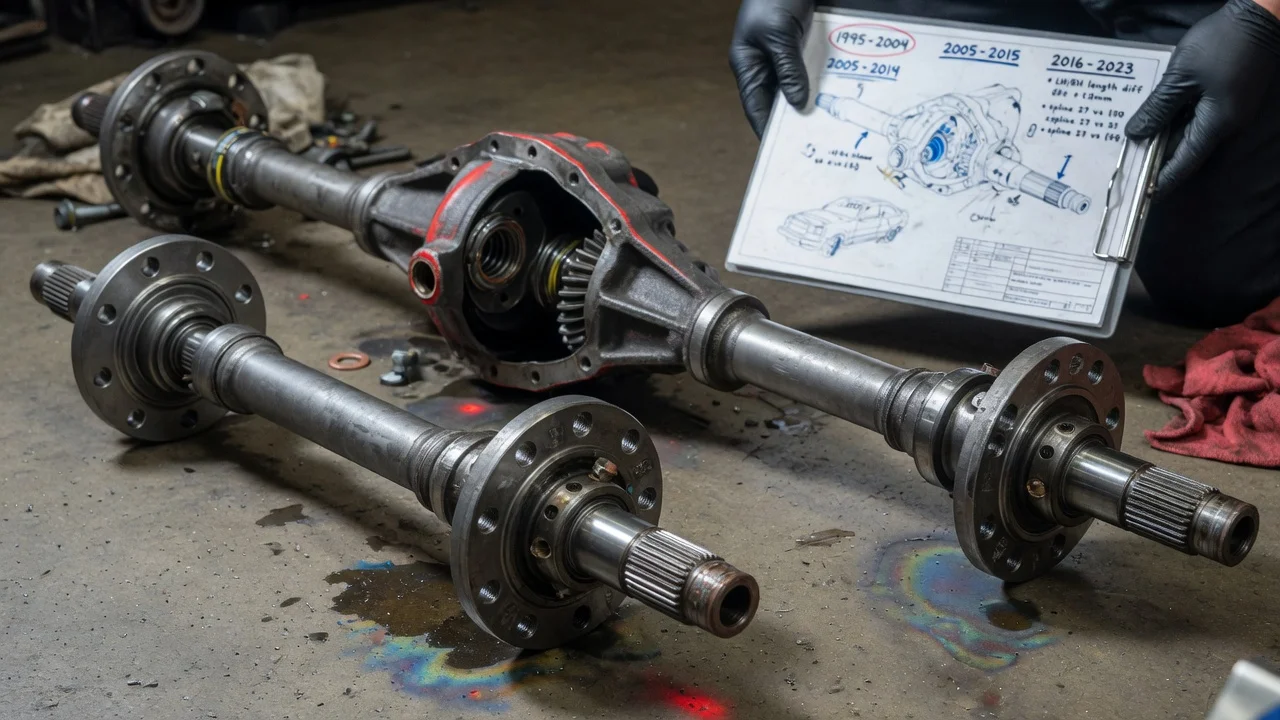
A rear axle shaft on a 2005 Toyota Tacoma is not a one-size part. The truck's year, drivetrain, wheel bolt pattern, differential option and the side of the vehicle all affect which shaft fits. Before ordering anything, confirm that the shaft is actually the failed component. Noise, leaks and wheel play near the rear hub often come from the bearing, seal, brakes or differential instead. This guide covers how to narrow it down and what to confirm before buying a replacement.
Establish the symptoms
Start by writing down what you notice and when it happens. Useful details include a growl or hum that rises with road speed, a noise that changes when you turn left or right, a clunk when you take off or shift between drive and reverse, gear oil on the inside of a rear tire or the backing plate, and rear brakes that grab, pull or feel weak. Note whether the problem started after towing, off-road use, a tire change, brake work or differential service. Recent changes like these often point straight to the cause.
Then pin down the exact vehicle configuration. The 2005 model year was the first year of the second-generation Tacoma. A 2003 Tacoma is a first-generation truck, so parts listed for it should not be assumed to fit a 2005 truck, and the reverse is also true. Within 2005 there are further differences. Two-wheel-drive and four-wheel-drive models differ, as do trims with different wheel bolt patterns and trucks with or without a factory rear locking differential. Left and right shafts are also different parts. The VIN, the trim, and the option labels or service records are the most reliable way to identify the assembly you have.
Distinguish plausible causes
The Tacoma rear axle is a semi-floating design. The axle bearing is pressed onto the shaft and held by a retainer, so shaft, bearing and seal problems tend to produce similar symptoms. Here is how the common causes usually show up. A worn axle bearing usually makes a speed-related growl that may change as weight shifts in turns, and it may allow wheel play. A leaking axle seal shows as gear oil on the backing plate, inside the brake drum or on the tire sidewall, often with no noise at all. A bent shaft can cause a vibration or wobble that tracks with wheel speed and may follow an impact or off-road incident. Worn splines or a broken shaft are more likely to produce clunking, a loss of drive at one wheel, or in serious cases a wheel that moves outward.
Competing explanations need to be ruled out too. Tire noise from cupped or uneven tread can sound like a bearing but often changes when the tires are rotated. Differential gear noise usually changes between acceleration and coasting rather than with steering. A clunk on takeoff can come from driveshaft joints, leaf spring mounts or worn differential components. Brake drum or shoe problems can mimic a dragging bearing. Evidence that supports an axle-end fault is noise or play concentrated at one corner. Evidence that weakens it is noise that stays the same regardless of load or side.
Checks in a useful order
Begin with observations that need no tools and no lifting. Park on level ground and look at the inside of each rear tire and the area behind the wheel for wet, dark residue or a gear oil smell. Check tire tread for uneven wear and confirm the lug nuts are tight. Then take a careful drive at moderate speed on a quiet road. Note whether the noise changes with speed, with gentle turns in each direction, or between accelerating and coasting.
The next checks require proper lifting equipment and supports rated for the truck. With the rear raised and the vehicle secured, grab the tire at the top and bottom and rock it to feel for play. Spin the wheel by hand and listen for roughness. Check the differential fluid level against the procedure in the factory service information. Removing the brake drum lets you see whether oil has reached the shoes and whether the backing plate area is wet.
Some tests belong with a qualified technician or a well-equipped home mechanic using the factory manual. These include measuring axle end play or runout against manufacturer specifications, pulling the shaft from the housing, and inspecting splines. Separating or installing a pressed axle bearing and retainer requires a hydraulic press and correct fixtures. Brake components contaminated with gear oil also need proper replacement rather than cleaning by guesswork.
Interpret the findings
A wet backing plate with no noise and no play points to a seal leak. It does not show that the shaft itself is damaged, although the bearing should still be inspected when the shaft is out. Roughness or play at one wheel supports a bearing fault, and the shaft surface at the bearing and seal area should be examined before choosing between a bearing-only repair and a complete shaft assembly. Measured runout beyond specification or a visible bend confirms a shaft problem. Feel and sight alone do not.
If the noise follows the tires after rotation, the axle is probably not the cause. If it changes mainly with throttle, the differential deserves closer inspection first. Before replacing any part, confirm the failed component and the exact side. Also confirm whether a replacement shaft comes with the bearing, retainer and seal already fitted, or whether those must be sourced and pressed on separately. Your service history may show earlier axle or differential work, and that can affect which parts are already in the housing.
Urgency and next action
Stop driving and arrange inspection or towing if any of the following happens: a rear wheel visibly moves outward or wobbles, a grinding noise appears suddenly, you hear repeated loud clunks with loss of drive, or gear oil has reached the brakes and braking feels uneven. A failing semi-floating axle can compromise wheel retention, and contaminated brakes reduce stopping ability. Do not rely on an estimate of how many miles remain. Operating conditions such as towing, heavy loads and off-road use make any existing fault progress less predictably.
For a correct repair or parts order, collect the following: the VIN, model year, two-wheel or four-wheel drive, cab and bed configuration, engine, wheel bolt pattern, whether a factory rear locker is fitted, and which side failed. Add a description of the symptoms, the results of your inspection, and any relevant service history. With this information a parts supplier or technician can match the shaft to your assembly. Without it, you risk buying a part listed for a different Tacoma generation or configuration.