Toyota Tacoma Rear Axle Bearing Tools: Checking Fit and Required Adapters
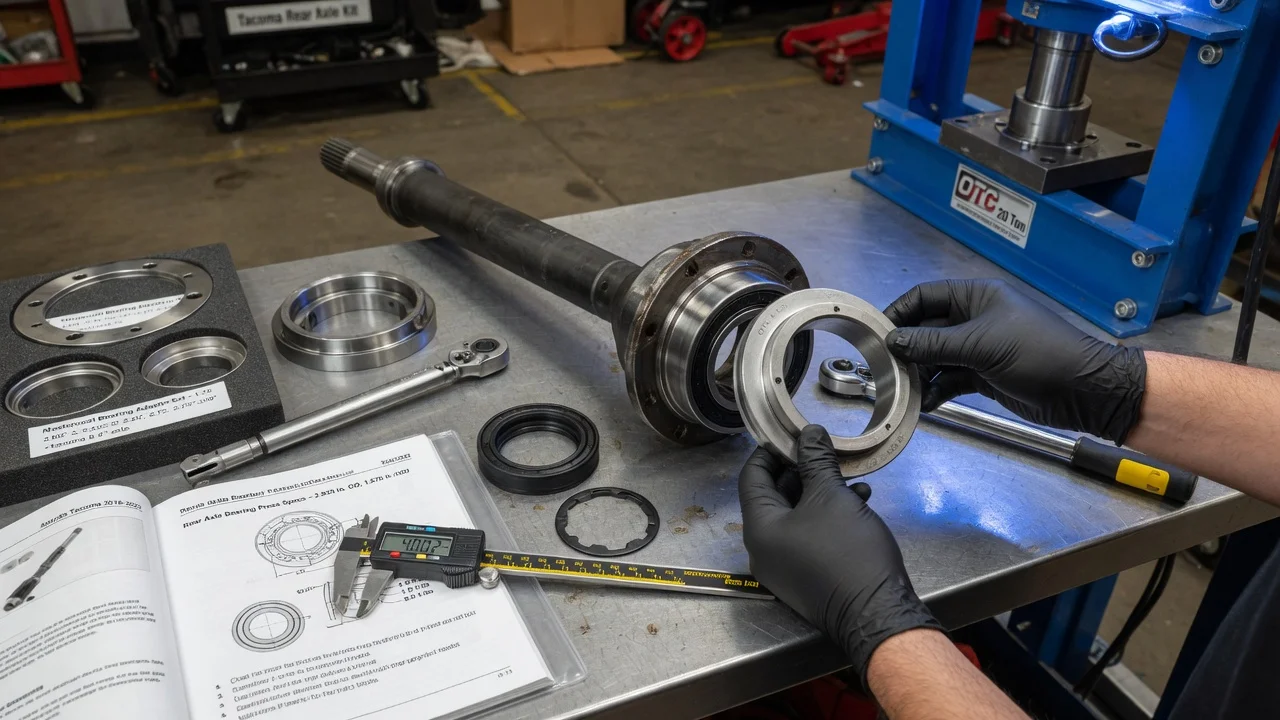
Before buying or renting a rear axle bearing removal tool for a Toyota Tacoma, confirm two things: that the noise or play really comes from a rear wheel bearing, and that the tool and its adapters match your truck. On a Tacoma, the rear bearing is typically pressed onto the axle shaft and held by a retainer. That means the job usually involves pulling the shaft out of the housing and then removing the bearing from the shaft. This guide covers symptoms, competing causes, checks and what each finding means for choosing tools.
Establish the symptoms
Start by writing down exactly when the problem appears. Note the speed range where a hum, growl or rumble starts, and whether it changes when you accelerate, coast or hold a steady speed. Note whether it gets louder in left or right sweeping turns. A bearing that is shifting load in a turn often changes pitch. Also record whether the sound follows road speed rather than engine speed, and whether you feel any vibration through the floor or seat.
Next, list anything that changed recently. Examples include new or rotated tires, a lift or leveling kit, wheel spacers, different wheels, brake work, heavy towing, or driving through deep water. Look for related signs: gear oil on the inside of a rear tire or on the backing plate, a brake that grabs or feels weak on one side, an ABS warning, or a clunk when the load shifts. Check the service history too, such as earlier bearing or seal replacement and differential fluid changes. These notes help separate a bearing fault from problems that only sound similar.
Distinguish plausible causes
A worn rear wheel bearing is one candidate, but not the only one. Bearing noise is usually tied to one side. It tends to rise with speed and change with cornering load, and it may come with play or roughness at that wheel. Tire noise from cupped, feathered or aggressive tread can sound almost the same. A strong clue is that the noise changes or moves after a tire rotation, which a bearing will not do.
Differential or pinion bearing wear is another common source. That noise usually seems to come from the center of the axle and changes between throttle and coast, not between left and right turns. A leaking axle seal does not make much noise on its own, but it can soak the brakes with gear oil and often appears alongside bearing wear. A dragging brake, a worn driveshaft U-joint or a failing carrier bearing can also cause humming or vibration. Each cause you rule out reduces the chance of buying tools you do not need.
Checks in a useful order
Some checks are safe for most owners. Inspect the tire tread for uneven wear and rotate the tires if the pattern suggests it, then see whether the noise changes. With the truck parked, look for oil streaks on the inner wheel, backing plate and brake parts. Confirm the lug nuts are tight. Using a stethoscope or listening device on a test drive with a helper is useful only if it can be done safely on a closed or quiet road.
The next checks require proper lifting equipment. Support the axle on rated jack stands on firm, level ground and chock the front wheels. Grip the tire at the top and bottom and rock it to feel for play. Then spin the wheel by hand and listen for roughness. Removing the drum or rotor lets you feel the axle flange directly and check for in-and-out movement. Measuring axle end play against manufacturer specifications, inspecting the differential, or tearing down the axle is work for someone with the service procedure and tools, or for a qualified technician.
Before ordering tooling, pin down your exact vehicle configuration. You need the model year and generation, two-wheel or four-wheel drive, rear brake type, wheel lug pattern, and how the ABS sensor is mounted. A slide hammer axle puller needs a flange adapter that bolts onto your lug studs. To remove the bearing from the shaft, you generally need a bearing separator that fits behind the bearing and a press with suitable plates. Installation requires a driver or sleeve that pushes only on the inner race. Some service procedures call for notching and splitting the retainer ring instead of pressing it off, so follow the instructions for your specific truck.
Interpret the findings
Roughness or play at one wheel, on the same side where the noise is loudest, points strongly to that rear bearing. Before blaming it, rule out loose retainer nuts or a damaged flange. Oil on the brakes or backing plate shows that a seal has failed. However, a leak alone does not prove the bearing is worn. Because the shaft must come out to reach either part, many owners replace the seal and bearing together and also replace any oil-contaminated brake linings. If both sides feel smooth and tight and the noise changed after a tire rotation, the tires are the likely source. A noise that changes between throttle and coast points toward the differential.
On the tooling side, a good fit means the puller adapter matches your stud pattern and thread, the separator fits the bearing without gouging the shaft, and the press has enough capacity for the job. If you do not have a press, a common option is to pull the shaft yourself and have a machine shop or repair shop press the bearing off and on. Renting a slide hammer and adapter set can also make sense for a one-time job. Whatever you choose, confirm the bearing and seal part numbers against your truck before anything is pressed.
Urgency and next action
Stop driving and arrange a tow if any of these appear: grinding that keeps getting louder, a hub that is clearly hotter than the other side, a visible wheel wobble, an axle that moves in and out, or gear oil soaking the brakes and reducing braking performance. A failed rear bearing can let the axle shaft shift in the housing, which affects both braking and wheel retention. No reliable remaining mileage can be promised once a bearing is noisy or loose. Base the decision on inspection results, not on time or distance alone.
Whether you do the work yourself or hand it to a shop, gather the following first: the VIN, model year, cab and drive configuration, rear brake type, the affected side, your symptom log including speeds, turns and load, and the relevant service history. With that information and the procedure for your truck, you can order matching bearings, seals and adapters in one pass. You can also decide whether you need a full axle puller and press setup or only the tools to pull the shaft before handing off the pressing step.