Toyota Camry Transmission Fluid Change: Requirements and Procedure
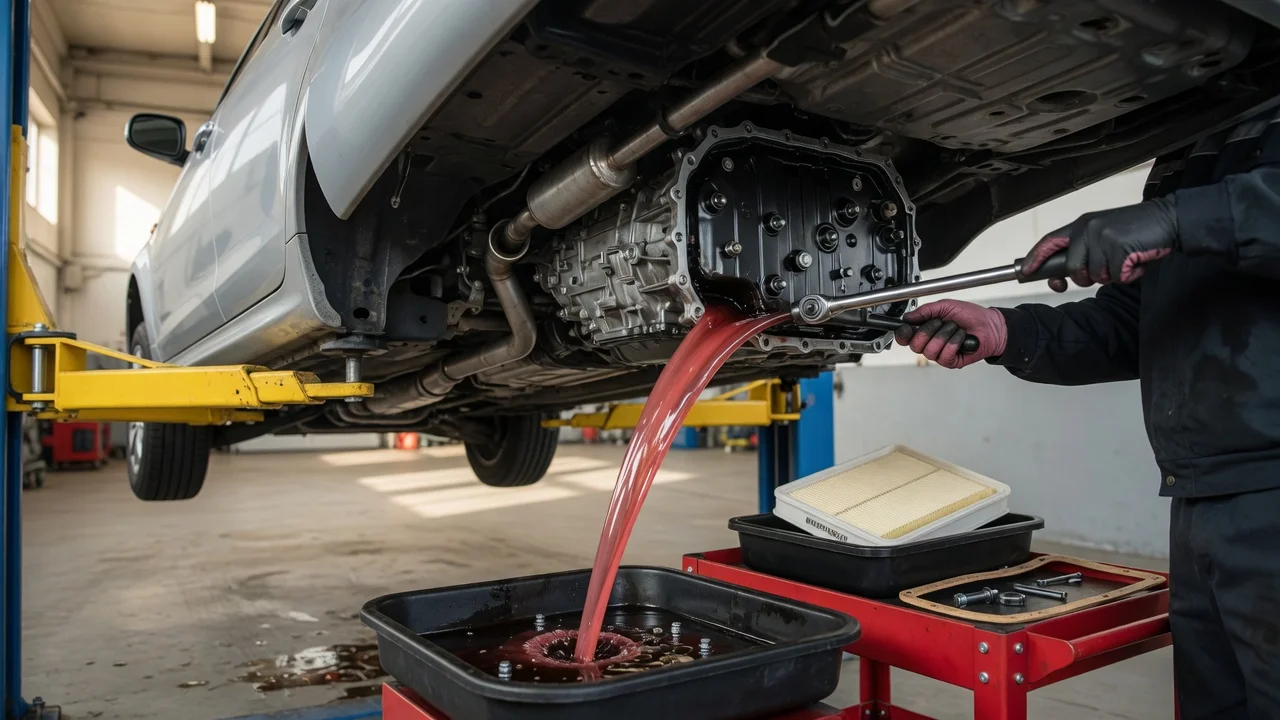
What a Camry transmission fluid change actually covers
A Toyota Camry transmission fluid change is a drain-and-fill of the automatic transmission or hybrid transaxle, using the fluid Toyota specifies for that model year and powertrain. It does not mean the same job on every Camry. Conventional automatics and hybrid transaxles use different hardware, fill methods, and service literature. Many later Camrys also lack a conventional dipstick, so the fluid level is set at an overflow plug with the fluid in a specified temperature range.
Toyota owner literature for many U.S. Camrys lists automatic transmission fluid as an inspection item rather than a single universal replacement mileage. Replacement is still a common ownership task in heat, stop-and-go use, towing, mountain driving, or high mileage. A shop power flush is a different service from a pan drain-and-fill; Toyota service procedures for these transmissions are built around drain, refill, and a temperature-correct level check, not a pressurized machine exchange unless a specific repair procedure says otherwise.
Requirements that change by year, generation, and powertrain
Confirm three facts from the owner’s manual, the under-hood or transaxle identification, and a Toyota repair procedure for that VIN before buying fluid or opening the pan: transmission or transaxle type, the exact fluid specification printed for that vehicle, and whether level is checked with a dipstick or an overflow plug. Those three facts control capacity, fill method, and whether a filter in the pan is part of the job.
Conventional automatic Camrys from the mid-2000s onward commonly specify Toyota ATF WS. Earlier four- and five-speed automatics often specified Type T-IV. Do not treat those as interchangeable.
Conventional automatic Camrys from the mid-2000s onward commonly specify Toyota ATF WS. Earlier four- and five-speed automatics often specified Type T-IV. Do not treat those as interchangeable.
Camry Hybrid uses an electronically controlled planetary transaxle rather than a conventional automatic. Fluid type is still the Toyota specification on the filler cap and in the manual for that year; it is not generic CVT fluid.
Camry Hybrid uses an electronically controlled planetary transaxle rather than a conventional automatic. Fluid type is still the Toyota specification on the filler cap and in the manual for that year; it is not generic CVT fluid.
Later Camrys, including many six- and eight-speed automatics, are filled as sealed units. There may be no dipstick. Level is set at an overflow or fill plug after the fluid reaches the temperature window in the repair procedure.
Later Camrys, including many six- and eight-speed automatics, are filled as sealed units. There may be no dipstick. Level is set at an overflow or fill plug after the fluid reaches the temperature window in the repair procedure.
A single pan drain removes only the fluid in the pan. A large share stays in the torque converter, cooler, and valve body. Repeat drain-and-fills after driving, or a pan drop with filter service where the design allows it, replace more of the sump charge. Exact refill volume is vehicle-specific and is not a universal Camry figure.
A single pan drain removes only the fluid in the pan. A large share stays in the torque converter, cooler, and valve body. Repeat drain-and-fills after driving, or a pan drop with filter service where the design allows it, replace more of the sump charge. Exact refill volume is vehicle-specific and is not a universal Camry figure.
Published drain, refill, and dry-fill capacities, drain-plug and pan-bolt tightening values, and the overflow temperature window were not supplied for a specific Camry in this guide. Use the figures in the Toyota repair procedure for that generation, engine, and transmission code. Guessing those numbers is how sealed units are overfilled or run low.
What you need before you start
Match the fluid to the vehicle first. Use Toyota-specified ATF, or an equivalent that explicitly lists the same Toyota specification on the container. Mixing Type T-IV, ATF WS, engine oil, or aftermarket CVT fluid in the wrong unit can cause harsh shifts, delayed engagement, or internal damage.
Owner’s manual or Toyota repair information for that year, engine, and transmission or hybrid transaxle.
Owner’s manual or Toyota repair information for that year, engine, and transmission or hybrid transaxle.
The specified ATF in a quantity at least equal to a pan drain, plus extra if you will repeat the drain or drop the pan.
The specified ATF in a quantity at least equal to a pan drain, plus extra if you will repeat the drain or drop the pan.
A drain pan large enough for hot ATF, the correct drain-plug washer if the plug is serviced that way, and a replacement pan gasket and filter if the procedure calls for dropping the pan.
A drain pan large enough for hot ATF, the correct drain-plug washer if the plug is serviced that way, and a replacement pan gasket and filter if the procedure calls for dropping the pan.
Jack and stands or a lift, with the vehicle level for the final level check. A slight tilt throws off an overflow-style fill.
Jack and stands or a lift, with the vehicle level for the final level check. A slight tilt throws off an overflow-style fill.
On sealed units, a way to read transmission fluid temperature as the Toyota procedure requires, plus the correct fill and overflow fittings. A dipstick-equipped earlier Camry still needs the engine idling and the shift lever cycled as the manual describes.
On sealed units, a way to read transmission fluid temperature as the Toyota procedure requires, plus the correct fill and overflow fittings. A dipstick-equipped earlier Camry still needs the engine idling and the shift lever cycled as the manual describes.
Work on a cold enough vehicle to handle fittings safely, then bring fluid to the specified check temperature before setting the level. Transmission fluid can be hot enough to burn. Support the car on stands; a jack alone is not enough. On a hybrid, follow Toyota high-voltage precautions if the procedure puts you near orange cabling or the transaxle electrical connector. If you cannot measure fluid temperature on a sealed unit, the level check is incomplete.
Drain-and-fill procedure
The sequence below is the standard Toyota-style service path for a Camry automatic or hybrid transaxle. Plug locations, whether a pan filter is serviceable, and the temperature-based overflow steps differ by generation. Stop and use the factory procedure at any step where the hardware on the car does not match this outline.
Identify the transmission or transaxle and the specified fluid. Photograph or note the current level method: dipstick, fill plug, or overflow plug.
Identify the transmission or transaxle and the specified fluid. Photograph or note the current level method: dipstick, fill plug, or overflow plug.
Warm the vehicle with a short drive so the fluid flows, unless the procedure for that unit says to drain cold. Do not open the system at full operating heat if you cannot handle hot ATF safely.
Warm the vehicle with a short drive so the fluid flows, unless the procedure for that unit says to drain cold. Do not open the system at full operating heat if you cannot handle hot ATF safely.
Raise and support the Camry so it will sit level for refill and level check. Place the drain pan under the transmission pan drain plug, or under the pan if you are dropping it.
Raise and support the Camry so it will sit level for refill and level check. Place the drain pan under the transmission pan drain plug, or under the pan if you are dropping it.
Remove the drain plug and let the pan empty. Inspect the fluid: dark brown or black fluid with a burnt smell is aged; metal flakes or clutch material beyond a light gray film on the magnet are a reason to stop and have the unit inspected rather than only refilling.
Remove the drain plug and let the pan empty. Inspect the fluid: dark brown or black fluid with a burnt smell is aged; metal flakes or clutch material beyond a light gray film on the magnet are a reason to stop and have the unit inspected rather than only refilling.
If the repair procedure includes pan removal, unbolt the pan, replace the filter and gasket as specified, clean the magnet, and reinstall the pan. Tighten pan bolts in a crossing pattern to the Toyota value for that pan. Do not use a made-up torque figure.
If the repair procedure includes pan removal, unbolt the pan, replace the filter and gasket as specified, clean the magnet, and reinstall the pan. Tighten pan bolts in a crossing pattern to the Toyota value for that pan. Do not use a made-up torque figure.
Reinstall the drain plug with a new sealing washer if that is how the plug is designed. Tighten it to the specified value from the repair procedure.
Reinstall the drain plug with a new sealing washer if that is how the plug is designed. Tighten it to the specified value from the repair procedure.
Refill through the dipstick tube or the designated fill port with the same specification ATF you drained, starting with a volume close to what came out. On a sealed unit, fill until fluid begins to drip from the overflow only after the procedure’s temperature window is reached, with the engine running if Toyota requires it.
Refill through the dipstick tube or the designated fill port with the same specification ATF you drained, starting with a volume close to what came out. On a sealed unit, fill until fluid begins to drip from the overflow only after the procedure’s temperature window is reached, with the engine running if Toyota requires it.
With the engine idling and the brake applied, move the shifter slowly through each range and return to Park or Neutral as the procedure states. This fills passages and the torque converter.
With the engine idling and the brake applied, move the shifter slowly through each range and return to Park or Neutral as the procedure states. This fills passages and the torque converter.
Set the final level. Dipstick units are checked on level ground at the temperature the manual names, typically with the engine idling. Sealed units are checked at the overflow with fluid in the published temperature band; fluid should drip, not pour. Overfill is as harmful as a low level.
Set the final level. Dipstick units are checked on level ground at the temperature the manual names, typically with the engine idling. Sealed units are checked at the overflow with fluid in the published temperature band; fluid should drip, not pour. Overfill is as harmful as a low level.
Shut the overflow or fill port, lower the vehicle, and inspect the pan, drain plug, and cooler lines for leaks. Road-test through upshifts and kickdown, then recheck level and leak points after the fluid is hot.
Shut the overflow or fill port, lower the vehicle, and inspect the pan, drain plug, and cooler lines for leaks. Road-test through upshifts and kickdown, then recheck level and leak points after the fluid is hot.
Completion check: the correct specification fluid is in the unit, the level is set by the method that transmission uses, there are no leaks, engagement into Drive and Reverse is prompt, and shifts are no worse than before the service. Harsh shifts, delayed engagement, or a whistling or grinding noise after a fill usually mean the level is wrong, the fluid type is wrong, or the unit already had internal wear. Do not keep driving in those conditions without a recheck.
When the job belongs in a shop
Use a Toyota dealer or an independent shop with the factory procedure and a scan tool that can display transmission fluid temperature when the Camry is a sealed automatic or hybrid transaxle and you cannot complete the temperature-based overflow fill. The same boundary applies if the pan is damaged, the drain plug is rounded, fluid is heavily contaminated with metal, or the car already slips, flares, or stores transmission fault codes. Changing fluid will not repair worn clutches, a failing valve body, or a leaking cooler.