Toyota Camry Check Engine Light: Causes and Next Steps
What the light means
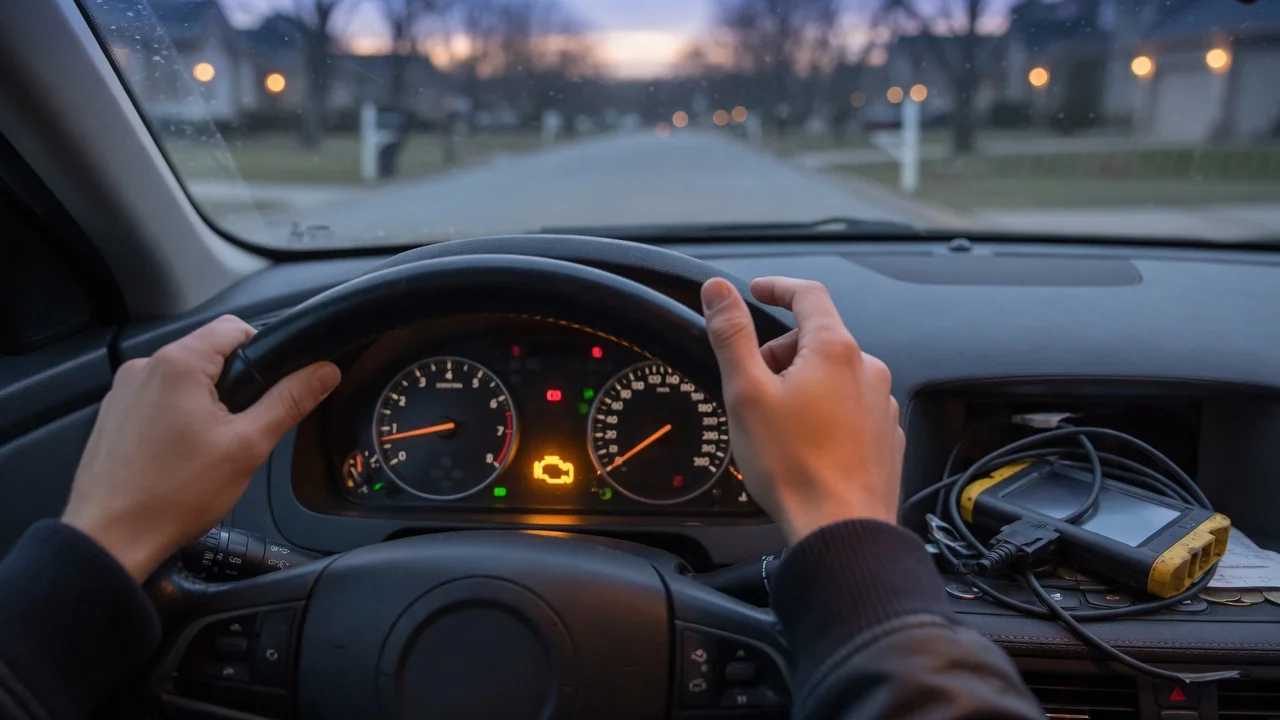
A check engine light on a Toyota Camry is the malfunction indicator lamp. It means the engine control module has stored at least one emissions-related diagnostic trouble code and has judged a monitored system to be outside its expected range. The lamp identifies that a fault is stored. It does not identify a failed part by itself.
This guidance applies to OBD-II Camrys sold for the U.S. market from the 1996 model year onward, including four-cylinder, V6, and hybrid powertrains. Pre-1996 Camrys used an earlier diagnostic approach and may not present or store faults in the same way. On hybrid Camrys the check engine lamp still covers the gasoline engine, exhaust, evaporative-emissions, and related sensors. A separate hybrid-system warning covers the high-voltage drive system and is a different lamp.
How the lamp behaves
The same amber engine silhouette can mean three different conditions. Read the behavior first, then decide whether the car can stay in service.
Lamp behavior What it indicates Immediate action; Comes on at key-on, then goes out after start Normal bulb check No stored-fault indication from this cycle alone; Stays on or comes on while driving and remains steady A confirmed emissions-related fault is stored Drive with care, note other symptoms, plan diagnosis; do not ignore it; Flashes while the engine is running Active misfire that can overheat and damage the catalytic converter Reduce load, avoid hard acceleration and high speed, and arrange diagnosis promptly; Comes on with reduced power, rough running, or stalling The fault is affecting combustion or airflow now Limit driving; stop if the engine knocks, overheats, or will not stay running
A flashing lamp is the condition that most often requires you to stop using the car as you normally would. Continued misfire can send unburned fuel into the converter. A steady lamp with otherwise normal driving is still a stored fault and can affect emissions inspection, fuel use, and later repair cost if the underlying condition worsens.
What commonly turns the light on
Most Camry check-engine events fall into a short list of monitored systems: evaporative emissions, air-fuel control, ignition, catalyst efficiency, and sensor or wiring faults. A stored code is evidence that a monitor failed a test. It is not proof that a named part has failed, because several parts can set the same code.
Fuel cap and evaporative-emissions leaks
A loose, missing, cracked, or poorly sealing fuel cap is a frequent trigger after refueling. The evaporative-emissions (EVAP) system looks for a sealed fuel tank. Typical stored codes in this family include P0440, P0441, P0442, P0455, and P0456. A large leak (often P0455) can follow a cap left loose. A small leak (often P0456) can come from the cap seal, a cracked hose, a purge or vent valve, or the charcoal canister.
Check that the cap is present, the tether is intact, and the cap clicks through its ratchet when tightened. Inspect the rubber seal for flattening, cracks, or fuel residue. If the lamp appeared right after filling the tank and the engine otherwise runs normally, reseat or replace the cap, then see whether the lamp clears after several drive cycles. Persistence after a known-good cap points to the rest of the EVAP circuit, which needs a smoke test or equivalent leak check rather than parts replacement by guess.
Air-fuel ratio and oxygen sensors
Camrys use an upstream air-fuel ratio sensor and a downstream oxygen sensor on each monitored bank. The upstream sensor helps the computer set fuel delivery. The downstream sensor checks catalyst function. Age, exhaust leaks, oil or coolant contamination, and wiring damage near heat shields can set sensor-circuit, heater, or fuel-trim codes (examples include P0138, P0141, P2195, P0171, and P0172).
An exhaust leak ahead of the upstream sensor can pull in extra air and mimic a lean mixture. A sensor code after a recent converter or exhaust repair often traces to a pinched wire or a connector left unseated. Do not replace a sensor solely because a catalyst code is stored; the downstream sensor may be reporting converter efficiency, not its own failure.
Catalytic converter efficiency
Code P0420 (catalyst system efficiency below threshold, Bank 1) is one of the more common long-term Camry codes, especially on higher-mileage four-cylinder cars. It means the downstream sensor’s switching pattern looks too much like the upstream pattern, so the converter is no longer storing oxygen as designed. Causes include a converter that has aged out, a converter damaged by misfire or oil consumption, an exhaust leak between the converter and sensors, or a downstream sensor that is slow.
Some 2007–2011 Camry 2.4-liter 2AZ-FE engines had elevated oil consumption in a subset of vehicles. Chronic oil burning can foul spark plugs and contaminate the converter, after which P0420 or misfire codes appear. That pattern is generation-specific and does not describe every Camry. Confirm oil use with a documented consumption check before assuming the converter is the only failed part.
Misfire: plugs, coils, and injectors
Random or cylinder-specific misfire codes (P0300 and P0301 through P0304 on four-cylinder engines; through P0306 on V6) mean one or more cylinders are not contributing as expected. Observable signs include a rough idle, a shudder under load, a flashing lamp, and a sudden drop in fuel economy. Likely contributors are worn spark plugs, a failed ignition coil, a clogged or leaking injector, low compression, or a vacuum leak at that cylinder.
Plug type, gap, and replacement interval vary by engine family and model year. The 2AR-FE 2.5-liter (roughly 2012–2017 in many markets), the 2GR-FE V6, and the later A25A-FKS 2.5-liter Dynamic Force engine do not share the same plug service specification. Use the interval and part type in the owner’s manual or underhood emissions label for that vehicle. Coil-on-plug designs can fail one cylinder at a time; swapping a coil to another cylinder and rechecking which code follows the coil is a standard isolation method when a scanner is available.
Airflow, vacuum leaks, and the mass airflow sensor
Unmetered air after the mass airflow (MAF) sensor, a dirty MAF element, a split intake hose, or a stuck positive crankcase ventilation (PCV) valve can lean the mixture and set fuel-trim or idle codes. A whistle, hiss, or idle that hunts after a cold start points toward a vacuum leak. Oil film on the MAF is more likely on engines that consume oil or after an overfilled oil change. Cleaning a MAF is only appropriate with a cleaner made for that sensor; other solvents can damage the element. Freeze-frame data showing high long-term fuel trim at idle, with trim nearer normal at cruise, often supports a vacuum leak rather than a failing fuel pump.
Coolant temperature and thermostat influence
If the engine stays below normal operating temperature, the computer may keep fuel enrichment higher than intended and set a thermostat or coolant-temperature code such as P0128. A gauge that never reaches the usual mark, weak cabin heat, and a lamp that returns in cool weather are consistent with a thermostat stuck open. A temperature sensor that reads implausibly hot or cold can set the lamp without a true overheating event. Overheating itself is a stop-driving condition whether or not the check engine lamp is the first warning.
Wiring, connectors, and aftermarket equipment
Heat-cycled exhaust-sensor harnesses, rodent damage in the engine bay, and poorly grounded aftermarket remote-start or audio equipment can set intermittent codes that appear and disappear. An intermittent lamp with no drivability complaint often deserves a visual harness inspection before any sensor is replaced. Recent collision repair, oil-pan work, or exhaust replacement is also a reason to look at connectors first.
What to check next, in order
Work from what you can observe without tools toward a stored code and freeze-frame data. Stop at professional diagnosis when the lamp is flashing, when the engine is unsafe to run, or when a code points at catalyst, fuel, or internal-engine work you are not equipped to confirm.
Note when the lamp came on: after refueling, after a cold start, under hard acceleration, in rain, or with no obvious event. Write down any extra symptoms: rough idle, loss of power, fuel smell, ticking, overheating, or a change in fuel use. Look at the lamp itself. Flashing means reduce engine load and arrange prompt service. Steady with normal running still needs a code read, but the car can usually be driven a short distance to a shop. Check the fuel cap: present, seated, and ratcheted tight, with an intact seal. Confirm the filler neck is not damaged. Look under the hood for obvious problems only: disconnected vacuum or intake hoses, a loose electrical connector, fluid leaks, a very low oil level, or a coolant level that has dropped. Do not probe running belts or the cooling fan. Low oil on a 2AZ-FE 2.4-liter is especially worth documenting because oil use can cascade into misfire and converter damage. Confirm other warning lights. A red oil-pressure or temperature warning overrides the check engine lamp: shut the engine down. A hybrid-system warning is a separate path from the check engine lamp. Read the diagnostic trouble codes with an OBD-II scan tool. Record every stored and pending code and the freeze-frame snapshot (engine speed, load, coolant temperature, fuel trims, and whether the engine was warm). Treat those codes as the investigation list, not as a parts list. Match the code family to the checks above. EVAP codes start at the cap and leak path. Misfire codes start at plugs, coils, and fueling for the named cylinder. P0420 starts with exhaust leaks and upstream misfire or oil consumption history, then converter and downstream sensor function. Lean codes start at intake leaks and MAF/fuel delivery. Do not clear codes until you have recorded them, unless a technician needs a clean slate after a confirmed repair. Clearing the lamp without a repair can erase freeze-frame data and reset inspection monitors. After a real repair, the lamp may take several drive cycles to go out on its own. Inspection-readiness monitors must complete before many emissions tests will pass, even if the lamp is dark.
When to stop driving and when to see a shop
Stop as soon as it is safe if the lamp is flashing and the engine is shaking, if power falls off sharply, if there is a strong fuel smell, if the engine overheats, or if oil pressure is lost. A converter that is already overheating from misfire can create extra heat under the floor. Continued driving in that state can turn a coil or plug job into converter replacement.
Professional diagnosis is the right next step when codes point to the converter, the EVAP canister and valves, internal engine mechanical wear, hybrid-related engine controls, or when you have a misfire that does not follow a swapped coil. Shops confirm cause with smoke testing, fuel-pressure testing, relative compression or power-balance tests, and live sensor data. Replacing a part because it is named in a code description is a common path to a repeat lamp.
Model-year and powertrain qualifications
Exact sensors, coil layout, and EVAP hardware change across Camry generations. A 1997–2001 XV20, a 2002–2006 XV30, a 2007–2011 XV40, a 2012–2017 XV50, an 2018–2024 XV70, and the current generation do not share one parts list. Four-cylinder and V6 cars store bank-specific catalyst and sensor codes differently because the V6 has two banks. Hybrid models add engine start-stop and intake control behavior that can confuse a generic scanner interpretation if freeze-frame context is ignored.
Service campaigns, warranty enhancements, and technical service bulletins exist for some Camry engines and model years, including oil-consumption coverage on a subset of 2.4-liter vehicles. Whether a given VIN is included is a dealer or manufacturer-records question and is not assumed here. Plug gap, coil torque, fuel-cap part number, and monitor-enable criteria are likewise vehicle-specific; use the service information for that year, engine, and market rather than a generic value.
What this guide cannot settle from the lamp alone
A check engine light does not report remaining converter life, exact fuel-trim numbers, or whether a sensor or the part it monitors has failed. Those answers require the stored code, freeze-frame data, and follow-up tests. Failure-rate comparisons across Camry generations are not included here because they need a defined sample. Tightening values, fluid specifications, and plug gaps are omitted because they must come from the manufacturer information for the specific engine. If the lamp is on and you cannot read codes, the supported next action is a code scan, beginning with the fuel cap and any flashing-lamp or overheating precautions above.