Toyota 4Runner Rear Axle Shafts: Checking Third-Generation Fitment
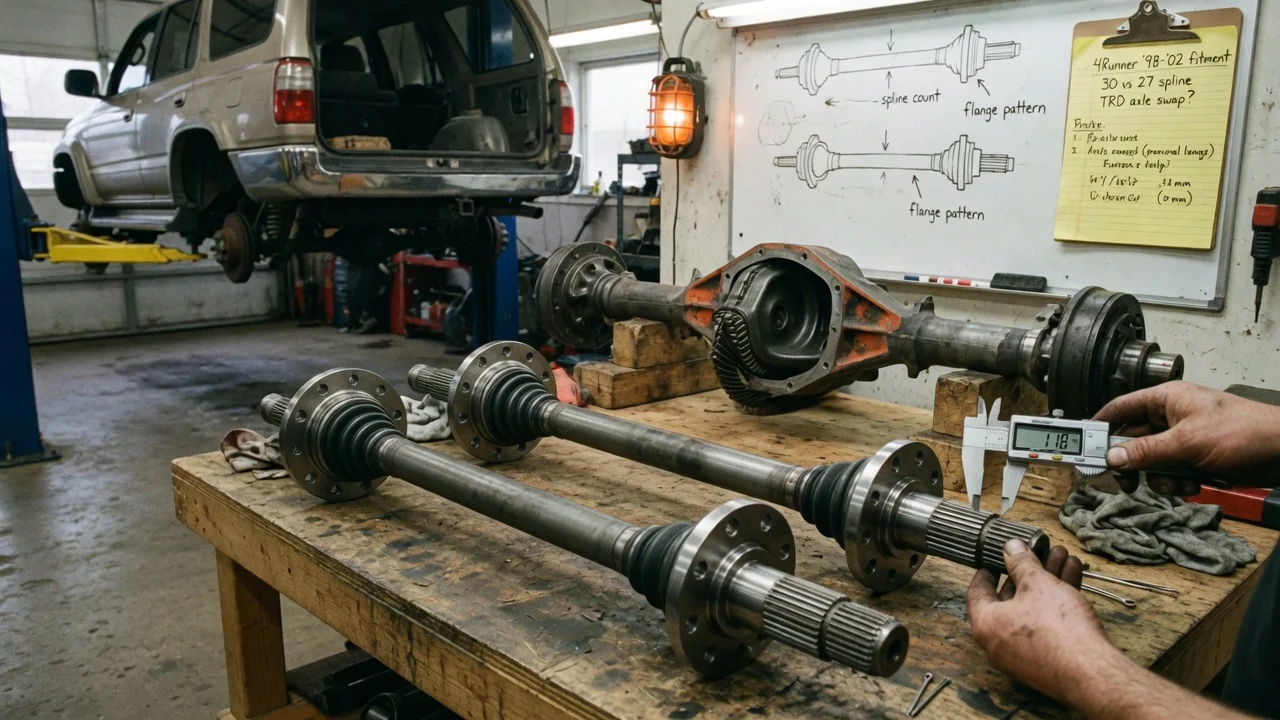
On a third-generation Toyota 4Runner, the rear axle shaft supports the wheel and carries the rear wheel bearing and axle seal. Because of that, a problem in that corner can look like several different faults. Before ordering a replacement 4Runner rear axle shaft, confirm what is actually failing and which part matches your exact vehicle configuration. This guide covers symptoms, likely causes, checks and the details a parts supplier or technician will need.
Establish the symptoms
Start by writing down when the problem appears. Note whether a noise is a hum, growl, grind or click, and whether it follows road speed or engine speed. Note whether it differs between accelerating and coasting, and whether it changes when the vehicle leans into a left or right turn. These details help separate wheel end faults from differential and driveline noise later.
Then record the signs you can see and feel. These include gear oil on the inside of a rear tire or the backing plate, rear brakes that grab or feel contaminated, an ABS warning light, vibration, or a wheel that feels loose. Add recent changes to the list, such as brake work, a differential service, a lift, larger tires, towing or off-road use. This service history often explains more than the symptom alone.
Distinguish plausible causes
A worn rear wheel bearing is a common reason to look at the axle shaft. On this semi-floating axle design, the bearing is typically pressed onto the shaft and held by a retaining collar. A steady growl that rises with speed and changes with cornering load supports a bearing fault. Noise that stays the same in left and right turns, but changes between acceleration and coasting, weakens that theory and points toward the differential or driveline.
Oil at the wheel end usually means a failing axle seal. However, the seal may be leaking for other reasons: a worn bearing, a damaged sealing surface on the shaft, or an overfilled or poorly vented differential. Fresh oil with no bearing noise and no play supports a seal-only problem. Oil combined with roughness or play suggests the leak is a consequence rather than the root cause.
A bent shaft, worn splines or a damaged ABS sensor ring are less common. They become more likely after an impact, heavy off-road use or a previous repair. Several signs support these causes: vibration that persists after the wheel is balanced, a brake drum or flange that visibly wobbles when spun, or an ABS fault tied to one rear wheel. A clean, quiet wheel end with no play makes a shaft fault unlikely.
Checks in a useful order
Begin with checks that need no disassembly. With the vehicle parked on level ground, inspect the inner sidewall of each rear tire, the backing plate and the axle housing ends for oil. Check the differential fluid level if you can reach the fill plug, and look for a blocked vent. On a road test, note whether the noise changes with speed, load and steering direction. Stop testing if a sound is metallic or the vehicle pulls under braking.
Checking for wheel play requires lifting the rear with a proper jack and supporting it securely on stands. Grip the tire at the top and bottom and rock it, then spin it by hand and listen for roughness. Any noticeable play needs further confirmation. Measuring axle flange runout requires a dial indicator and the manufacturer specifications for your model year. Diagnosing an ABS fault requires a scan tool that can read wheel speed data.
Removing the shaft means taking apart the rear brake assembly, unbolting the bearing retainer and, where fitted, disconnecting the ABS sensor. Pressing a bearing and retaining collar on or off the shaft requires a hydraulic press and correct support. It is not a safe job to improvise with heat or a hammer. Without those tools, have a qualified technician handle the removal and inspection.
Interpret the findings
Each finding answers a narrow question. Oil at the wheel end confirms a leak but not why it started. Play or roughness at the hub confirms a wheel end problem, but it does not by itself prove the shaft is bad. A new bearing, seal and retainer may be all that is needed. The shaft itself becomes a clear candidate if any of these apply: the splines are worn, the bearing journal or seal surface is scored, the sensor ring is damaged, or runout exceeds the specification.
Before buying a replacement, confirm fitment against your actual vehicle configuration, not just the model name. Third-generation 4Runners were built with different drivetrains, trims and equipment, and options such as a factory rear differential lock or ABS can affect which shaft and related parts apply. Use the VIN and production date, and check whether the listing is side-specific. Compare the old shaft with the new part: length, spline count, flange and stud pattern, and sensor ring.
Also check what the part includes. Some shafts are sold bare, while others come with the bearing, retainer and seal already installed. A used shaft from a salvage vehicle deserves the same inspection as yours, since it may carry the same wear. If measurements or part numbers do not line up, resolve the mismatch before installation.
Urgency and next action
Stop driving and arrange a tow if you notice any of these signs: a rear wheel feels loose, the wheel or brake assembly appears to be moving outward, there is grinding with heat or smoke from the wheel end, or the brakes are soaked with oil and braking feels weak or uneven. On a semi-floating axle, a failed bearing retainer or broken shaft can let the shaft and wheel move out of the housing. Once these signs appear, no remaining distance can be considered safe.
For a minor leak or mild noise, book an inspection soon rather than waiting for it to worsen. Bring the following: • VIN and model year; • Drivetrain, and whether the vehicle has a rear differential lock; • Which side is affected; • When the symptom occurs; • Recent service history; Photos of any leak help a supplier or technician confirm the correct replacement the first time. So does the old part number, if the shaft has already been removed. If oil was lost, ask for the differential fluid level to be checked and corrected after the repair.