Torque Wrench for Car Battery Terminals: What You Need to Know
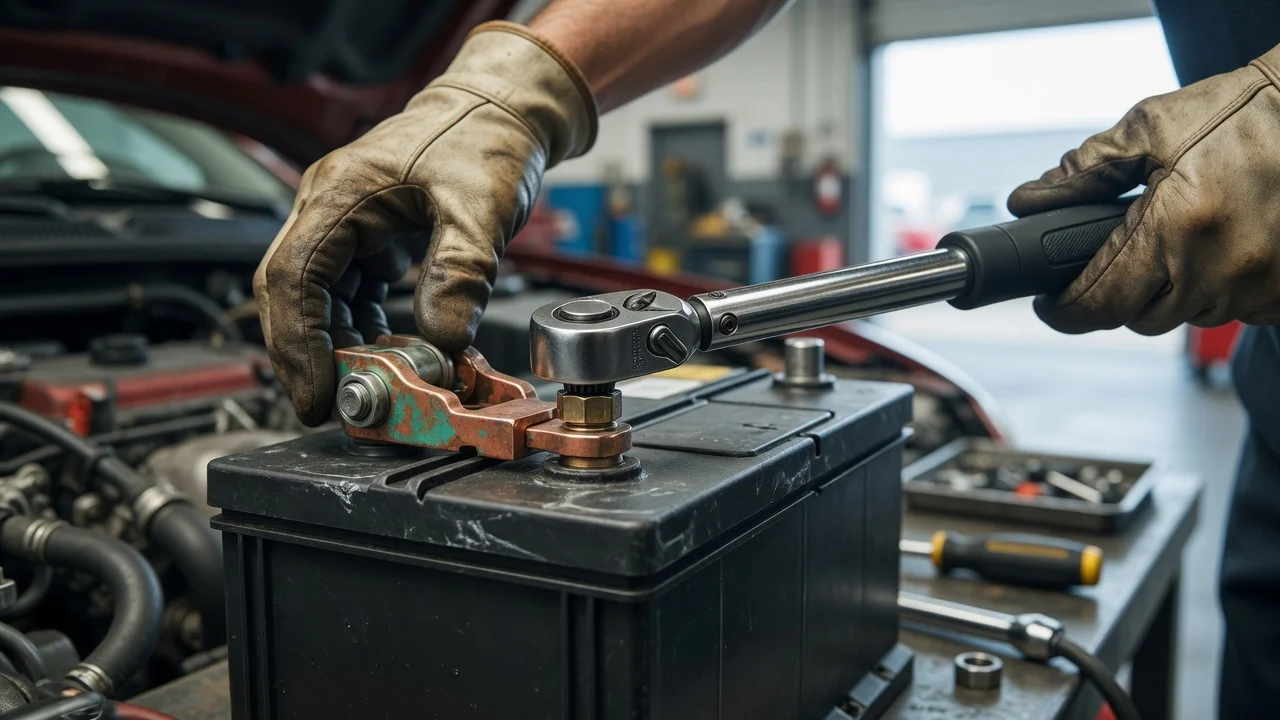
Immediate Answer
Yes, you can use a torque wrench on car battery terminals, but it is not required for most passenger vehicles. Most battery terminal fasteners are tightened by hand with a standard wrench or socket to a snug, firm fit. A torque wrench becomes useful when the battery or vehicle manufacturer specifies a narrow torque range, or when you want to avoid overtightening soft lead terminals. The answer changes if you are working on a vehicle with a battery monitoring sensor, a side-post battery, or a terminal design that uses a bolt with a specific clamp load requirement.
Typical Torque Values for Battery Terminals
Many automotive battery terminal nuts are tightened to a torque between roughly 4 and 8 newton-meters, or about 35 to 70 inch-pounds. Some side-post battery bolts fall in a similar low range. These values are general guidance, not a substitute for a service manual. When a specific value is not published, the practical goal is to make the connection tight enough that the terminal cannot rotate or lift by hand, without crushing the battery post or deforming the clamp.
When a Torque Wrench Helps
A torque wrench is most helpful when the battery post is lead and the terminal clamp is relatively soft. Overtightening a standard top-post clamp can strip the threads, crack the clamp, or distort the post into an oval shape. A small 1/4-inch drive torque wrench with an inch-pound scale gives finer control in this low range than a large 1/2-inch drive foot-pound wrench. If you already have only a foot-pound wrench, it may not read accurately at the bottom of its scale, so a hand wrench may be the safer tool.
Choosing a Torque Wrench for This Job
For battery terminals, a 1/4-inch drive click-type or beam-type torque wrench calibrated in inch-pounds is the most practical option. The drive size matches common small sockets used on 8 mm, 10 mm, or 5/16 inch terminal nuts. Before buying, check the tool's stated working range. The useful range for battery terminals is roughly 30 to 80 inch-pounds, and a wrench should not be used below or above its rated span. A digital torque adapter can also work if it fits the available access space around the battery tray.
Procedure and Precautions
Disconnect the negative terminal first and reconnect it last when doing battery work. Clean the post and clamp with a battery terminal brush so the mating surfaces are smooth and free of corrosion. Place the clamp fully over the post, not tilted or sitting on top of the post taper. Run the nut down by hand, then tighten in small increments, alternating between the two sides of a split clamp when present. If using a torque wrench, set it to the specified value and stop when it clicks or reads the target. After tightening, try to twist the terminal by hand. A properly seated terminal should not move.
Common Mistakes
Using a foot-pound torque wrench at the very bottom of its range, where accuracy is poor. Assuming all battery terminal bolts need the same torque. Check the vehicle service information for the exact value. Tightening a warm or hot terminal and then rechecking it later when cold, which can produce a false sense of tightness. Overtightening because a connection was loose for another reason, such as corrosion between the post and clamp. Using an impact wrench or a long breaker bar, which makes it easy to exceed the low torque needed here.
What to Do Without a Torque Wrench
If no torque specification is available and you do not have a torque wrench, use a short-handled combination wrench or a 1/4-inch ratchet. Tighten until the clamp is snug and the terminal cannot be rotated by hand with moderate force. Then recheck the connection after a short drive. A loose terminal commonly causes slow cranking, dim lights, or an electrical cutout, while an overtightened one may show a cracked clamp or a post that has been pressed out of shape.
Evidence Gaps
Exact torque specifications vary by vehicle make, model, year, and battery type. This article does not list model-specific values because none were supplied. Treat the general ranges here as orientation only. If your battery has a current sensor integrated into the negative terminal, follow the manufacturer's tightening procedure because the sensor clamp is often more fragile than a plain cable lug. For unresolved differences between sources, the vehicle service manual is the controlling reference.