Tire Pressure Gauge Brands Compared: Craftsman, Snap-on, Etenwolf, Dill and More
Immediate Answer: What Tire Pressure Gauge Should You Consider?
There is no single best tire pressure gauge for every driver. The right choice depends on where you use it, how often you check pressures, and whether you prefer a digital, dial or pencil design. For a shop-grade digital gauge, Snap-on and its Blue Point line are widely regarded for durable construction but carry high prices. Craftsman offers more accessible digital, dial and programmable options for home use. Etenwolf and Slime provide affordable digital gauges with backlit displays and common valve compatibility. Dill, Milton and Haltec are strong choices for traditional pencil and dial gauges, especially where a simple, serviceable tool is preferred. If the main need is a quick regular check at home, a mid-priced digital gauge from Craftsman, Slime or Etenwolf is usually sufficient. If the gauge will live in a professional toolbox and see daily use, a Snap-on, Matco, Cornwell or Blue Point tool may justify the added cost.
What to Look for in a Tire Pressure Gauge
Tire pressure gauges measure air pressure in pounds per square inch, usually abbreviated psi. Most passenger car and light truck tires call for pressures in the 30 to 40 psi range when cold, but the correct number is printed on the vehicle placard, typically in the driver door jamb, not on the tire sidewall. A good gauge should be easy to seat on the valve stem without leaking air, easy to read in low light, and consistent across repeated measurements. Accuracy matters more than brand name. A gauge that reads within about 1 to 2 psi of the true pressure is adequate for routine use. For performance driving, towing or professional work, a gauge with repeatable readings and a more precise scale is worth the extra cost.
Digital Tire Pressure Gauges
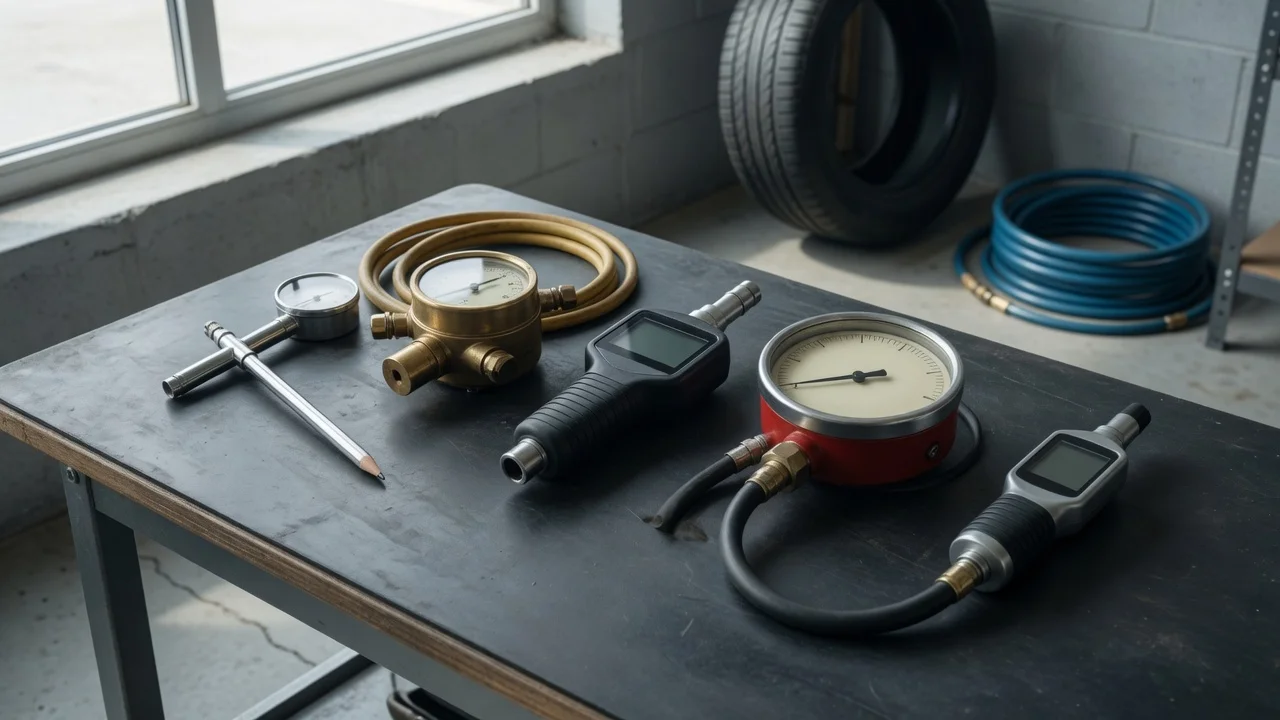
Digital gauges display pressure on an LCD or LED screen. They are generally easier to read than dial or pencil gauges, especially in the dark. Many run on coin-cell or AAA batteries and automatically shut off after a period of inactivity. Digital gauges from Etenwolf, Slime, Craftsman, Snap-on, Matco, Cornwell and Blue Point usually read in 0.5 psi increments or finer. Some also switch between psi, bar, kPa and kg/cm2. A backlit display is useful when checking tires at night or in a shaded garage.
Dial Tire Pressure Gauges
Dial gauges use a needle and a circular scale. They often include a flexible hose between the chuck and the gauge body, which makes it easier to hold the chuck on the valve stem while reading pressure. Blue Point, Milton, Dill and Haltec offer dial gauges in various ranges. Dial gauges do not need batteries, but the mechanical movement can be damaged by dropping or by moisture. A rubber boot or bumper around the dial helps protect the gauge in a glovebox or toolbox.
Pencil and Stick Tire Pressure Gauges
Pencil gauges are inexpensive, compact and require no batteries. When pressed onto the valve stem, a calibrated rod extends from the body to show pressure. Milton, Dill, Haltec and CZC Auto make pencil gauges in different pressure ranges. They are convenient as a backup tool, but the scale is harder to read precisely than a digital display or a large dial. Some include a bleed button to release small amounts of air while the gauge is still attached.
Craftsman Tire Pressure Gauges
Craftsman sells digital, dial and pencil tire pressure gauges. The Craftsman digital lineup includes compact gauges that read in psi and often include an angled chuck or a swivel head for easier access to valve stems. Some Craftsman digital gauges are programmable, allowing the user to set a target pressure and receive an alert or reference point when that pressure is reached. A commonly cited example is the Craftsman programmable digital tire pressure gauge, which is intended to simplify checking all four tires to the same value. The Craftsman 100 psi digital gauge is suited to passenger cars, light trucks and SUVs operating at ordinary street pressures. Craftsman dial gauges offer a traditional option without batteries, while the brand's pencil gauges work as an inexpensive backup. Availability varies by retailer, and the warranty may depend on where the tool was purchased.
Snap-on and Blue Point Tire Pressure Gauges
Snap-on tire pressure gauges are aimed at professional technicians and serious enthusiasts. The digital versions often feature a durable housing, an easy-to-read display and a chuck designed for repeated daily use. Snap-on tools are generally sold through franchise dealers, which affects availability and price. Blue Point is a Snap-on-owned brand that offers many of the same tool designs at a somewhat lower cost. Blue Point digital, dial and pencil gauges are common in automotive shops. A Blue Point dial tire pressure gauge is a practical choice for mechanics who prefer an analog readout. The main trade-off is cost: Snap-on and Blue Point gauges are expensive compared with retail brands, and the added precision may not be necessary for a driver who checks tires once a month.
Matco and Cornwell Tire Pressure Gauges
Matco and Cornwell are tool-truck brands serving professional technicians. Matco digital tire pressure gauges and Cornwell digital tire pressure gauges are built for shop use and tend to be priced accordingly. Like Snap-on, these gauges are usually purchased from a mobile dealer. The practical advantage is serviceability and replacement support through the tool dealer. For a home user, the same budget can often buy a capable gauge from a retail brand and leave money for other maintenance items.
Etenwolf Tire Pressure Gauges
Etenwolf is a lower-cost digital gauge brand. The Etenwolf T300 digital tire pressure gauge is a common model with a backlit display, an angled or swivel chuck, and a range that covers normal passenger and light truck pressures. Etenwolf digital gauges often read in multiple units and include an automatic shutoff. They are typically sold online. Etenwolf is best understood as a consumer-grade alternative to tool-truck brands: easier on the wallet and adequate for regular home use, but not generally regarded as professional shop equipment. Checking that the gauge seals well on the valve stem is important, since a poor seal can produce a low or inconsistent reading.
Slime Tire Pressure Gauges
Slime is known for tire sealant and inflation products, and its pressure gauges are widely available at auto parts stores and general retailers. The Slime digital sport tire pressure gauge, model 20017, is a compact digital gauge intended for cars, motorcycles, bicycles and other sports equipment. The Slime Elite 150 psi digital tire pressure gauge 20475 has a higher maximum range and a backlit display. Slime also makes high pressure tire gauges for larger tires. Slime digital tire pressure gauge reviews generally describe the gauges as convenient and readable, with accuracy sufficient for routine vehicle maintenance. Because Slime products are so common, they are a reasonable first digital gauge for most drivers.
Dill, Milton and Haltec Tire Pressure Gauges
Dill, Milton and Haltec are established brands in tire service equipment and valve hardware. Their gauges are often supplied to tire shops and service stations. Dill tire pressure gauges include pencil and dial designs, and Dill digital tire pressure gauges are also available. Milton Industries tire pressure gauges have a long history in air fittings and inflation tools, and some Milton gauges are still marketed as made in the USA. Haltec tire pressure gauges serve passenger, commercial and off-highway applications. These brands may not have the display features of a modern digital gauge, but they compete on simple construction, service parts and dependable mechanical operation.
Michelin, Goodyear, Honda and Other Branded Gauges
Michelin and Goodyear sell tire pressure gauges under their tire brand names. These are generally consumer tools built for occasional use. Michelin tire pressure gauge reviews describe useful entry-level and mid-grade models, often with a digital display or a comfortable grip. Goodyear tire pressure gauges serve a similar role. Honda tire pressure gauges are usually accessories or branded tools associated with Honda vehicles or dealerships, not necessarily a distinct gauge technology. A Honda digital gauge or tire service tool should still be checked against your vehicle's recommended pressure, because the gauge does not know the required setting for a specific model.
Specialty, Vintage and Regional Gauge Options
Some vehicles require gauges outside the ordinary passenger car range. A Ford Model A tire pressure gauge may need to read lower pressures than modern radial tires, depending on the tire and usage. Owners of vintage cars should confirm the recommended cold pressure and select a gauge with a scale that places that pressure in the middle of the range, not at the extreme low end. German made tire pressure gauges and tire pressure gauges made in Germany are often sought for their build quality and clear dial markings. Flaig, a German brand, is one source of precision gauges. Tekiro and other regional brands also appear in motorcycle and industrial tool markets. For most car owners, however, a standard gauge from a known automotive brand is sufficient.
Digital Gauge Brands Worth Noting
Several additional digital gauge brands appear regularly in owner discussions: CZC Auto, DIYCO, Etekcity, EVT, Exwell, Fabric AccuBar, Geartronics, Tuisy and Tyre Plus. These are typically consumer electronics or accessory brands sold online. Their gauges often share similar digital modules, displays and chuck styles. They can be a practical low-cost choice for a driver who wants a backlit digital readout, but consistency and long-term durability vary. Treat claims of extreme precision cautiously unless the gauge has been checked against a known reference. For critical use, a repeatable reading matters more than the number of decimal places on the display.
Where to Buy and What to Expect
Tire pressure gauges are available from auto parts stores, hardware stores, tool trucks, tire dealers and online marketplaces. Snap-on, Matco, Cornwell and Blue Point are normally sold by mobile tool dealers. Craftsman, Slime, Michelin, Milton, Dill and Haltec are more widely available at retail. Jaco tire pressure gauges are also sold primarily online and have developed a following for their dial and digital models. When buying, check the pressure range, the display or scale resolution, the hose length on dial gauges, and whether the chuck has a straight or angled design. An angled chuck helps on hard-to-reach valve stems. A gauge that stores in a protective sleeve or case will survive longer in a vehicle.
Which Type Fits Your Use Best
For a driver who wants a quick monthly check and an easy readout, a digital gauge from Slime, Craftsman or Etenwolf is a sensible starting point. For a mechanic or detailer who checks tires every day, a Snap-on, Blue Point, Matco or Cornwell digital or dial gauge offers stronger build quality and dealer support, at a much higher price. For a simple backup that never needs batteries, a Milton, Dill or Haltec pencil gauge is hard to beat. For vintage or collector vehicles, choose a gauge with a scale suited to the lower or higher pressure range of those tires. The best gauge is the one you will actually use, and that gives the same reading when you check the same tire twice.
Practical Check Before Relying on Any Gauge
Even a new gauge can arrive out of calibration or with a leaking chuck. Check it against a second gauge, preferably one known to be accurate, or against a calibrated shop gauge. Measure the same tire three times. If the readings vary by more than 1 to 2 psi, look for a poor valve seal, a damaged chuck or a weak battery in a digital unit. Remember to measure pressures when the tires are cold. Driving heats the air inside the tire and raises the pressure. A few psi of variation between a cold morning and a hot highway is normal. Set pressures to the vehicle placard specification, not to the maximum pressure molded on the tire sidewall.
Final Brand Guidance
Choose Craftsman for a familiar retail brand with digital, dial and programmable options. Choose Snap-on, Blue Point, Matco or Cornwell for professional daily use and dealer support. Choose Etenwolf or Slime for affordable digital convenience. Choose Dill, Milton or Haltec for traditional pneumatic service tools. Choose a German made gauge such as Flaig if mechanical precision and clear markings are priorities. For most owners, the practical answer is a mid-priced digital gauge with an angled chuck and a backlit display, verified against a second gauge before routine use.