Tire Changing Tools: What You Need to Replace a Car Wheel
The short answer
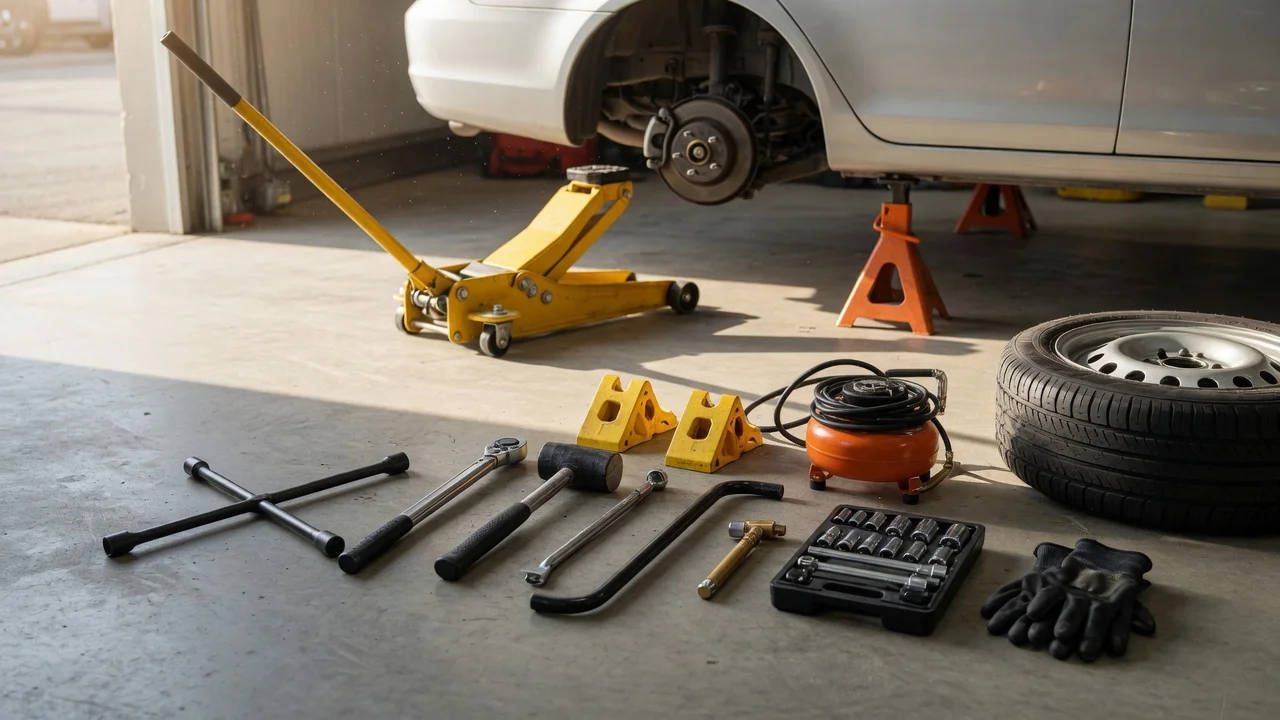
To replace a car wheel you need four essentials: a jack that can lift your vehicle, a lug wrench that fits your wheel fasteners, a usable spare wheel and tire, and a way to stop the car from rolling, such as wheel chocks. If your wheels have locking lug nuts, you also need the matching key. A torque wrench is strongly recommended so the fasteners can be tightened to the vehicle maker's specification once the car is back on the ground.
Two conditions change this answer. First, many newer cars are sold with a tire sealant and inflator kit instead of a spare. In that case the car may have no jack or lug wrench at all, and you cannot swap a wheel unless you buy a spare and the tools to go with it. Second, if you mean removing a tire from its rim, that is a different job requiring tire irons or a tire-changing machine and a bead breaker. It is usually left to a tire shop because the tire must be remounted, sealed and balanced correctly. This article covers swapping the whole wheel.
What each tool does
Jack
A jack lifts one corner of the car so the wheel clears the ground. Three types are common. A scissor jack is the compact screw-driven type often supplied with the car. A bottle jack is a small vertical hydraulic unit. A floor jack is a wheeled hydraulic unit that is quicker and more stable on a garage floor but too bulky for most trunks.
Whatever the type, it must be placed only at the jacking points the manufacturer specifies. These are reinforced spots on the body or frame, and the owner's manual shows where they are. A jack is designed to lift, not to hold a car up while someone works underneath. Changing a wheel does not require getting under the car. If you will be under it for any reason, support the vehicle on jack stands rated for its weight.
Lug wrench
Lug nuts, or on some vehicles lug bolts, are the fasteners that clamp the wheel to the hub. A lug wrench loosens and tightens them. The tool supplied with many cars is a short L-shaped bar, which gives little leverage on tight fasteners. A four-way cross wrench or a breaker bar with the correct socket gives more leverage. The socket size must match your fasteners exactly. Your owner's manual or a check of the existing tool will tell you the size. This article does not list sizes because they vary by vehicle.
Locking wheel nut key
Some wheels use one locking nut or bolt per wheel with an unusual pattern that only a matching key adapter can turn. Without the key, that wheel cannot be removed with ordinary tools. Before you need it, confirm whether your car has locks and where the key is kept.
Spare wheel and tire
Spares come in two broad forms. A full-size spare matches the road wheels. A compact temporary spare, often called a donut, is lighter and narrower and is intended only to get you to a repair. Compact spares carry speed and distance restrictions, printed on the tire or in the owner's manual, and those limits should be followed. Any spare needs to be at its correct inflation pressure to be usable, and spares are easy to forget during routine checks.
Wheel chocks
Chocks are wedges placed against a tire that stays on the ground, typically the wheel diagonally opposite the one being lifted. They reduce the chance of the car rolling while it is partly raised. They work alongside the parking brake and park or gear selection, not in place of them.
Torque wrench
Torque is the twisting force applied to a fastener. Wheel fasteners have a specified tightening torque. Too little torque risks the wheel loosening, and too much can stretch studs or distort components. A torque wrench lets you hit the specified value, which is listed in the owner's manual or service information for your model. Some manufacturers also advise rechecking the torque after a short distance. Follow the guidance for your vehicle rather than a general figure.
Useful extras
Work gloves, because wheels and fasteners are dirty and can have sharp edges. A flashlight or headlamp for roadside work after dark. A tire pressure gauge to check the spare before fitting it. A reflective vest and warning triangle for roadside visibility, where appropriate or legally required. A small mat or kneeling pad. A flat, solid board to spread a jack's load on soft ground.
Checks before you buy or rely on these tools
Start with what the car already has
Look in the trunk floor, side panels and under the vehicle, since some spares hang beneath the rear. Note whether you have a spare, a jack, a wrench and a locking-nut key, or only a sealant kit. This tells you whether you are filling one gap or buying a full set.
Match the jack to the vehicle
Check the jack's rated capacity against your vehicle's weight, which the owner's manual or door-jamb information typically lists. Also check its lowest height, so it fits under the jacking point, especially on low cars or with a flat tire, and its maximum lift, so it can raise taller vehicles enough to fit an inflated spare. A jack that suits a small hatchback may not suit a pickup or SUV, and the reverse is also true for clearance. Specifications differ between model years, trims and body styles, so check the figures for your exact vehicle.
Match the wrench and sockets to the fasteners
Confirm the fastener size and whether your car uses nuts or bolts. Some alloy wheels have recessed lug holes that need a thin-walled socket to avoid scratching the wheel. If you are buying a torque wrench, make sure its range covers your vehicle's specified wheel torque.
If you are adding a spare to a car that lacks one
Check several points: that the wheel's bolt pattern, center bore and offset suit your vehicle; that the tire size is approved for it; that there is somewhere secure to store it; and, on all-wheel-drive vehicles, whether the manufacturer restricts using a mismatched or compact spare. Bolt pattern is the number and spacing of the fasteners. Center bore is the hole that locates on the hub. Offset is how far the wheel's mounting face sits from its centerline. These details vary by model year, market and trim, so confirm them in the manufacturer's information or with a dealer instead of assuming a spare from a similar model will fit.
Cost and convenience
No pricing data was supplied for this article, so no price ranges are given. When comparing offers, check whether a kit includes chocks, the correct sockets and a storage case, and whether a spare is sold as a wheel only or with a mounted tire. Also weigh the alternatives. Roadside assistance coverage, or relying on the factory sealant kit, may suit some drivers. Note that sealant kits generally cannot fix sidewall damage or large punctures.
What this guide cannot tell you
Fastener sizes, torque values, jacking points, jack ratings, spare compatibility and any limits on temporary spares are all vehicle-specific. They were not part of the information available here. Before buying tools or a spare, take these from the owner's manual or manufacturer service information for your exact model year, market, trim and drivetrain.