Timing Belt Tensioner: Failure Symptoms and Replacement Cost
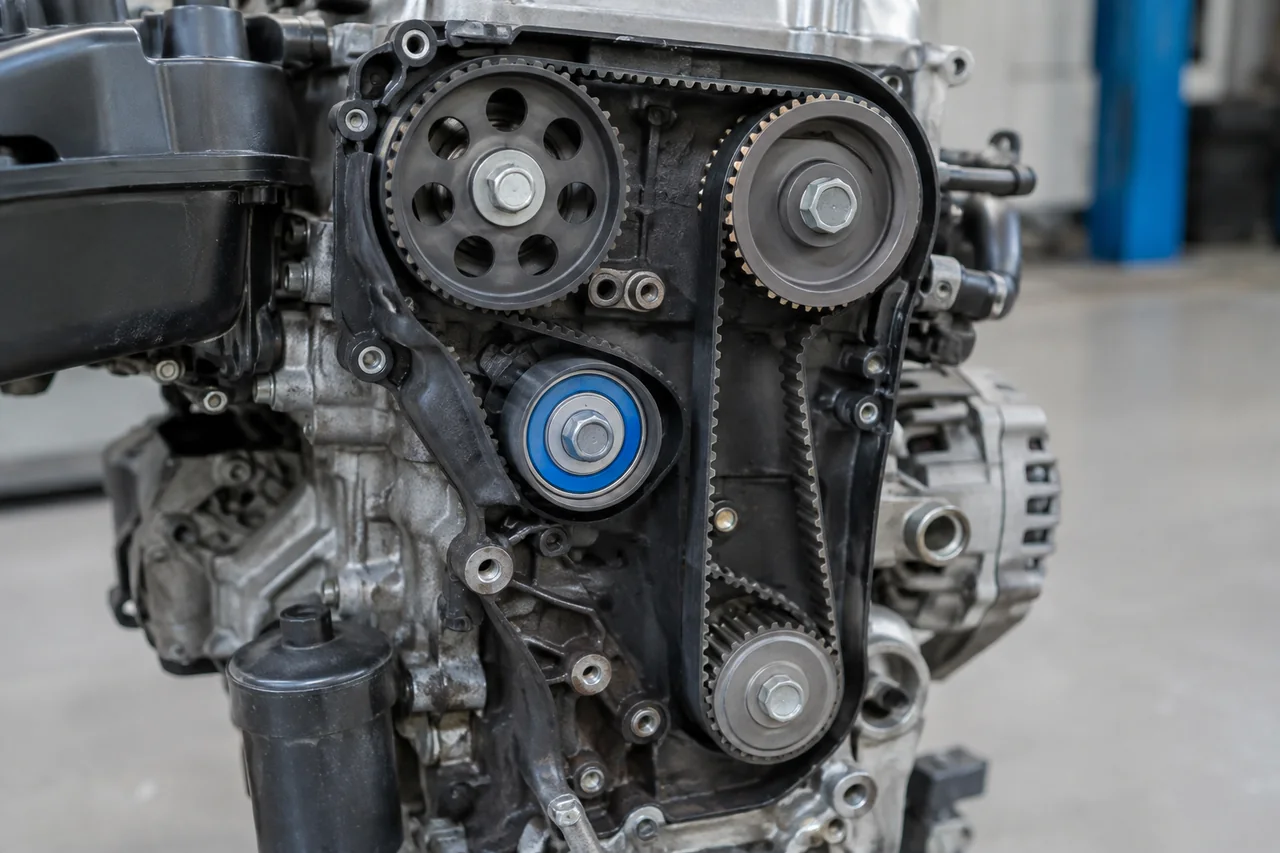
The timing belt tensioner keeps the belt at the tension needed for accurate engine timing. When it weakens, belt tracking and pulley engagement can suffer, and the cost to replace a timing belt tensioner often depends on whether the job is done alone or as part of a full timing belt service. Understanding how the assembly works, what symptoms warrant inspection, and what a timing belt and tensioner replacement cost includes helps you evaluate a shop estimate.
How the Tensioner Supports Correct Timing Belt Operation
The timing belt must stay taut enough that its teeth stay fully engaged with the crankshaft and camshaft pulleys as the engine turns. A timing belt tensioner applies controlled belt tension so the belt does not skip a tooth, slap, or wander. If tension is too low, engine timing can drift; if it is too high, the belt, tensioner pulley, and related bearings can wear faster. The tensioner is part of the engine timing drive, not a cosmetic cover piece, and its job is to keep that engagement consistent across idle, acceleration, and temperature change.
Designs vary. Some engines use a spring-loaded mechanical tensioner that presses a pulley against the belt. Others use a hydraulic tensioner that damps movement with oil pressure and a piston, often still acting through a tensioner pulley. Neither layout is universal. This assembly is not the accessory belt tensioner that loads the serpentine belt for the alternator, air conditioning compressor, or power steering pump. A repair estimate should name the timing-side part so you are not paying for, or approving, the wrong tensioner.
Symptoms That Warrant a Timing System Inspection
A rattle, squeal, or grinding sound near the timing cover can be an early warning that the tensioner pulley, hydraulic tensioner, or belt path needs diagnosis. Noise does not prove the tensioner has failed, because covers, idler pulleys, and nearby accessories can make similar sounds. Still, those noises justify a professional inspection before a small problem becomes a skipped-tooth event. Rough running, hard starting, or stalling may appear if engine timing is disturbed, but those drivability issues also come from ignition, fuel, and sensor faults, so they cannot identify a failed tensioner by themselves.
During inspection, a technician may look for abnormal timing belt tracking, oil or hydraulic fluid seepage from a hydraulic tensioner where that design is used, and scoring or play at the tensioner pulley or idler pulley. A belt that has walked toward a flange, glazed, or frayed at an edge can signal uneven loading rather than a simple stretch. Symptoms overlap with other faults, and a quiet engine does not establish that the tensioner is healthy. Condition is judged from mechanical findings and timing verification, not from noise alone.
When to Stop Driving and Arrange Professional Testing
If you hear a sudden severe mechanical noise from the timing cover area, the engine stalls with suspected timing failure, or a shop has already confirmed a timing system fault, shut the engine off safely and arrange towing rather than driving on. Continued running with lost belt tension can let the belt jump teeth or leave the pulleys, shifting engine timing. On some designs that interference can damage valves or pistons; on others the risk is mainly a no-start. Treat a confirmed timing fault as a tow, not a test drive.
Note when the noise or stall happens, whether at cold start, hot idle, or acceleration, and gather maintenance records so the technician can compare them with vehicle-specific procedures. Do not keep running the engine solely to reproduce a concerning sound, because that can worsen a slipping belt. Cover removal, belt tension checks, and timing verification belong with a qualified technician. Those steps require correct locking tools and alignment references on many engines, and incorrect handling can itself disturb engine timing. Your role is to get the vehicle there safely and describe what you heard and felt.
What Determines the Cost of Tensioner Replacement
The cost to replace a timing belt tensioner is not a single catalog number. An estimate typically splits the tensioner assembly, labor to reach it, required hardware such as fasteners or seals, taxes, and shop fees. Timing belt tensioner replacement cost rises when the timing cover, engine mounts, or other components must come off for access, and it falls when that labor overlap is already planned as part of a timing belt service. Timing belt tensioner cost to replace also tracks local labor rates and whether the shop uses an original-equipment unit or an aftermarket equivalent.
Ask what the quoted part actually is. Some listings are a tensioner pulley only; others are a hydraulic actuator; still others are a complete assembly with bracket and damper. Terminology is not standardized across engines, so a cheaper line item can omit the piece that actually failed. Authorizing a tensioner-only repair still requires assessment of the belt, idler pulley, service history, and vehicle-specific procedures. A worn belt on a freshly tensioned drive can fail soon after, and some manufacturers specify replacing related hardware whenever the drive is opened.
What a Timing Belt and Tensioner Service Estimate Includes
A combined timing belt and tensioner service usually covers the belt, the tensioner, specified idler pulleys, and the fasteners the procedure calls out as single-use or torque-critical. Timing belt and tensioner replacement cost is often quoted this way because the same access path serves every part of the drive. Shared work on the timing cover, ancillary brackets, and alignment steps creates labor overlap, so a combined estimate should list which operations are included rather than burying them in a lump sum. That clarity is what lets you compare shops.
A water pump is not automatically part of every timing belt service. Inclusion depends on whether the pump sits behind the belt, its condition, and the service requirements for that engine layout. If the pump is driven elsewhere, replacing it during this job may add cost without addressing a timing need. Extra charges can appear for diagnosed leaks, related damage found after the cover is off, or fluids required to refill cooling or lubrication systems. Those items should be presented for approval before the extra work proceeds, not added as a surprise.
Details to Confirm Before Approving the Repair
Before you approve the work, confirm the estimate names the exact engine, the diagnostic findings, itemized parts, labor hours or a labor package, and the warranty terms on parts and workmanship. Ask the shop to explain the evidence that the tensioner has failed, such as play, leakage, tracking marks, or a collapsed hydraulic unit, and whether belt condition or timing integrity is still uncertain. A fault observation is a reason to inspect, not automatic proof that the tensioner must be replaced in isolation. If timing remains unverified, the repair plan should say how that will be checked.
Use the vehicle's maintenance documentation for any applicable timing belt requirements rather than assuming a generic interval. Those documents, and the shop's procedure for that engine, govern whether the belt, tensioner, and related pulleys are due together. After the job, keep the invoice, mileage, replacement scope, and next-service guidance with the vehicle's records. That file is what a later technician uses to judge remaining life of the drive and to avoid repeating labor that was already paid. It also documents what was actually installed if a warranty question arises.