How to Test Car Fuses with a Multimeter
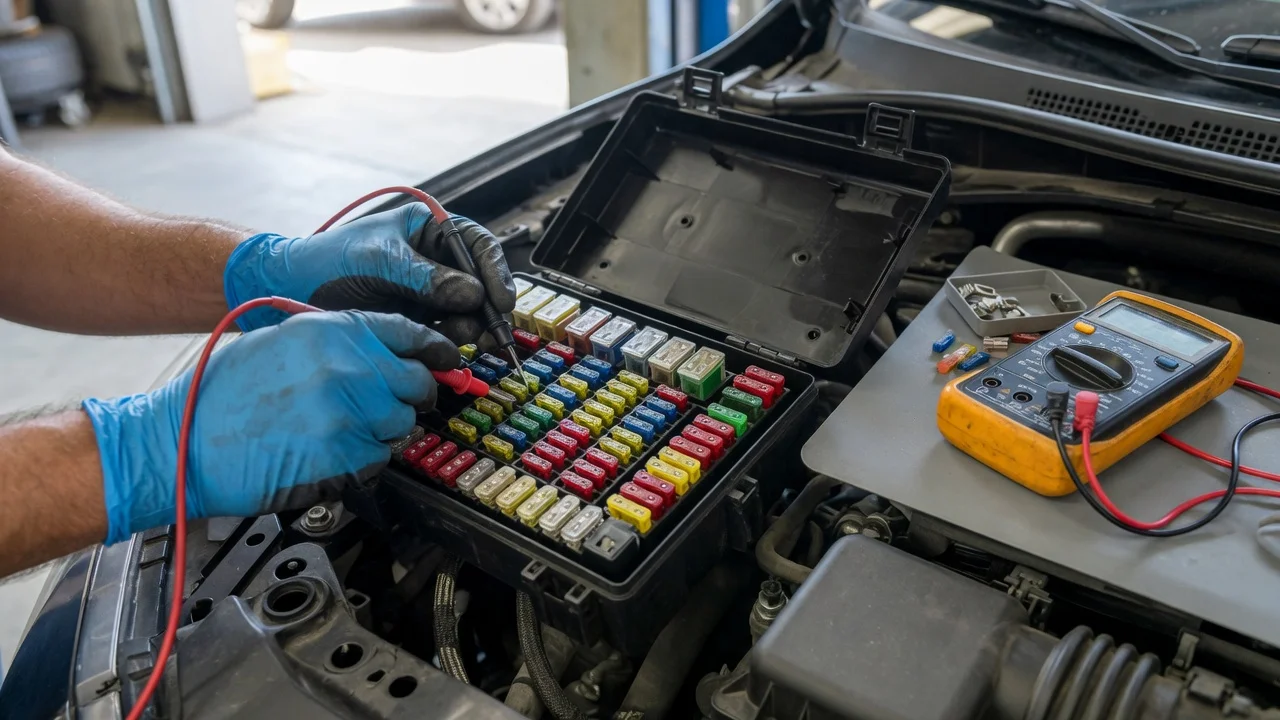
The Essential Answer
You test a car fuse with a multimeter by measuring continuity across its two metal test points while the fuse is removed from the circuit. A good fuse reads near zero ohms; a blown fuse reads open circuit or infinite resistance. Some fuses can also be checked for voltage present on both sides while installed, but the continuity method is the most reliable because it directly confirms the internal link is intact. The condition that matters most is access: you must be able to touch the two exposed test contacts on the fuse body. If the fuse is heavily corroded or the test points are obscured, replace it or clean the contacts before testing.
Tools and Safety Before You Start
You need a digital multimeter with a continuity or resistance setting, and access to the fuse panel. On most vehicles the fuse panel is inside the cabin near the driver's knee area or under the hood in a covered box. Switch the ignition off before removing fuses. Removing a fuse with the ignition on can trigger fault codes or cause a short if a tool bridges adjacent terminals. For under-hood fuse boxes, avoid testing while the engine is running unless you are using the voltage method and can safely reach the fuse without contacting moving parts or hot surfaces.
Method 1: Continuity Test
Remove the fuse from its slot using the plastic puller supplied in the fuse box or a pair of non-conductive plastic pliers. Do not use metal pliers or a screwdriver to pry the fuse out, because you can short adjacent live terminals or damage the fuse body.
Set the multimeter to the continuity setting, often marked with a diode or sound-wave symbol, or to the lowest resistance range, usually 200 ohms. Touch the two meter leads together to confirm the meter reading goes to zero or beeps. Then place one lead on each of the two small exposed metal test points on the top or back of the fuse. The fuse does not need to be oriented in a particular direction for this test.
A good fuse will read very low resistance, typically under one ohm, and the continuity beeper will sound if available. A blown fuse will read open circuit, often displayed as OL or a blank reading, with no continuity tone. A reading that is unstable or shows several ohms can indicate internal corrosion or a partially separated link; treat this as a failed fuse. If you are unsure of the specification for your fuse type, replace it with a new fuse of the identical amperage rating and retest the old fuse against the new one.
Method 2: Voltage Test on an Installed Fuse
You can also check a fuse without removing it by measuring voltage across the two exposed test points. Set the multimeter to DC volts, typically 20 V DC. Turn the ignition to the position that powers the circuit you are testing, but do not start the engine unless the circuit requires it. Touch one lead to each test point on the fuse.
A good fuse under load will show zero or very close to zero volts across it, because the internal link conducts without dropping voltage. A blown fuse will show battery voltage, typically around 12 V, because the open link creates full potential difference between the two sides. This method works only if the circuit is actually powered and the fuse is intended to carry current at that moment. Some fuses feed circuits that are only active when a relay closes, so a zero-volt reading on an unpowered circuit does not prove the fuse is good.
Completion Check
After testing, confirm the fuse is fully seated in its original slot. If you replaced a fuse, use the same amperage rating as the one removed. Installing a higher-rated fuse can overheat wiring and cause fire, while a lower-rated fuse may blow again immediately. If a new correct fuse blows again after installation, stop and have the circuit diagnosed by a qualified auto electrician. A repeatedly blowing fuse indicates a short or excessive current draw that no fuse should be used to mask.
When a Fuse Looks Good but Tests Bad
Some blade fuses can develop a hairline crack in the internal link that is visible only under magnification. Others fail near the terminal from vibration or corrosion without darkening the plastic window. The continuity reading is decisive in these cases. Do not judge a fuse solely by looking at the colored plastic body. If the multimeter shows open circuit but the fuse appears visually intact, treat it as blown.