Honda Accord TCC Solenoid: Identification and Location
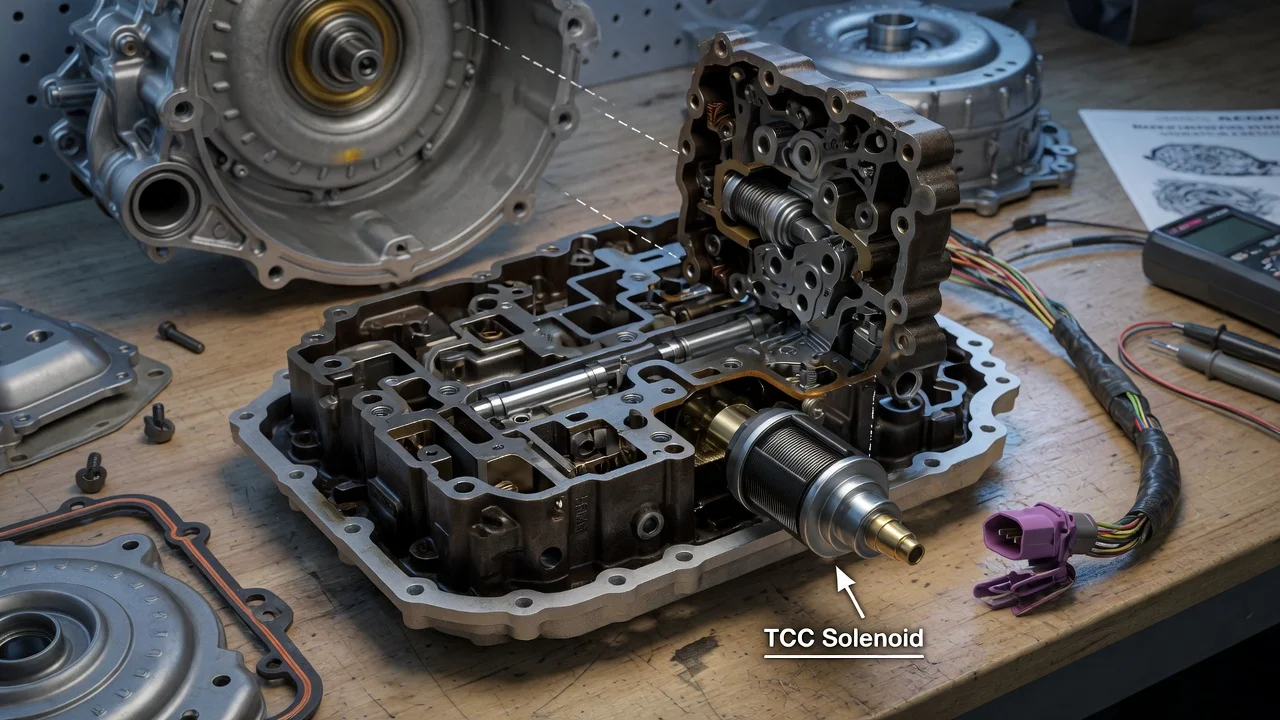
On a Honda Accord with an automatic transmission, the torque converter clutch (TCC) is applied through a solenoid-controlled hydraulic circuit. Which part does that job, and where it sits, depends on the model year and transmission type. This guide explains how to identify the lock-up control on your Accord, why the answer differs between generations, and how to approach a suspected TCC problem without replacing parts on a guess.
Short answer: it depends on the transmission
Honda service literature usually calls this part a lock-up control solenoid rather than a TCC solenoid. On many older four-speed Accord automatics, lock-up was handled by a dedicated lock-up control solenoid valve assembly bolted to the outside of the transmission case, so it could be reached without opening the transmission. Later conventional automatics rely on shift solenoids and linear (pressure control) solenoids, and lock-up may be controlled by more than one of them, so there may be no single part labeled as the TCC solenoid. CVT-equipped Accords control lock-up through the CVT's own solenoid set. Accord hybrids with Honda's two-motor system do not use a conventional torque converter, and manual-transmission cars have no TCC at all.
Because of these differences, the model year alone is not a reliable guide to fitment. The dependable way to identify the correct part and its location is the transmission model code, found on the transmission case, together with the VIN, matched against a Honda parts catalog or factory service information for that exact vehicle.
How torque converter lock-up works
A torque converter couples the engine to the transmission through fluid, which allows the car to idle in gear but also creates slip and heat. At steady cruising speeds, the lock-up clutch inside the converter mechanically connects the engine to the transmission input, reducing slip, lowering fluid temperature and improving fuel economy. The control module decides when to apply it based on inputs such as vehicle speed, throttle position, fluid temperature and the current gear. It then commands the solenoid, which directs or modulates hydraulic pressure to the lock-up control valve, and that pressure applies the clutch. Many newer units apply lock-up gradually or partially rather than simply switching it fully on or off.
The solenoid itself is only an electrically operated valve. A lock-up complaint can originate in the solenoid, its wiring or connector, worn or incorrect fluid, a sticking valve in the valve body, the clutch inside the converter, or a faulty sensor input to the control module. A symptom that points to the lock-up system does not by itself confirm that the solenoid has failed.
What changes the answer
Transmission type is the biggest variable. Across its generations the Accord has been offered with four-, five- and six-speed conventional automatics, CVTs, a ten-speed automatic on some turbocharged versions, and hybrid drive units, depending on year and engine. Each design has its own solenoid layout, diagnostic path and repair procedure, so instructions written for one generation can be misleading for another.
Fluid specification also matters. Many Honda conventional automatics call for Honda ATF DW-1, which superseded the earlier Z1 fluid, while many Honda CVTs require a dedicated CVT fluid such as HCF-2. The wrong fluid, or fluid that is old and degraded, can change how smoothly lock-up engages and may cause shudder. Confirm the correct fluid for your vehicle in the owner's manual. Operating conditions affect the result too: lock-up is normally withheld when the fluid is cold, at low speeds and under heavy acceleration, so the converter not locking in stop-and-go traffic is not necessarily a fault.
Diagnostic codes vary by model year as well. Generic codes in the P0740 range describe torque converter clutch circuit or performance problems, and older OBD-II Accords also used Honda-specific codes for the lock-up solenoid circuits. A code description identifies the circuit or function that failed a test, not necessarily the component that must be replaced.
What the owner can do
Start by recording exactly how the problem shows itself. Lock-up issues often appear as a shudder or vibration at steady light-throttle cruising, an engine speed flare or drift at highway speed, noticeably worse fuel economy, or the engine stalling or nearly stalling when coming to a stop, which can indicate lock-up staying applied. Note the speed, engine temperature, load and whether the check engine light is on. This shift behavior record is far more useful to a technician than a general description.
Next, read stored codes with a scan tool that can access transmission data; some basic readers show only generic engine codes. Check the fluid level and condition using the procedure for your transmission, since the method differs between models. Inspect the visible solenoid connectors and harness for oil contamination, corrosion or damage. Review the service history for when the fluid was last changed and with what. A technician with suitable equipment can measure solenoid resistance against specification and command the solenoid with a scan tool to see whether it responds.
Repair options depend on what the diagnosis confirms. They range from a fluid service with the correct fluid, often done as one or more drain-and-fill cycles, to wiring or connector repair, replacement of an externally mounted solenoid, a control module software update where applicable, or valve body or torque converter work for internal faults. When buying a replacement solenoid, match the part number to your transmission model code rather than relying on year and trim alone.
Limitations and next step
This guide describes general patterns across Honda Accord automatics; it cannot confirm the exact solenoid, location or procedure for a specific car. Use factory service information or a parts catalog keyed to your VIN and transmission code before ordering parts or removing components.
Seek professional diagnosis if codes return after a repair, if the fluid is burnt or contains debris, if internal failure is suspected, or if the engine stalls when stopping, since that can create a safety risk in traffic. Continuing to drive with persistent shudder or slip can increase wear, so it is better to have the transmission evaluated early than after the damage spreads.