SUV Wheel Alignment: When to Book Service and Choose a Shop
The essential answer
Wheel alignment sets the angles of an SUV’s wheels so they match the vehicle maker’s specified geometry. The three primary angles are camber (inward or outward tilt of the wheel as viewed from the front), caster (forward or rearward tilt of the steering axis), and toe (whether the fronts of the tires point in or out). On many SUVs a fourth reading, thrust angle, describes whether the rear axle sits square to the vehicle centerline. When those angles are out of specification, the vehicle can pull, the steering wheel can sit off center, and tires can wear unevenly.
Book an alignment when you notice those symptoms, after a hard impact, after suspension or steering repairs, and when fitting new tires. Most modern SUVs, including all-wheel-drive and four-wheel-drive models, need a four-wheel alignment rather than a front-only adjustment. Exact target angles are variant-dependent: they change with model year, generation, powertrain, trim, tire size, and whether the vehicle is in the market’s original ride height. A lifted, lowered, or heavily loaded SUV may no longer use the factory printed specification, and that is a material qualification before you choose a shop or accept a printout.
When to book the service
Alignment is condition-based more often than it is a fixed mileage job. Many makers do not publish a universal interval in miles or months that applies to every SUV. Shops sometimes recommend a check at tire rotation or with a new set of tires; treat those as service policies, not as a single documented factory rule. Use symptoms and recent work as the booking triggers, then confirm the correct procedure for your specific vehicle.
The vehicle drifts or pulls to one side on a level road with even tire pressures. The steering wheel sits off center when the vehicle is traveling straight. Tires show inner- or outer-shoulder wear, feathering across the tread, or faster wear on one corner than the others. The steering feels vague, the vehicle wanders, or it does not self-center after a turn. You hit a curb, deep pothole, or debris, or you use the SUV off pavement hard enough to shock a knuckle, control arm, or rack. You replace tie-rod ends, control arms, ball joints, struts, springs, or a steering rack. You fit new tires, or you change wheel offset, tire size, or ride height.
A pull is not proof of an alignment fault by itself. Unequal tire pressure, a dragging brake, a damaged tire belt, and road crown can produce the same feel. Check pressures and a quick visual of the tires and brakes first. If those are sound, an alignment inspection is the next supported step. After collision or airbag deployment, have the shop inspect for bent knuckles, subframes, or control arms before anyone adjusts the bolts; an alignment machine cannot straighten bent metal.
Two-wheel or four-wheel alignment
A two-wheel, or front-end, alignment adjusts only the front camber, caster, and toe, and it assumes the rear axle is already square. A four-wheel alignment measures all four corners and sets front geometry relative to the rear thrust line. Independent rear suspension, which is common on many crossover and car-based SUVs, usually has adjustable rear camber and toe. Body-on-frame SUVs with a solid rear axle may have little or no rear adjustment; the shop still needs to measure thrust angle and may use shims or note that a bent axle or spring perch is the real fault.
Four-wheel service is the better default for an SUV that will see highway miles, all-wheel drive, or new tires. Front-only service can be acceptable on an older solid-axle vehicle when the rear measurement is already in spec and the complaint is a simple toe-related wear or an off-center wheel after a tie-rod replacement. It is the weaker choice when the vehicle pulls, when rear tires wear oddly, or when the shop cannot show a rear reading. Compatible comparison stops there: published labor times, menu prices, and “lifetime alignment” packages vary by market, shop equipment, and whether the technician must use aftermarket kits. No single price or test result applies across model years without matching the configuration.
How to choose a shop
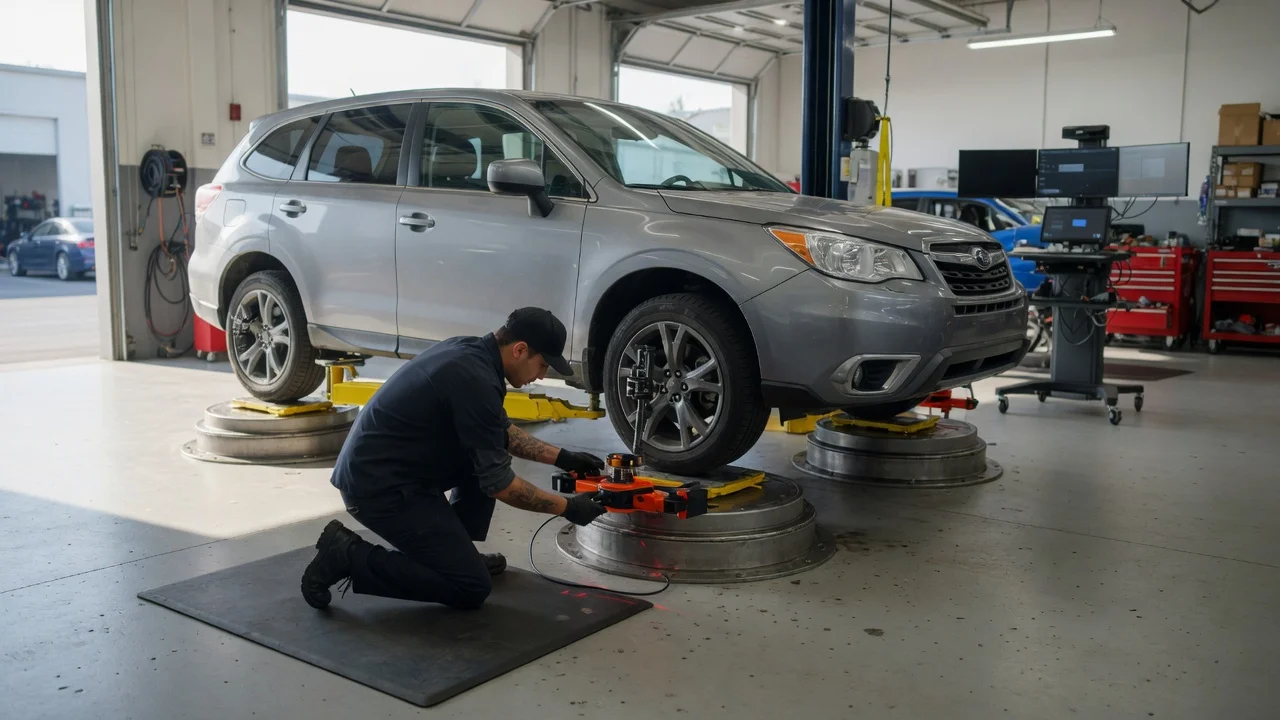
The useful choice is not a brand name. It is a bay that can lift your SUV’s weight, read the correct OEM specification for your VIN or model-year build, and produce a before-and-after printout of camber, caster, toe, and thrust angle. Ask whether the machine is a current four-wheel system and whether the technician will inspect suspension play before adjusting. Worn ball joints, bushings, or tie rods will not hold an alignment; a shop that quotes an adjustment without a wear check is skipping a required step.
Confirm four-wheel measurement, not a front-only rack, unless your vehicle’s rear is documented as non-adjustable and already in spec. Ask for the specification source: factory procedure for your model year and drivetrain, not a generic “SUV” setting. Require a printed or digital report with before and after values and the in-spec range. If the SUV is lifted, leveled, or on plus-size tires, ask whether the shop uses modified alignment specs and has the camber kits or adjustable arms those setups often need. Check that the lift and turn plates can take the vehicle’s curb weight and wheelbase; some passenger-car racks are a poor fit for large three-row or heavy-duty SUVs. For all-wheel-drive models, ask whether the shop follows any maker steps that limit turning a wheel on the rack or that call for a steering-angle sensor calibration after toe is set.
Dealer, independent alignment shop, or tire retailer
A dealer is usually the stronger fit when the SUV is under warranty, has an electronic steering-angle or driver-assistance calibration that the maker ties to alignment, or uses a procedure stored only in factory service information. An independent alignment specialist is often the stronger fit for repeated adjustments, modified ride height, or a vehicle the dealer treats as out of scope. A tire retailer is a practical fit when you are already replacing tires and the store can show four-wheel readings and a wear inspection on the same visit.
Prefer the dealer when a campaign, calibration, or warranty language requires OEM tooling. Prefer a specialist when the complaint is chronic pull, rear-axle thrust, or aftermarket suspension. Prefer the tire shop when the decision is bundled with new tires and the printout matches the same criteria you would demand anywhere else. Menu prices, “free lifetime alignment,” and advertised turnaround are not comparable across those channels without matching what is included: inspection, rear adjustment, sensor calibration, and parts such as camber bolts. Those commercial terms were not supplied here as dated, market-specific figures, so they should be quoted for your vehicle rather than assumed.
What a competent visit includes
A complete job starts with tire pressures set to the placard, a check for bent wheels and uneven tire wear, and a dry-park or lift inspection of joints and bushings. The technician then compensates the targets, measures all four wheels, adjusts what the design allows, and reprints the report. If a rear value cannot be brought in range, the honest outcome is a recommendation to repair the bent or worn part, not a claim that the alignment is finished. On many late-model SUVs, a steering-angle sensor or camera-based driver-assistance system may need calibration after toe changes; ask whether that step is in the quote.
After the visit, recheck tire pressures, confirm the steering wheel is centered on a straight, level road, and watch the first few thousand miles of tread wear. An alignment does not repair a tire that already has a damaged belt, and it does not restore tread that has already been worn to a shoulder. If a pull remains with a printout in specification, the next checks are tires (including a side-to-side swap to see if the pull moves), brakes, and road-test conditions, not a second random adjustment.
Gaps you should still confirm for your vehicle
This guide does not include model-year camber, caster, or toe tables, labor times, or shop prices. Those values are not interchangeable across generations, trims, markets, or measurement equipment, and no road-test ranking of shops is supplied here. Confirm the factory procedure and any required calibrations for your VIN, and treat any quoted interval or lifetime package as a shop policy until it is matched to the maker’s service information for your SUV.