SUV All-Wheel Drive Maintenance: What to Service and When
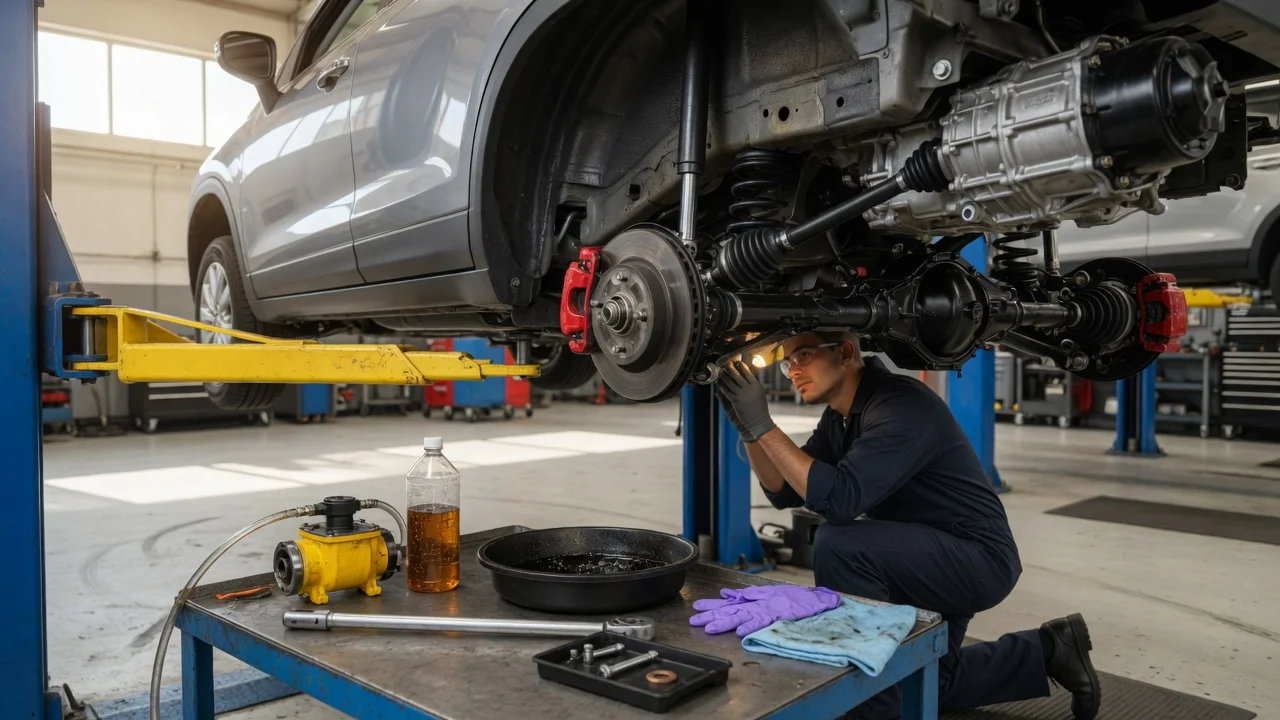
What AWD Maintenance Actually Covers
All-wheel drive maintenance focuses mainly on the transfer case, front and rear differentials, and their fluids. Unlike engine oil, these fluids are often overlooked, but they protect the gears and clutches that split power between the axles. The exact items depend on the vehicle: full-time systems with a center differential may need a specific center differential fluid, while part-time or automatic systems route power through a transfer case with its own lubricant.
There is no single universal interval for every SUV. Manufacturer guidance varies by model year, generation, powertrain, and whether the vehicle is used for towing, off-road driving, or frequent cold starts. Because specifications can differ even within the same model line, the owner's manual or an official service schedule for the specific vehicle is the reliable reference.
How AWD Differentials and Transfer Cases Work
A differential allows the wheels on an axle to rotate at different speeds during cornering. In an all-wheel drive SUV, a transfer case takes power from the transmission and sends it to the front and rear axles. Many modern systems also use an electronically controlled clutch or center differential that can vary the front-to-rear torque split, especially when a wheel loses traction.
The lubricant in each unit has several jobs: it reduces friction between gear teeth, helps carry away heat, and protects against wear and corrosion. In systems with wet clutches, the fluid also affects how smoothly the clutch engages and releases. Degraded or incorrect fluid can change shift quality, increase wear, and eventually cause damage that is far more expensive than a fluid change.
Fluids and Components to Service
Transfer case fluid; Front differential oil; Rear differential oil; Center differential fluid, on vehicles that use a separate center differential; Limited-slip or locking differential additive, where specified by the manufacturer; Inspect the breathers and vents that let these assemblies equalize pressure
Do not assume one fluid works everywhere. Transfer cases, automatic transmissions, and some all-wheel drive couplers can have different requirements. A differential designed for a friction-modifier additive may need that additive to avoid chattering and excessive wear, while a fluid that already contains the modifier may be specified for another unit. Using the wrong fluid can create symptoms that resemble a mechanical fault.
Typical Service Intervals and Why Conditions Matter
Many SUVs call for differential and transfer case fluid changes well before engine coolant or spark plug replacement. A typical interval may fall between roughly every 30,000 and 60,000 miles for normal use, but severe-service schedules can reduce that figure. Severe use commonly includes towing, repeated short trips, prolonged off-road operation, driving through deep water or mud, and sustained high-speed or mountainous driving.
Water contamination deserves special attention. If axles, transfer cases, or their breathers are submerged, water may enter through a vent or seal. The resulting milky or discolored fluid can lose its ability to protect gears and may need to be changed promptly rather than at the normal interval. This is a material qualification: the proper interval depends on how the vehicle has actually been used.
Signs That Service May Be Due
Unusual whine, howl, or rumble that changes with road speed; Clunking or binding during low-speed turns; Tire scrubbing feel in tight parking maneuvers; Leaks or wetness at the differential cover, axle seals, or transfer case seams; Milky, dark, gritty, or burnt-smelling fluid when inspected; Warning messages related to the all-wheel drive or drivetrain system
A symptom is a starting point, not a diagnosis. A drivetrain noise can come from tires, wheel bearings, universal joints, or the differential. Matching tire circumference matters on many all-wheel drive SUVs, so a significant difference in tread depth across axles may overwork the system. If a warning light or fault code appears, the code should be investigated rather than treated as proof that one part has failed.
An Owner's Inspection Sequence
1) Park on a level surface and set the parking brake before looking underneath. 2) Once the area is cool, visually check the transfer case and differential housings for leaks or damaged seals. 3) Confirm tire sizes and pressures match the specification, since uneven tires can stress the system. 4) Note any new noise, vibration, or binding and record when it occurs: speed, turning, acceleration, or coasting. 5) Check the service history to see whether the differential and transfer case fluids are due according to the vehicle's normal or severe schedule.
Fluid changes often require access to fill and drain plugs, a fluid pump, and the correct torque specifications. Some drain plugs use a specific bit or may be recessed behind a skid plate. Do not open a fill plug that has been rounded or seized without a plan to extract it, because the vehicle cannot be safely refilled if the fill plug cannot be reinstalled. If the vehicle shows evidence of water entry or if a drivetrain warning is active, professional diagnosis is the safer boundary.
What to Expect from Proper Service
Correct fluids and intervals support smooth torque transfer, reduce gear noise over time, and help the transfer case and differentials reach their expected service life. The benefits are most visible to owners who tow, off-road, or drive long distances in demanding conditions. The compromise is cost and scheduling: all-wheel drive service adds maintenance items that a front-wheel or rear-wheel drive vehicle may not require.
For a general-use SUV driven gently, the original schedule is usually sufficient. For one that tows or sees wet, dusty, or low-speed off-road use, earlier fluid changes may be justified. The deciding factor should be the vehicle-specific severe-service criteria, not a universal mileage number remembered from another model.
Evidence Gaps and Professional Confirmation
Specific fluid types, capacities, additive requirements, tightening values, and exact intervals must be confirmed against the manufacturer's documentation for the relevant model year, generation, powertrain, trim, and market. This guide deliberately avoids presenting a single generic mileage or fluid specification because those values vary by application. Documented specifications, test findings, and editorial judgments are separate: no fuel economy, reliability, or performance claim here is based on instrumented testing.
Where uncertainty remains, the practical next step is to identify the drivetrain configuration of the individual SUV and verify its service requirements from the owner's manual or official repair information before ordering fluid or attempting a change.