Suspension Ball Joints: Wear Symptoms, Safe Checks, and Replacement
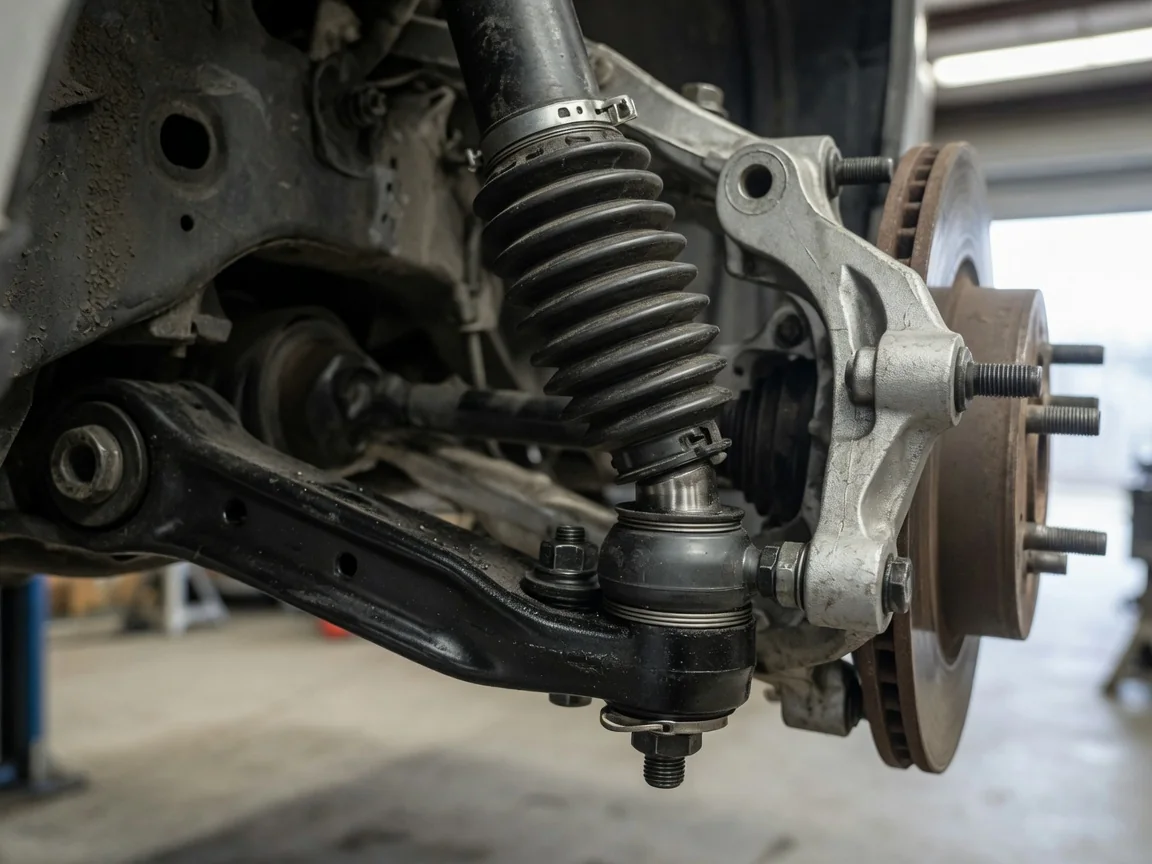
A car suspension ball joint is a pivot that lets a control arm and steering knuckle move together as the wheel travels and steers. Wear can show up as noise, steering looseness, or uneven tire wear, but those clues also appear with other faults. Safe parked observations have limits. A shop confirms play against the vehicle's procedure, and car suspension ball joint replacement is a safety-critical repair followed by alignment as required.
How Ball Joints Support Suspension and Steering Movement
A ball-and-socket design lets the stud tilt and rotate inside a housing so the control arm can follow suspension travel while the steering knuckle turns the wheel. That combination of motion is why a car suspension ball joint sits at the connection between those parts rather than acting as a rigid bolt. As the spring compresses and rebounds, the joint accommodates changing angles. During a turn, the same socket allows the knuckle to steer without binding the arm. Load path and geometry still depend on how the rest of the axle is built.
A flexible ball joint boot covers the socket to hold grease in and keep water, grit, and road salt out. Once the boot tears, lubricant can escape and contamination can enter, which accelerates internal wear even if the stud still looks seated. Not every vehicle uses the same number of joints or the same load-bearing layout. Some designs place a loaded joint at the lower control arm, others use upper and lower positions, and some struts change which joint carries vertical load. Location, count, and duty always follow the specific suspension architecture.
Warning Signs That Warrant a Suspension Inspection
Drivers often notice a clunk over bumps, a loose steering feel, wandering in a straight line, or irregular tire wear when a joint is wearing. Those clues matter because the joint locates the steering knuckle relative to the control arm; extra clearance can let the wheel shift slightly under load. Uneven tire wear can appear as a feathered or inner-edge pattern if camber or toe changes with travel. Steering looseness may feel like delayed response or a vague on-center sensation. None of these signs, however, name the failed part by themselves.
The same noises and handling changes can come from bushings, tie rods, wheel bearings, loose fasteners, or tires that are worn or underinflated. A torn ball joint boot or grease on the housing is a reason to inspect, not proof of how much internal wear exists; the socket can still be within limits, or it can be badly worn behind an intact boot. Addressing suspected wear is important because joint separation can leave the wheel poorly controlled. Inspection, not symptom matching, is what distinguishes a worn joint from neighboring faults.
Safe Observations You Can Make With the Car Parked
During ordinary driving, note when a clunk, knock, or steering change appears over a specific bump, during braking, at low speed, or only when turning, without trying to provoke the noise. Those details help a technician later. With the car parked on level ground, look at tread for uneven tire wear and stand back to see whether a wheel looks unusually cambered or toed compared with the opposite side. Record what you see rather than applying force to the wheel. Timing and visual clues are useful history, not a diagnosis of suspension play.
If a ball joint boot is visible from a standing position without lifting the vehicle, reaching into wheel wells, or crawling underneath, you can note tears, missing clamps, or obvious grease splash. Stay outside confined areas and do not rely on a flashlight inspection of hidden joints. A driveway glance cannot establish whether the joint is safe because wear is measured as movement under specified loading. Lifting, wheel-shaking, and pry-bar checks belong in a properly equipped inspection where the vehicle is supported and the correct method for that suspension can be used.
How a Shop Confirms Ball Joint Wear
A technician starts by identifying the suspension layout so the correct joint, load path, and inspection method are used. Wear limits and procedures are vehicle-specific; a generic wiggle at the tire can misread a loaded joint that is designed to show little free play until the suspension is supported or loaded in a particular way. Because suspension loading changes how movement appears, one generic play check is not enough. The shop should follow the applicable service information rather than assuming every car suspension ball joint is judged the same way.
Inspection typically includes the boot, stud and housing movement, control-arm and steering-knuckle attachments, and nearby parts such as bushings and tie-rod ends that can mimic joint wear. Ask which joint failed and what measured movement or physical damage supports that call. Manufacturer-dependent wear limits require confirmation for that vehicle, because acceptable clearance varies with design. A stored fault code is evidence to interpret, not proof this part has failed, and any code definition still needs vehicle-specific confirmation.
What Ball Joint Replacement Involves
Car suspension ball joint replacement begins with confirming the worn joint, identifying whether the serviceable part is a separate joint or a control-arm assembly, installing the correct piece, and verifying the repair. Some designs allow pressing or bolting a new joint into the arm or knuckle; others specify replacing the entire control arm because the joint is not separately serviced. That choice is vehicle-specific and should be confirmed from service information, not assumed from another model. After installation, the shop checks related attachments and looks for remaining play in the repaired location.
Retention methods, special tools, fastener types, and tightening specifications make this a safety-critical job because the joint locates the wheel. Incorrect seating or a reused one-time nut can allow the stud to loosen. Wheel alignment should be checked and adjusted according to the vehicle's service requirements and the work performed, since disturbing a control arm or steering knuckle can change camber and toe. Estimate factors include which joint is involved, whether an assembly is required, labor access, corrosion that slows disassembly, and alignment, without assuming both sides must be replaced.
When to Stop Driving and Arrange Assistance
If steering control changes suddenly, a wheel looks displaced, or the vehicle feels unstable, stop in a safe place and arrange towing rather than continuing. Those conditions can mean the knuckle is no longer being held in position. For persistent clunks, steering looseness, or a visibly damaged boot, schedule a prompt inspection. Do not treat remaining mileage as known; wear can progress without a reliable countdown. Symptom intensity is not a substitute for a loaded play check, so urgency should follow what the technician finds.
Continued driving after mild symptoms is a judgment that only a proper inspection can support, because a joint that still looks seated can have excessive internal clearance. After car suspension ball joint replacement, return if steering problems or suspension noises remain; leftover play, a missed neighboring part, or an alignment that was not completed can leave the same complaints. Ask the shop to recheck the repaired joint and adjacent components rather than assuming the first repair finished the job. Unresolved wandering or clunks deserve another look before they become a control issue.