Supercharger Bypass Valve Symptoms and a Valve Stuck Open
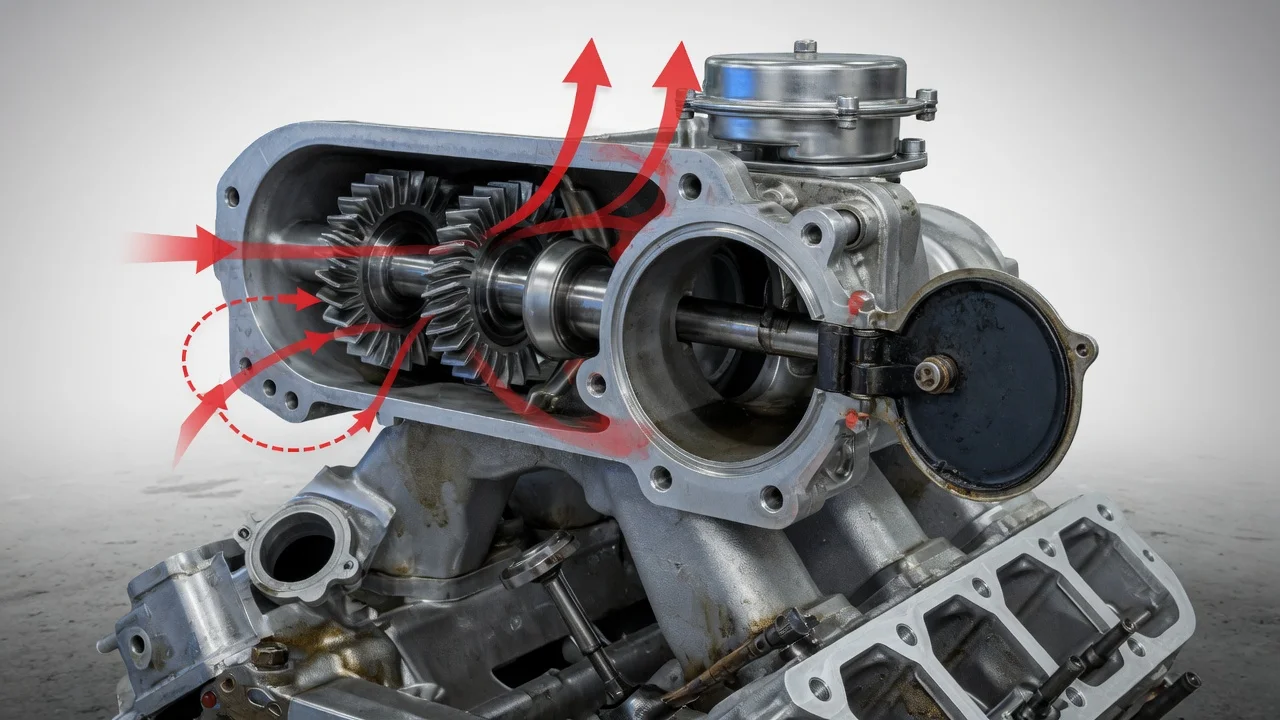
A supercharger bypass valve that sticks open usually shows up as a car that idles and cruises normally but feels flat when you ask for power. On positive-displacement superchargers, the valve lets air recirculate around the rotors at light load and closes as you press harder, so a fault directly affects boost. This guide explains which symptoms to note, how to separate a stuck valve from other causes, and what to check before buying parts.
What the bypass valve does
Roots and twin-screw superchargers move air whenever the belt turns them. To avoid pressurizing the intake when extra air is not needed, many designs use a butterfly-style valve that opens a passage between the supercharger outlet and its inlet. At idle and steady cruising, the valve is held open so air circulates instead of building pressure. Under heavier throttle it closes and boost rises. How the valve is actuated depends on the vehicle configuration: some engines use a vacuum diaphragm, while others use an electronically controlled actuator that the engine computer commands and monitors. Centrifugal superchargers manage pressure differently, so confirm which system your engine has before following any diagnosis.
Establish the symptoms
When the valve is stuck open, the most common sign is weak acceleration under load: the engine pulls like a non-supercharged version of itself, especially when merging, climbing hills or passing. A boost gauge or scan tool, if available, may show little or no pressure where it normally builds. Some owners notice a change in the familiar supercharger sound, and the check engine light may come on with an underboost code such as P0299 or a code related to the bypass actuator circuit. Idle and light cruising often feel normal, because that is when the valve is supposed to be open anyway.
Write down exactly when the problem appears: cold or warm engine, light or full throttle, constant or intermittent, and whether it changes with weather or after a long drive. Note any associated signs such as hissing near the intake, rough running, belt squeal or warning lights. Recent changes matter a great deal. Work on the intake, a new belt, an air filter replacement, a pulley or tune change, or a recent intercooler or coupler repair can all point the diagnosis in a specific direction. Your service history helps separate a new fault from one introduced during earlier work.
It also helps to know the opposite failure. A valve stuck closed tends to produce boost when it should not, which can show up as a harsher idle, surging at cruise, more supercharger noise at light load or worse fuel economy. If your symptoms look more like this, the stuck-open explanation is weaker.
Distinguish plausible causes
Valve-related causes include a torn actuator diaphragm, a cracked, collapsed or disconnected vacuum line, a broken or disconnected linkage, and a valve shaft seized by carbon or oil residue. On electronically controlled systems, add a failed actuator motor, damaged wiring or connector, or a control fault. Evidence that supports a valve problem includes an actuator code, a visibly damaged hose or linkage, or an actuator that does not move when it should. A problem that appeared right after nearby intake work also points toward a hose or connector that was left loose.
Several other faults produce the same low-boost feel. A boost leak at a coupler, intercooler hose or gasket lets pressure escape, often with an audible hiss under load. A slipping or glazed belt reduces how fast the supercharger turns and may squeal. A restricted air filter or intake, a faulty manifold pressure sensor, a throttle problem or internal wear in the supercharger itself can also cut power. If the valve and its control test normal, or a leak is found elsewhere, the stuck-open theory loses weight. Low power with no change in boost readings may point away from the supercharger altogether.
Checks in a useful order
Start with checks that need no special tools and only a cool engine that is switched off. Read stored codes with a basic scanner or have a parts store or shop read them, and record any freeze-frame data. Inspect the vacuum hoses running to the bypass actuator for cracks, softness, splits or loose ends, and look at the linkage for a missing clip or bent rod. Check the visible intake couplers and intercooler hoses for oil film, looseness or tears, and look at the drive belt for cracking or glazing. Do not reach near the belt or pulleys with the engine running.
The next stage requires tools and the manufacturer specifications for your engine. On a vacuum-actuated valve, a hand vacuum pump applied to the actuator should show whether the diaphragm holds vacuum and whether the valve moves through its range freely. A scan tool with live data can compare manifold pressure against throttle position, and on electronic systems may show commanded versus actual valve position or allow an actuator test. A smoke test is the reliable way to find boost and vacuum leaks. Electrical checks of actuator wiring need the correct wiring information for that exact vehicle.
Removing the valve body, freeing a seized shaft, inspecting supercharger internals or anything involving the fuel system or engine calibration is best left to a qualified technician, particularly on engines where intake components must be removed to reach the valve.
Interpret the findings
A disconnected or split vacuum hose explains the symptom well, but after repairing it, confirm that boost returns under load before considering the job finished. An actuator that will not hold vacuum indicates a failed diaphragm, yet it is still worth checking whether the valve shaft moves freely, since a seized shaft can damage a new actuator. If the actuator holds vacuum and the valve moves smoothly, the valve itself is probably not stuck, and attention should shift to its control signal, a boost leak or belt drive.
An actuator circuit code confirms that the computer detected a problem, not which part caused it; wiring and connectors must be ruled out before replacing an electronic actuator. An underboost code without any valve fault only confirms low pressure. A smoke test that finds a leak elsewhere does not rule out a second problem, so recheck boost after the repair. Normal boost readings combined with poor performance suggest the supercharger system may not be at fault.
Urgency and next action
A valve stuck open usually reduces performance rather than causing immediate damage, but lost power can make merging and passing unsafe, so drive with that in mind. Stop driving and arrange inspection if the check engine light flashes, the engine misfires or stalls, you hear grinding or metallic noise from the supercharger, smell burning, see smoke or heavy oil leaks, the belt squeals loudly or the temperature gauge rises. No safe remaining mileage can be promised for a car with an unconfirmed fault, because the underlying cause may differ from the valve.
For an efficient repair, give the shop the year, model, engine and supercharger type, the exact codes and freeze-frame data, your notes on when the symptoms occur and the operating conditions involved, and any recent work from the service history. Ask whether the valve and actuator were tested before replacement and request confirmation that boost was verified afterward. Follow the manufacturer maintenance schedule for related items such as the belt and air filter rather than assuming a universal interval.