Supercharger Bypass Valve: Function and Operation
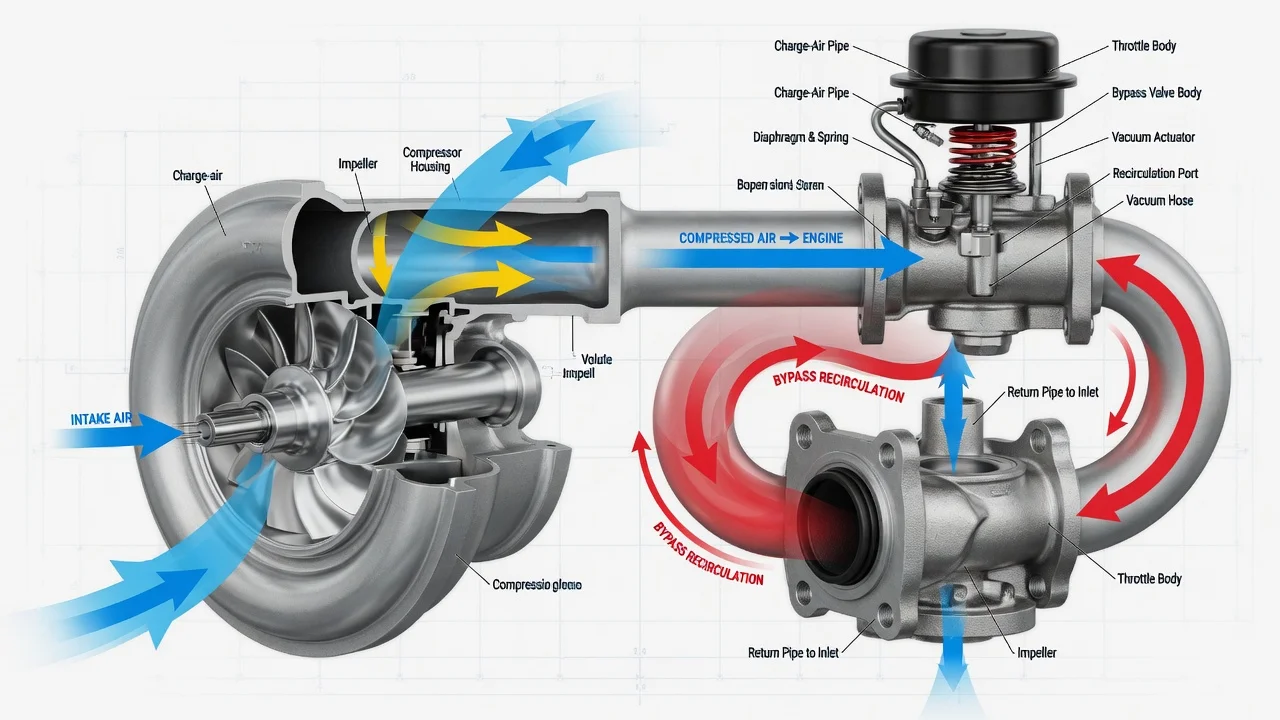
A supercharger bypass valve lets a belt-driven blower stop building boost when the engine does not need it. Because the supercharger is mechanically linked to the crankshaft, it spins whenever the engine runs, so something has to manage the air it moves at idle, during cruise and on deceleration. This article explains what the valve does, how it operates, how designs differ and what an owner can reasonably check.
What the bypass valve does
On a positive displacement supercharger, such as a Roots or twin-screw unit, the bypass valve controls a passage that connects the supercharger outlet back to its inlet. The valve is usually a butterfly plate. When the valve is open, air pushed out by the rotors circulates back to the intake side instead of being forced into the engine. Pressure across the blower stays close to zero, so the engine runs much like a naturally aspirated one. When the valve closes, that escape route is gone and the supercharger builds boost in the intake manifold. In practice, the valve is open at idle, at light cruise and on closed-throttle deceleration, and closed when the driver asks for more power. This reduces the power the engine spends driving the supercharger, keeps intake air cooler during everyday driving, can help fuel economy and quiets the blower. It also prevents the supercharger from pressurizing against a closed throttle plate.
How a supercharger bypass valve works
Many factory installations control the valve with a vacuum actuator. A diaphragm inside the actuator is connected by a rod or lever to the butterfly, and a hose links the diaphragm chamber to manifold vacuum. At idle and light throttle, the manifold is under strong vacuum, which pulls the diaphragm and holds the valve open. As the throttle opens, manifold vacuum falls toward atmospheric pressure, a spring inside the actuator takes over and the valve starts to close. Once the manifold reaches positive pressure, the valve is held shut and the full output of the supercharger goes to the engine. Because the movement follows manifold pressure, the transition from no boost to boost is gradual rather than an abrupt switch.
Some engines use an electronically controlled bypass instead. A motor or solenoid positions the valve based on commands from the engine control module, which can take throttle position, engine speed, load and intake temperature into account. This gives the calibration finer control over when boost arrives, but the basic idea is the same: open to recirculate air when boost is unnecessary, closed to deliver it.
Where the valve sits in the intake path
Without a diagram in front of you, the layout is easiest to picture by following the air. On most positive displacement setups, air flows through the filter and mass airflow sensor, then through the throttle body and into the supercharger inlet. The blower pushes air through an intercooler, if fitted, and into the intake runners. The bypass is a short channel, sometimes cast into the supercharger housing and sometimes an external tube, that joins the outlet side back to the inlet side downstream of the throttle. The valve sits in that channel, and on vacuum designs the actuator is mounted on or next to it with a small hose running to a manifold vacuum source. Exact placement varies by engine, so the service manual illustration for your vehicle is the reliable reference.
What changes from one setup to another
Everything above applies to positive displacement superchargers. Centrifugal superchargers, which behave more like a belt-driven turbocharger compressor, are different. Their boost rises with engine speed, and the throttle usually sits after the compressor. They typically use a blow-off or bypass valve mounted in the charge pipe that opens when the throttle snaps shut, releasing or recirculating trapped pressure so it does not surge back against the compressor. That valve mainly handles throttle lift-off rather than managing light-load operation.
Within positive displacement systems, details depend on vehicle configuration. Factory and aftermarket kits differ in actuator spring rate, hose routing and whether the valve is vacuum or electronically controlled. A smaller pulley, a different tune or a modified intake can change how the valve is expected to behave, and some aftermarket valves are adjustable. Operating conditions matter too: a valve that seems normal in steady cruising may reveal a problem only under heavy load, in hot weather or on a hard throttle lift. Not every supercharged engine uses a bypass valve, so confirm your setup before assuming one is present.
Signs the bypass valve may not be working
Failures usually show up in a few patterns. If the valve sticks open or the linkage disconnects, air keeps recirculating under load, so boost is low or missing and the engine feels weaker than it should, especially when accelerating hard. If the valve sticks closed, the supercharger builds pressure when it should not, which can appear as surging or uneven response at part throttle, more blower noise at idle or cruise, higher intake temperatures and worse fuel economy. A torn actuator diaphragm or cracked vacuum hose affects valve position and can also create a vacuum leak, causing a rough or unstable idle and lean-condition trouble codes. These symptoms overlap with other faults, including boost leaks, sensor problems and belt slip, so they point toward the bypass system rather than prove it has failed.
What the owner can check
With the engine off and cool, start with a visual inspection. Find the actuator, follow its hose and look for cracks, softening, loose fittings or a hose that has slipped off. Check that the rod or lever is attached and that the butterfly moves without binding where it can be reached safely. On a vacuum actuator, a hand vacuum pump is a useful test: apply vacuum and watch whether the linkage moves through its travel, then see whether the gauge holds steady. A reading that keeps dropping points to a leaking diaphragm. Releasing the vacuum should let the spring return the valve smoothly.
If a scan tool is available, look for stored codes and, where supported, watch boost or manifold pressure readings during a safe, legal drive. Note when the symptom appears, such as at cold start, idle, cruise or full throttle, because that context helps a technician. Record findings in the service history along with any recent work on the intake, drive belt or engine tune. For electronically controlled valves, owner testing is mostly limited to visual checks and reading codes; actuator diagnostics usually require dealer-level or capable aftermarket tools.
Limitations and next step
This explanation covers general function and operation. It does not replace the manufacturer specifications for your engine, which define actuator travel, expected manifold pressure readings and any related items in the maintenance schedule. There is no universal replacement interval for a bypass valve; its condition, not mileage alone, usually decides when it needs attention. If your checks are inconclusive, boost behavior seems wrong after modifications, or an electronically controlled valve is setting codes, a technician familiar with forced induction on your vehicle configuration is the right next step. Bring your notes on symptoms and operating conditions, as they shorten diagnosis and help avoid replacing parts that were not at fault.