Subaru WRX Wastegate Actuator: Identification and Function
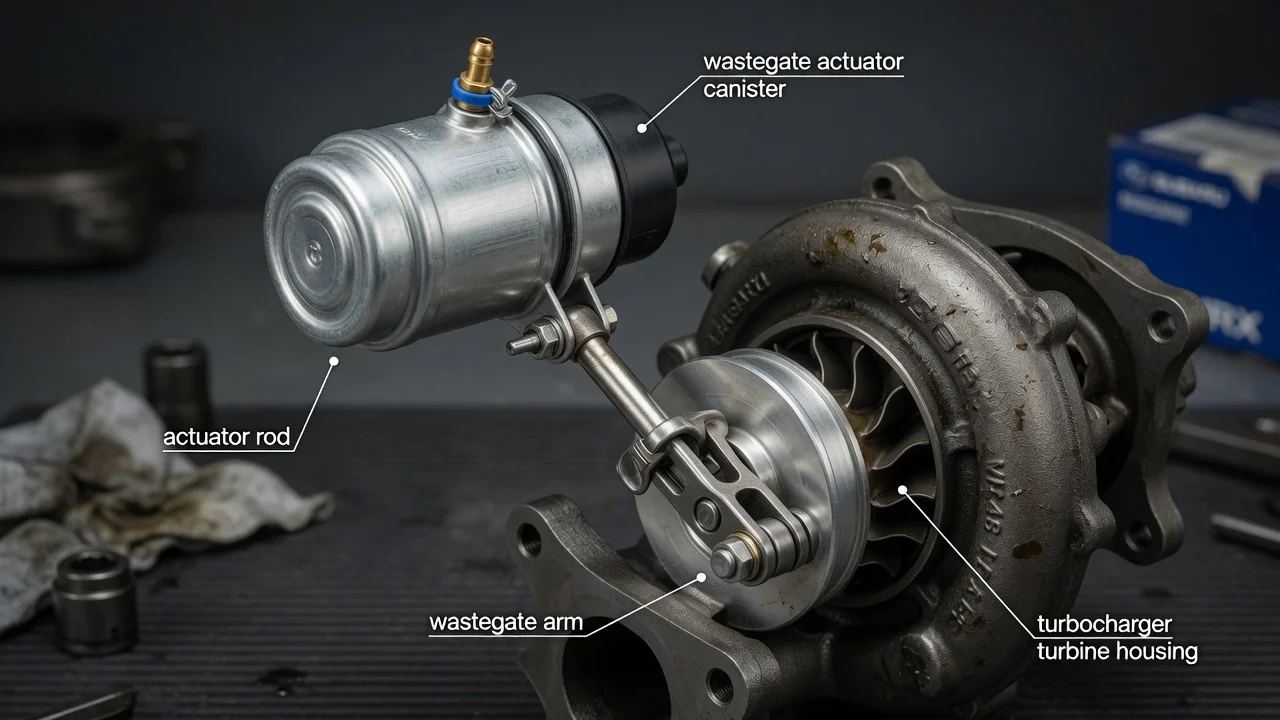
The wastegate actuator on a Subaru WRX is a small part of the turbocharger system with an important job. It sets how much exhaust gas bypasses the turbine, which limits how much boost the engine receives. If you know what the actuator looks like, where it sits and how it behaves, you can tell a real actuator fault from a leaking hose, a failing control solenoid or a tuning problem before you start replacing parts.
What the WRX wastegate actuator is
On a WRX with an internal wastegate, the actuator mounts on a bracket attached to the turbocharger. The pneumatic version is a round metal canister with a diaphragm and spring inside. It has one or more small hose nipples on the housing and a threaded rod coming out of one end. The rod connects to a lever arm on the turbine housing. That lever opens and closes a valve, often called the flapper, which lets exhaust bypass the turbine wheel. Some turbocharged engines use an electrically driven actuator instead, with a wiring connector rather than boost hoses. Checking whether the actuator has a harness plug or pressure lines is the quickest way to tell which type your car has.
The actuator's function is to limit boost. Without a working wastegate, the turbine would keep speeding up as engine load increased, and boost pressure would climb past what the engine and its management system are designed to handle. The actuator does not create boost. It controls how much of the available exhaust energy reaches the turbine.
How the actuator controls boost
In the pneumatic layout, a hose carries pressure from the intake side of the turbo system to the actuator. The spring inside holds the wastegate closed until boost pressure on the diaphragm overcomes the spring force. At that point the rod extends, the flapper opens, and some exhaust flows around the turbine instead of through it. The pressure at which this happens without any electronic intervention is usually called base boost or spring boost.
The engine control module raises boost above that baseline using a boost control solenoid, sometimes called a wastegate solenoid. The solenoid bleeds off part of the pressure signal going to the actuator. The diaphragm therefore sees less pressure than the intake actually has, and the wastegate stays shut longer. The module adjusts the solenoid's duty cycle based on its target boost and on sensor feedback. An electric actuator removes the hose and solenoid stage entirely: the module commands the actuator motor directly and typically monitors its position.
What changes the answer for your car
WRX models have used different engines and turbocharger arrangements across generations. Actuator type, mounting position, hose routing and control strategy are not the same from one generation to the next. Access also varies. On some layouts the turbo and actuator sit under or behind the intercooler, while on others they are lower in the engine bay and easier to reach from below. Before buying a replacement or following a procedure written for another generation, confirm your exact vehicle configuration: model year, engine and transmission.
Modifications change the picture further. Aftermarket actuators with stiffer springs, adjusted rod lengths, external wastegates, different boost control solenoids and reflashed engine software all change how the system behaves. A symptom that suggests a failed actuator on a stock car may be a calibration mismatch on a modified one. Operating conditions also matter. Altitude, intake air temperature, fuel quality and engine load all affect how much boost the module requests and how quickly the turbo reaches it. Check the service history for earlier turbo, actuator or solenoid work and for any software changes.
Symptoms that point toward the wastegate system
If the wastegate sticks closed, or a control fault keeps it shut, the engine can overboost. This may be logged as a generic overboost code such as P0234, and the engine module may cut power in response. If the wastegate sticks open, the diaphragm is torn or the rod has come loose, the result can be low boost, sluggish acceleration and an underboost code such as P0299. Erratic boost, a gauge reading that surges and drops, or a rattle from the turbo area at idle or while coasting can also involve the wastegate linkage.
None of these symptoms is unique to the actuator. Several other faults can produce similar complaints: boost leaks in the intercooler piping or couplers, split pressure lines, a sticking or misrouted boost control solenoid, a faulty pressure sensor, or an exhaust leak ahead of the turbine. Treat any of these symptoms as a reason to inspect the whole boost control path, not as proof that the actuator is bad.
What the owner can check
Start with a visual inspection, but only after the engine has fully cooled, because the turbo and exhaust stay hot long after shutdown. Find the actuator using the description above. Check the hoses running to it and to the boost control solenoid for cracks, hardening, loose ends or oil contamination. Make sure the rod is still attached to the wastegate arm and that its retaining clip is in place. Look for heavy corrosion on the rod or bracket. Also look for signs that someone has adjusted the actuator, such as tool marks on the rod's lock nut.
On a pneumatic actuator, you can connect a hand pressure pump to the actuator nipple. Watch whether the rod moves smoothly and whether the diaphragm holds pressure without leaking down. Do not apply more pressure than the service information allows. Do not change the rod length to cure a symptom, because on a stock car that alters base boost and can cause overboost. A scan tool that shows actual boost or manifold pressure, target boost and solenoid duty will tell you whether real boost follows the request. Record any stored codes before clearing them, and note when the problem appears, for example only in hot weather or only at high load.
If your car has an electric actuator, you can reasonably check the connector and wiring yourself. Testing the motor and its position feedback generally requires a scan tool that can read the module's live data and run the manufacturer's actuator tests.
Limitations and when to get professional help
This overview explains how wastegate actuators generally work on turbocharged WRX models. It does not replace the factory service information for your exact car. Manufacturer specifications for test pressures, rod preload, fastener torque and calibration procedures differ by generation, and you need them for an accurate diagnosis or replacement. Do not expect a fixed replacement interval in the maintenance schedule. The actuator is normally replaced when inspection or testing shows a fault.
See a qualified technician, ideally one familiar with Subaru turbocharged engines, in any of these situations: you get overboost codes, the car drops into a reduced-power mode, you hear metallic rattling from the turbo, or the car has been tuned and you are unsure how its boost control was changed. Persistent overboost can damage the engine, so avoid hard acceleration until the cause is found. A shop can run a boost leak test, check solenoid operation, review logged data and confirm whether the fault lies in the actuator, the wastegate flapper itself or another part of the system.