Subaru Transmission Fluid Change: Procedure by Transmission Type
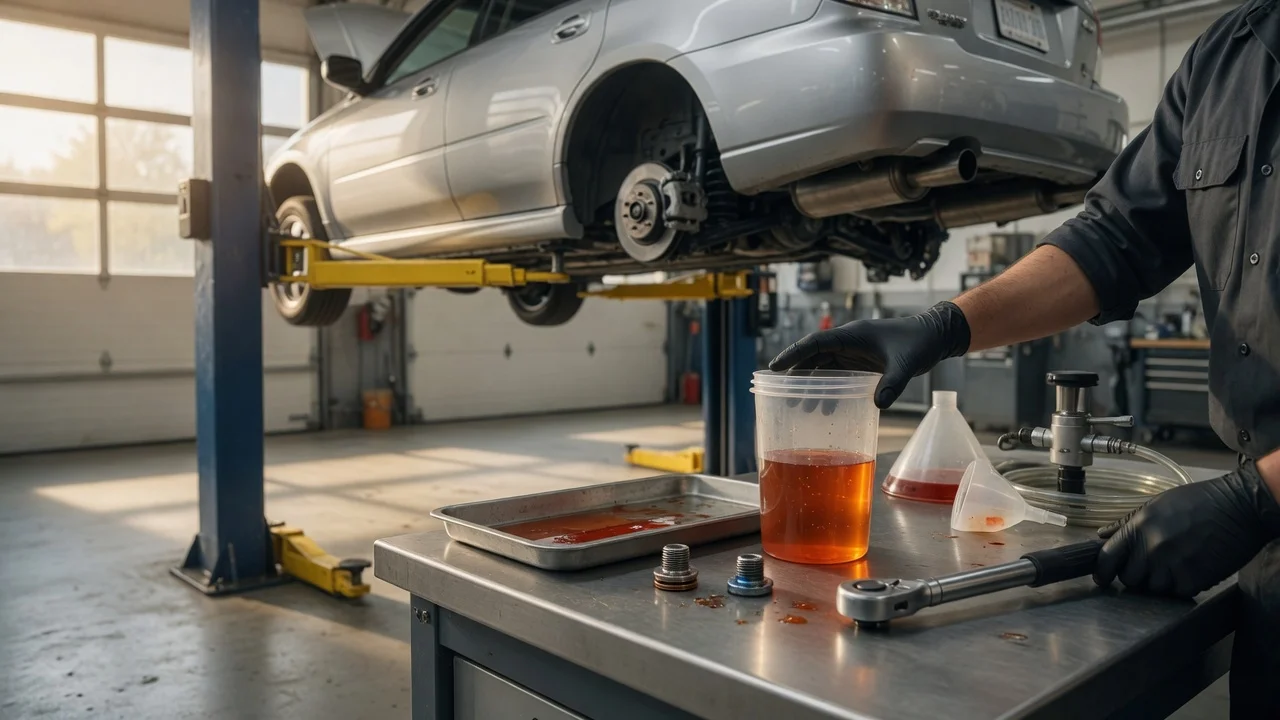
What this service actually is
A Subaru transmission fluid change is a drain-and-fill of the gearbox lubricant, and on some conventional automatics it also includes a pan-and-filter service. The fluid, interval, fill method, and level check are not interchangeable across Subaru transmissions. The three families you will meet on passenger cars and crossovers are the Lineartronic continuously variable transmission (CVT), the older 4EAT and 5EAT conventional automatics, and the five- or six-speed manual. Using the wrong fluid, overfilling, or setting CVT level without the factory temperature procedure can cause shudder, overheating, or internal damage.
Confirm the transmission type on the vehicle you are servicing, then use the fluid name, capacity, plug torque, and level-setting temperature published for that model year, market, and powertrain. Those figures vary by generation and are not listed here as a single set of numbers. The steps below describe the supported factory-style method for each family and the points where a scan tool or dealer-level service information is required.
Identify the transmission before you buy fluid
The underhood or owner's-manual transmission label, the VIN build data, and the pan or case shape are the reliable identifiers. A dipstick does not tell you the type by itself: some 4EAT and 5EAT units have a dipstick, while Lineartronic CVTs and many later automatics are sealed and are filled at a case plug.
Transmission family Typical Subaru applications Service character; Lineartronic CVT (including High Torque and Sport Lineartronic variants) Most automatic Forester, Impreza, Crosstrek, Legacy, Outback, Ascent, and WRX automatics from the early 2010s onward, with exact years varying by market Drain-and-fill with Subaru CVT fluid specified for that unit; level set by overflow at a specified fluid temperature; 4EAT / 5EAT conventional automatic Older Legacy, Outback, Forester, Impreza, Tribeca and related models before the CVT era Pan drop and filter on many 4EAT units; ATF specified for that year (commonly Subaru ATF-HP on later 4EAT/5EAT); Manual (5-speed or 6-speed) WRX, STI, and other models offered with a clutch Simple drain-and-fill with the specified gear oil; level at the fill-hole lip with the vehicle level
Turbocharged and higher-torque models often specify a High Torque CVT fluid rather than the standard Lineartronic fluid. Performance manuals (including many STI applications) can specify a different viscosity or Subaru-branded extra-duty gear oil than a base Impreza five-speed. Do not mix CVT fluid with ATF or gear oil.
When Subaru schedules a change
Service intervals are model-year and schedule dependent. Owner's manuals for some CVT years describe the fluid as a long-life or inspect-only item under normal driving, then call for replacement under severe use (short trips, extreme heat, mountain or trailer work, dusty roads). Other years and markets publish a replacement mileage. Conventional automatics and manuals more often have a stated replace interval. If the book in the glovebox and the factory service schedule disagree with an older “lifetime fill” claim, follow the schedule for that VIN and the severe-service column when the vehicle’s use matches it.
Change the fluid when it is dark, burnt-smelling, or contaminated with coolant or metal, regardless of mileage. Pink or milky ATF or CVT fluid points to a cooler or gasket leak and is a diagnosis job, not a simple drain-and-fill. A single drain-and-fill replaces only the fluid that leaves the pan and cooler lines; a large share stays in the torque converter, valve body, and passages. Shops that advertise a “flush” should use equipment and a fluid that the manufacturer accepts for that transmission; a high-pressure flush is not the factory drain-and-fill procedure.
Tools, fluid, and setup that apply to every type
Work on a level surface with the parking brake set and the wheels chocked. You need the correct Subaru-specified fluid in sufficient quantity for a drain-and-fill plus a small reserve, a drain pan large enough for the pan volume, new crush washers or pan gasket as fitted, a torque wrench, and a way to bring the vehicle to the specified inspection temperature. For Lineartronic CVTs, a scan tool that reads CVT fluid temperature (Subaru Select Monitor or an equivalent that reports that PID) is part of a correct level set. Have a refill pump or squeeze bottle that can reach the fill plug, which is often on the side of the case.
Match fluid to the transmission label and service information for that VIN. Standard CVT fluid, High Torque CVT fluid, ATF-HP, older Dexron-type ATF on early 4EAT, and manual gear oil are not substitutes for one another. Replace drain-plug and fill-plug washers, and the pan gasket or filter kit if the procedure drops the pan. Reused crush washers are a leak path. Do not use generic “universal CVT” or “universal ATF” unless the Subaru specification for that unit explicitly allows it. Most Subaru CVT applications call for Subaru CVT fluid. Keep dirt out of the fill opening. CVT valve bodies are sensitive to debris. Record the old fluid’s color and smell. Heavy metallic glitter, clutch material in clumps, or coolant in the oil means stop and inspect before you refill and drive.
Lineartronic CVT drain and fill
This is the procedure that applies to most late-model Subaru automatics. The factory method is a drain at the pan plug, a refill at the fill or overflow provision, then a level set with the engine running and the fluid in a published temperature window. Capacities, plug sizes, washer part numbers, and the exact temperature band are in the chassis service manual for that generation. Several Lineartronic variants exist (including higher-capacity High Torque units and Sport Lineartronic units with paddle shift); they share the overflow-at-temperature idea but not necessarily the same fluid or the same degrees.
Confirm CVT type and fluid. Read the transmission identification and the specified CVT fluid (standard or High Torque). Have enough fluid for a full drain-and-fill as listed for that model, plus extra for the level set. Warm the driveline. A short drive brings the fluid off a cold gel. Do not set level on a stone-cold or overheated unit. Raise and support the vehicle level. An unlevel car will over- or under-fill at the overflow. Use a lift or jack stands so the pan is accessible and the car sits true. Drain. Place the pan, remove the drain plug, and let the fluid empty. Inspect the magnet and the drained oil. A light grey film on the magnet is common; flakes, chips, or a burnt odor are not. Install a new washer and tighten the drain plug to the manual’s torque. Do not guess the figure. Refill through the fill plug. Remove the fill plug on the case, pump in the drained volume as a starting charge, then continue until fluid is at the fill opening if the manual’s static-fill step uses that method. Install the plug finger-tight if you must start the engine before the temperature set. Bring the unit to the specified inspection temperature. Start the engine, apply the brake, and shift slowly through the range and back to Park or Neutral as the manual directs so cooler lines circulate. Watch CVT fluid temperature on the scan tool. The overflow set is valid only inside the published window. Set the overflow level. With the engine idling, vehicle level, and temperature in range, remove the overflow or fill provision as specified so excess fluid drains to a stable trickle, then reinstall the plug with a new washer and torque it. If nothing drains, add fluid until it does, then repeat the trickle step. Do not set level by dipstick on a sealed Lineartronic unit. Road test and recheck for leaks. Confirm smooth take-up from a stop, quiet operation, and no CVT temperature or ratio warnings. Recheck the plugs after the first heat cycle.
A drain-and-fill does not replace all of the CVT charge. Repeating the drain after a short drive replaces a larger share of the old fluid. Subaru does not publish a single universal “flush volume” for every Lineartronic unit; stay with drain-and-fill and the specified fluid unless the service information for that year describes a different exchange method. Chain-type and belt-type Lineartronic hardware both still require the matching Subaru CVT fluid, not ATF.
4EAT and 5EAT automatic service
Older Subaru four- and five-speed automatics use ATF, not CVT fluid. Later 4EAT and 5EAT applications commonly specify Subaru ATF-HP; early 4EAT units followed a Dexron-type ATF listing in their period manuals. Verify the bottle against the year and transmission code. Many 4EAT services are a pan drop: the filter sits in the pan, so a drain-plug-only change leaves dirty fluid in the filter.
Warm the transmission with a short drive, then support the vehicle level. Drain at the pan plug if fitted, then unbolt the pan. Expect residual ATF when the pan breaks free. Keep the pan level until you can pour it. Replace the filter and pan gasket (or the reusable gasket only if the manual allows it and the gasket is undamaged). Clean the pan magnet. Do not use RTV as a substitute for the gasket unless the service information calls for sealant at specific joints. Torque pan bolts in the published sequence and to the published value. Over-tightening warps the pan and causes leaks. Refill with the specified ATF through the dipstick tube or fill plug. Add most of the pan capacity first. Set level with the engine running, at the ATF temperature the manual names, in Park or Neutral as specified, on level ground. On dipstick units the hot range marks are the target; on sealed units follow the overflow method in that manual. Add in small amounts. Overfill causes foaming and venting. Shift through each range with the brake applied, return to Park, and recheck the level and the pan for leaks.
A pan service still leaves ATF in the torque converter. Two or three drain-and-fills separated by a drive cycle replace more of the old fluid than one pan drop. Stop and inspect if the filter or pan is packed with clutch material.
Manual transmission drain and fill
A Subaru manual gearbox is the most straightforward of the three. Fluid is gear oil, not ATF or CVT fluid. Many five-speeds specify a GL-5 75W-90 product or Subaru Extra S; six-speeds and STI units can list a different Subaru extra-duty or viscosity specification. Front-axle fluid in a manual-transverse or AWD layout is a separate service; do not treat transfer and gearbox as one sump unless the manual shows a shared case.
Support the vehicle level. Locate both the fill plug and the drain plug before you open the drain. If the fill plug will not break free, do not drain the box. Remove the fill plug, then the drain plug. Drain completely. Replace washers. Reinstall the drain plug to the specified torque. Fill through the fill hole until gear oil reaches the bottom lip of the opening and holds a slight trickle, then install the fill plug and torque it. That lip is the level on a level vehicle. Check for leaks after a drive and a heat cycle. Confirm that shifts remain defined and that there is no new whine that was absent before the change.
Do not use ATF in a Subaru manual unless that specific gearbox is documented for it. Limited-slip or performance differentials, when separate from the gearbox, have their own fluid and friction-modifier rules.
Completion check
Plugs and pan are dry after a heat cycle, and washers or gasket were renewed. Fluid type on the bottle matches the transmission label and the service information for that VIN. Level was set by the method that transmission uses: overflow at specified CVT temperature, hot dipstick or overflow on 4EAT/5EAT, fill-hole lip on a manual. Scan tool shows no new transmission, ratio, or fluid-temperature codes after the road test. Take-up from a stop, upshifts or pulley ratio change, and reverse engagement are smooth. A brief change in shift feel after fresh fluid can occur; harsh slip, flare, or a burnt smell after the service is not a normal result. Old fluid appearance was recorded. Contamination that appeared during the drain was not ignored.
Where a professional service is the safer line
Use a shop with Subaru service information and a scan tool when you cannot read CVT fluid temperature, when the fill or overflow plugs are rounded or inaccessible on the lift you have, or when the transmission already slips, shudders, rattles on engagement, or overheats. Coolant in the fluid, a leaking cooler, a cracked pan, or metal in the drain belongs in diagnosis, not a parts-store drain-and-fill. High Torque and Sport Lineartronic units, and any vehicle still under a powertrain warranty that conditions coverage on specified fluid, are also reasons to stay with the published fluid and procedure rather than a universal substitute.
Torque values, exact fill volumes, overflow temperatures, and washer part numbers are omitted here because they are generation-specific. Look them up for the VIN before the plugs come out. If those figures are not in hand, do not improvise the level set.