Subaru Oxygen Sensors: Outback and Forester Locations and Faults
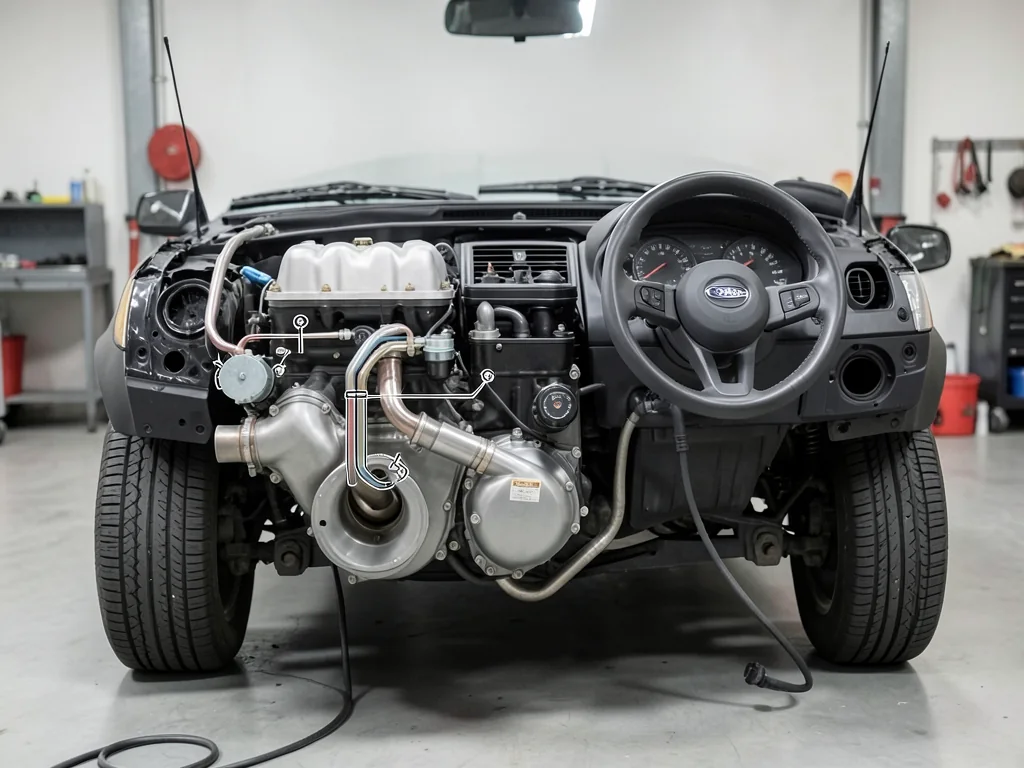
Subaru boxer engines use oxygen sensor and air-fuel ratio sensor feedback for fuel control and emissions monitoring. On an Outback or Forester, the correct Subaru oxygen sensor depends on model year, engine, and emissions layout, not the nameplate. This guide covers identification, location, related fault codes as evidence, and replacement planning without treating a code as proof a part has failed.
Identify the Subaru Sensor and Its Function
An oxygen sensor on a Subaru boxer engine samples exhaust oxygen so the engine control module can adjust injector pulse width and keep fuel trim near the target mixture. Many later layouts use a wide-range air-fuel ratio sensor ahead of the catalyst for closed-loop control, while a conventional downstream oxygen sensor watches converter efficiency. Upstream readings support fueling; downstream readings mainly support emissions monitoring. Neither signal by itself proves a sensor has failed, because mixture, leaks, and catalyst condition all influence what the module sees.
Service information labels an upstream oxygen sensor as the unit before a catalytic converter and a downstream oxygen sensor as the unit after it, then assigns bank and sensor numbers for the specific exhaust. Subaru boxer engines do not share one bank map, so sensor bank identification must come from that vehicle's diagram rather than a habit of calling one side bank one. Confirm model year, engine, emissions configuration, and the exact sensor designation printed in the diagnostic report before treating any bung as the reported Subaru oxygen sensor.
Locate the Correct Sensor on a Subaru Outback
On a Subaru Outback, a reported sensor designation maps to a physical bung only through that vehicle's exhaust diagram. Useful landmarks include the exhaust manifolds, the pipes that leave the boxer heads, and each catalytic converter in the path, but placement still changes with year and engine. An Outback oxygen sensor visible from above may sit in a manifold or downpipe; another may sit after a converter where only underbody access reaches it. Match the diagram callout to the connector and the bung, not to a generic left-or-right guess.
The Outback name alone cannot establish sensor count, bank assignment, access path, or the required part, because wagons of different years and engines use different emissions hardware. Limit owner observations to components that are safely visible with the engine off and the exhaust cool, such as a sensor connector in the engine bay or a bung on a manifold that can be seen without lifting the vehicle. Leave underbody work on an Outback oxygen sensor replacement to a shop with proper lifting equipment.
Locate the Correct Sensor on a Subaru Forester
A Subaru Forester oxygen sensor layout is set by model year, engine, and emissions configuration, not by the crossover badge. Some Foresters use one upstream air-fuel ratio sensor and one downstream oxygen sensor on a single catalyst path; others add a second bank or a second converter and therefore a different sensor count. Until those details are confirmed, calling a part the Forester oxygen sensor still leaves bung location, harness identity, and control-module function unresolved.
A service diagram identifies the Subaru Forester oxygen sensor and its sensor connector by circuit name and exhaust position, without assuming a driver-side or passenger-side default. Follow the harness from the labeled connector to the bung shown for that designation, because boxer exhaust routing can place an upstream unit where a casual glance would not expect it. Ordering a part or authorizing Subaru Forester oxygen sensor replacement requires that exact designation rather than a model-only description that could fit more than one sensor on the same exhaust.
Understand Warning Signs and Sensor-Related Fault Codes
A check-engine light, rough running, or increased fuel consumption can accompany a Subaru oxygen sensor concern, yet none of those signs establish the cause. The same complaints appear with an exhaust leak, a catalytic converter problem, ignition misfire, or a fueling issue that simply shows up in fuel trim. Read the exact stored code and confirm its vehicle-specific meaning before interpretation, especially when the definition is manufacturer-dependent. A fault code is evidence to investigate, not proof that the oxygen sensor itself has failed.
Circuit, heater, response, and mixture-related codes direct testing of the sensor heater circuit, wiring, connector, and exhaust path rather than an automatic parts swap. Wiring faults, an exhaust leak ahead of an upstream sensor, and engine conditions that skew mixture can all produce the same stored result. Professional scan-data, circuit, and exhaust testing is needed when the code does not clearly isolate a single failed component. Stop driving as soon as it is safe if the engine runs severely rough or the check-engine light flashes.
Plan an Outback or Forester Sensor Replacement
Oxygen sensor replacement on a Subaru should wait until diagnosis has identified the failed component, its position, and any underlying fault that would damage a new unit. Fitment then depends on vehicle identification, engine and emissions details, sensor function as upstream or downstream, and the sensor connector specification, not on the Outback or Forester name. A confirmed Subaru oxygen sensor replacement matches that designation; a look-alike bung thread is not enough if the heater circuit or air-fuel ratio sensing element differs.
A shop quote for oxygen sensor replacement on these models typically covers diagnostic time, the specified sensor, labor to reach the bung, and any confirmed wiring or connector damage, without a single price that applies to every Outback or Forester. Access, corrosion, and damaged threads can turn a straightforward swap into a longer job, especially on an underbody downstream oxygen sensor that has been heat-cycled for years. Leave hot-exhaust work, vehicle lifting, and seized-sensor removal to qualified technicians; those steps are not owner driveway tasks.
Confirm the Repair and Address Returning Codes
Successful Subaru oxygen sensor replacement is confirmed by restored operation and resolution of the original fault, not by clearing the warning light and calling the job done. A technician should recheck live sensor data, fuel control where the upstream unit participates, wiring integrity at the sensor connector, and whether the same or related diagnostic codes return after a proper drive. If a code comes back, the new part is only one possibility; an exhaust leak, catalyst issue, or remaining circuit fault may still be in play.
Clearing codes may reset emissions readiness monitors, and those monitors complete only under vehicle-specific driving conditions that the service information describes for that Outback or Forester. A Subaru oxygen sensor has no universal replacement interval, and an Outback or Forester layout should not be copied onto another boxer model. Other Subaru boxer applications need their own verified sensor layout and service information before location, bank identification, or parts selection. Treat returning codes as a reason to retest, not as a cue to replace another sensor by habit.