Subaru Control Arm Bushings: Fitment and Selection
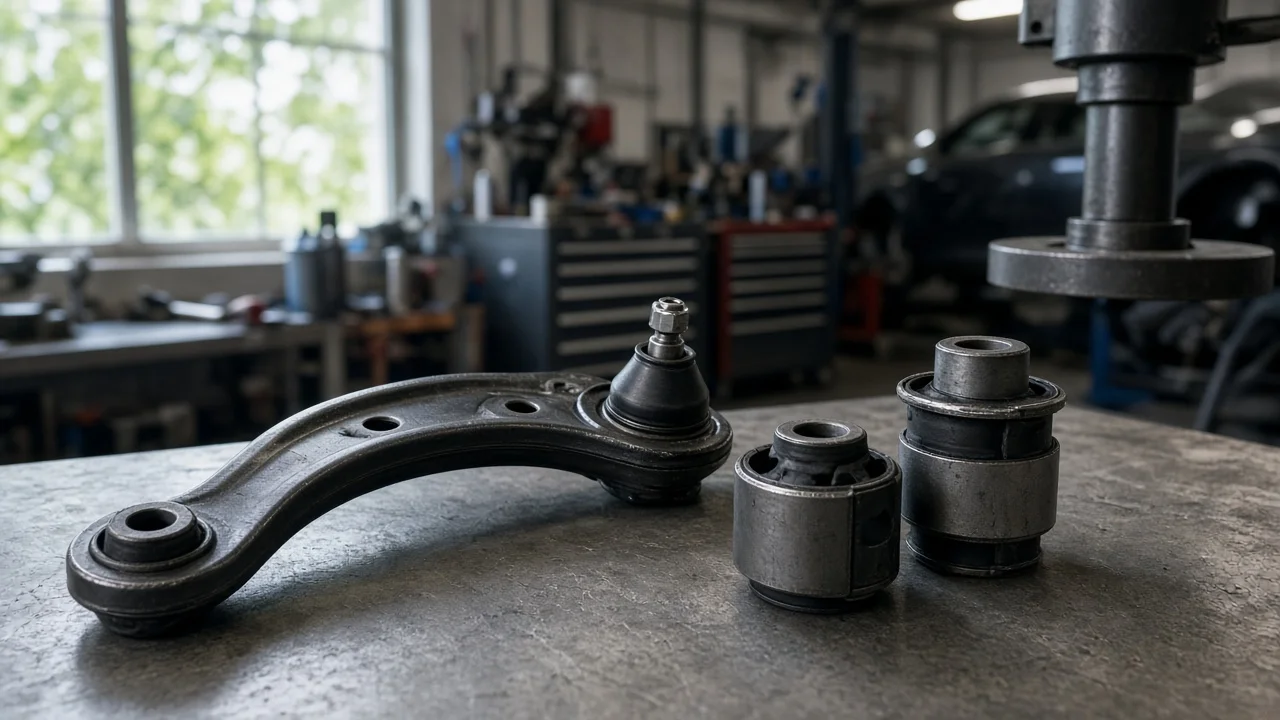
Worn control arm bushings on a Subaru usually show up as a clunk over bumps, steering that wanders under braking, or tires wearing on one edge. Picking replacements depends less on brand than on matching the exact position, the bushing design your car uses, and how you want it to ride afterward. This guide covers confirming fitment, weighing material and design options, and budgeting for the work that comes with the parts.
Define the job the product must do
Start by confirming that the bushings are actually the problem. Clunks and vague handling can also come from sway bar links, worn ball joints, tie rod ends, strut mounts or wheel bearings. With the car on proper vehicle support, meaning jack stands at the manufacturer's lift points and never a jack alone, look at each bushing for cracked or torn rubber, rubber separating from the metal sleeve, or an arm sitting off-center in its mount. A pry bar lets you check movement at the bushing, and you can compare it with joint play at the ball joint so you replace the right part.
Next, decide what the car is for. A commuter Impreza or Legacy usually benefits most from factory-style rubber that keeps road noise low. A WRX on a track or autocross may suit firmer bushings that hold alignment under load. An Outback or Forester used on gravel or fitted with a lift kit has different demands. Also be honest about your tools and time. Pressing bushings needs a press or a dedicated tool set, while bolting in complete arms needs only hand tools and an alignment afterward.
Check compatibility
Fitment begins with model, model year, generation and trim, and the VIN is the most reliable way to confirm a part number. Subaru has changed suspension parts within a model name, and sometimes mid-generation, so a listing that just says Forester or Outback is not enough. Pin down the position as well: front or rear suspension, left or right, and which bushing on the arm. On many Subaru front lower control arms, the forward bushing is pressed into the arm, while the rearward bushing is a larger unit held in a separate bracket. These are different parts and are often sold separately.
Compare the details a listing should state: outer diameter, inner sleeve size, bolt diameter, overall width, and whether a bracket, sleeves or hardware are included. Some bushings have voids or an offset center that must face a specific direction, so the instructions should show the orientation. Check the car's mounting points too. Corroded subframe brackets, elongated bolt holes or seized pivot bolts can turn a parts swap into a repair, especially on vehicles from road-salt regions. If the car has been lifted or lowered, confirm the part was designed for that change in ride height.
Features that affect the choice
Material is the main trade-off. OE-style rubber isolates vibration and noise best and needs no maintenance, but it allows more deflection under hard cornering and braking. Polyurethane resists that deflection and gives sharper steering response, but it transmits more noise and vibration into the cabin, and it can squeak if not lubricated as the manufacturer directs. Some aftermarket kits use an offset bore to change caster or reduce front-end lift under acceleration. That changes suspension geometry on purpose, so treat it as a tuning choice rather than a like-for-like repair.
Read marketing labels skeptically. Terms like heavy duty, performance or premium say little on their own. Useful evidence includes a stated material and hardness, dimensions matched to the factory part, included sleeves or brackets, clear installation and lubrication instructions, and written warranty terms. Also decide between bushings alone and a complete control arm with new bushings already fitted. A complete arm saves pressing work and replaces a possibly corroded arm, but check what it includes. On some models the ball joint is a separate part, so a new arm may not cover a worn joint.
Limitations and ownership costs
The parts price is only part of the cost. Replacing pressed-in bushings takes a hydraulic press or a bushing tool kit, and some rear brackets need specific adapters. Plan on a wheel alignment after the job, because removing and refitting control arms disturbs suspension geometry, and offset bushings change it on purpose. Some fasteners may be specified as single-use, so check the service information and budget for new bolts and nuts where required. Use the correct fastener specification for your exact model from that information rather than a generic chart.
How the job is done also affects how long the parts last. Rubber bushings are normally tightened with the suspension loaded at normal ride height, not hanging on a lift. Tightening them at full droop can preload the rubber and shorten its life. Polyurethane may need periodic re-greasing to stay quiet. New bushings cannot fix worn ball joints, tie rods, struts, bent arms or a damaged subframe, and they do not tell you how much life is left in the rest of the suspension. If other components show play, deal with them in the same visit to avoid paying for a second alignment.
Build a practical shortlist
Narrow the options with a short checklist. First, confirm the part number for your VIN and the exact position: front or rear axle, side, and forward or rearward bushing. Second, check that the listed dimensions, bracket, sleeves and hardware match what is on the car, or note what you will need to source separately. Third, choose a material that fits how the car is used, accepting more cabin noise if you pick polyurethane. Fourth, decide whether you want geometry-changing offset bushings or a straight factory-equivalent replacement.
Then cover the practical side. Decide whether you will press bushings yourself, pay a shop to press them, or buy complete arms. Check that clear instructions, lubrication guidance and a written warranty come with the parts. Add the cost of an alignment and any single-use hardware to every option so you compare full job costs rather than part prices. A shortlist of two or three candidates that pass every step gives you a sound choice without relying on rankings or untested claims.