Subaru Automatic Transmission Relearn Procedure: What Owners Should Know
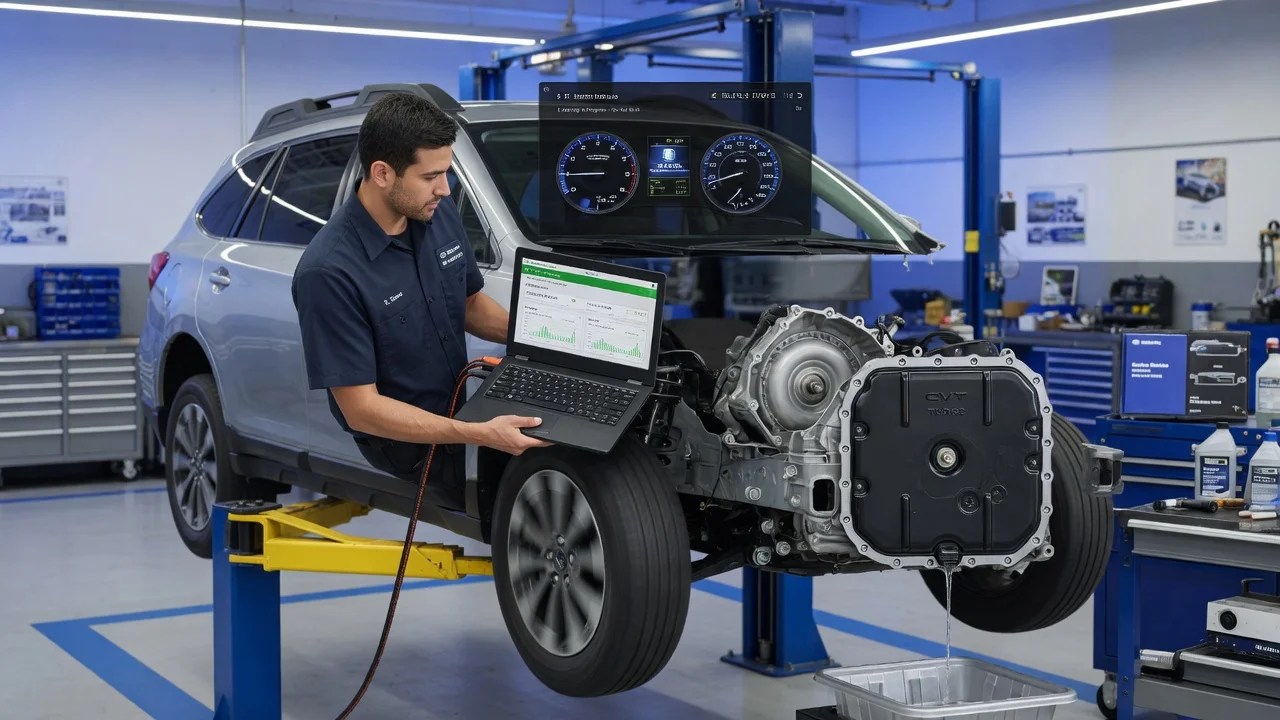
A Subaru transmission relearn resets or rebuilds the adaptive values the transmission control module uses to time clutch engagement and shifts. Owners usually look for it after a fluid service, battery disconnection, software update or repair, or when shift behavior starts to feel off. The right procedure depends on whether the car has an older stepped automatic or a Lineartronic CVT, and on the model year. This guide explains what relearning does, what changes the answer and what you can realistically do yourself.
The short answer on Subaru transmission relearning
On most modern Subarus, a proper relearn is not a key-and-pedal routine you can perform from the driver's seat. Dealers and well-equipped independent shops use the Subaru Select Monitor or a compatible scan tool to clear stored learning values and, where the procedure calls for it, run a guided learning routine with the engine running and the transmission at operating temperature. After that, the control module continues refining its values during normal driving.
Whether a relearn is needed at all depends on what was done to the car. Replacing the control module, valve body, transmission assembly or certain sensors usually calls for one. A routine drain and fill may only require a fluid-related reset on some CVT models, or nothing beyond normal driving on others. A relearn also does not repair anything mechanical. If shifting stays harsh, delayed or erratic afterward, the underlying cause still has to be diagnosed.
How adaptive transmission learning works
The transmission control module, which on many Subarus shares hardware or communication closely with the engine controller, commands hydraulic pressure through solenoids in the valve body. Because clutches, friction surfaces, fluid and solenoids vary slightly from unit to unit and change with wear, the module stores correction values that adjust pressure and timing so engagements feel consistent. It updates those values by watching input and output speed sensors during shifts or ratio changes.
When stored values are cleared, the module falls back to base values. Until it relearns, the car can feel different: firmer or softer engagement into drive or reverse, slightly abrupt shifts, or changes in how torque converter lock-up behaves. In a CVT, the module also manages pulley clamping pressure, ratio control and lock-up, and some of those functions have learned values that the service procedure handles separately. Learning through driving is gradual and depends on the module seeing the right conditions, which is why a guided routine is used after major work.
What changes the procedure for your Subaru
Transmission type is the first question. Subaru used four- and five-speed conventional automatics in older models, introduced the Lineartronic CVT with the 2010 Legacy and Outback and spread it across most of the lineup in the following years, while some six-cylinder and older-platform models kept a stepped automatic longer. Higher-torque applications use a different CVT family than smaller-engine models. Each family has its own service steps, fluid specification and scan tool functions, so instructions written for one should not be applied to another.
The reason for the relearn matters too. On many older stepped automatics, disconnecting the battery or clearing codes was commonly used to reset learned values, after which the module relearned through driving. On CVT models, a scan tool is generally needed to clear learning, perform the learning routine and, on models that track it, reset the fluid deterioration counter after a fluid change. Software reflashes, a replacement control module, or a rebuilt or used transmission may also need registration or coding steps beyond learning. Vehicle-specific service information matched to the VIN defines the exact sequence and conditions.
What you can do as an owner
Start by gathering facts rather than assuming a relearn will fix the problem. Note exactly when the symptom appears: cold or warm, under light or heavy throttle, on engagement into drive or reverse, or at a particular speed. Read stored diagnostic codes with a scan tool that can access the transmission module, since many basic code readers only see engine codes. Watch whether any transmission-related warning light is on or flashing, as some older Subarus flash the AT oil temperature light to signal a stored fault. Record the service history, especially recent fluid work, battery replacement or software updates.
Confirm the fluid level using the method specified for your transmission. Some Subaru units have a dipstick, while many CVTs are checked at a level plug at a specified temperature, so the wrong method can give a misleading reading. Use only the fluid specification listed for that exact unit; CVT fluid and conventional ATF are not interchangeable, and fitment of fluids, filters and parts should be confirmed against the VIN. If you recently disconnected the battery on a car whose module relearns through driving, give it a period of varied, normal driving with smooth acceleration and gentle stops before judging the result.
If you own or can access a scan tool that supports Subaru transmission functions, it may offer learning clear and learning routines. Follow its on-screen conditions exactly, and stop if it reports a fault or a condition that is not being met rather than repeating the routine.
Limitations and when to see a professional
There is no single universal step-by-step sequence, because the correct procedure depends on model year, engine, transmission type and software level, and Subaru revises its service information over time. Treat any relearn instructions that do not first ask which transmission you have with caution.
Book a dealer or transmission specialist when there are stored transmission codes, a flashing or illuminated transmission warning, slipping, delayed engagement, shudder, unusual noise, or a symptom that persists after relearning. A harsh shift is a symptom, not proof of a failed valve body, torque converter or belt. A qualified technician can review sensor data, pressures and fluid condition before recommending repair options, which may range from a software update or fluid service to component replacement. It is also worth asking whether a software update, service bulletin or extended warranty coverage applies to your VIN, since Subaru has extended CVT coverage on certain model years in some markets.