Subaru 2.5L H4 Engine Problems: What Goes Wrong and Which Versions Are Affected
The short answer
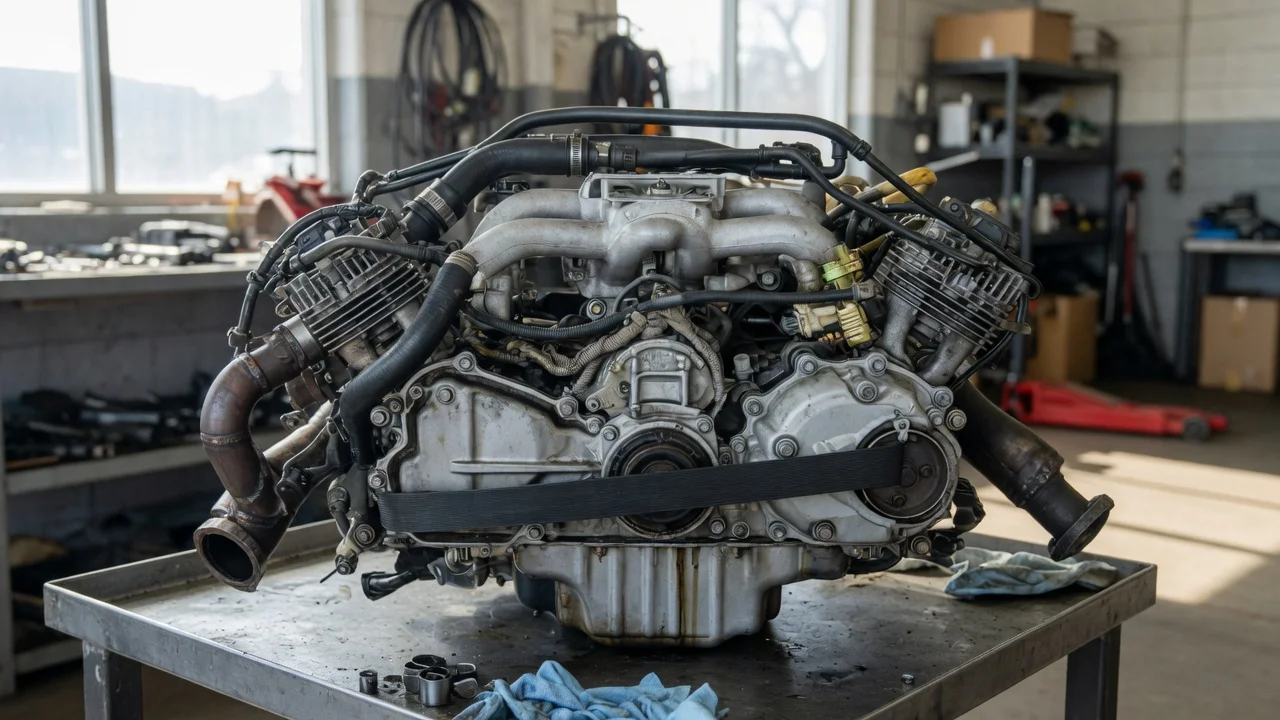
Subaru's 2.5-liter horizontally opposed four-cylinder (H4, or "boxer") is not one engine. It spans two main families with different weak points. The older EJ25 family is best known for head gasket leaks on naturally aspirated versions and for piston and rod bearing failures on turbocharged versions. The newer FB25 family, which replaced the EJ25 in most naturally aspirated models during the early 2010s, is better known for excessive oil consumption in some early model years than for head gasket trouble. Which problems matter depends on the engine code in the specific vehicle.
This article draws on widely reported patterns rather than a single published dataset, so it does not give failure rates. Exact model-year cutoffs vary by model and market. Confirm the engine code, recall status and any warranty extensions for a specific vehicle with a Subaru dealer using its VIN.
How to tell which 2.5-liter engine you have
The EJ25 uses a timing belt. The FB25 uses a timing chain. In North America, naturally aspirated EJ25 engines appeared in models including the Legacy, Outback, Forester and Impreza from the mid-1990s. The FB25 took over in the Forester for the 2011 model year and in the Legacy and Outback for 2013. Turbocharged EJ25 variants remained in performance models, most notably the WRX STI, after the naturally aspirated EJ25 was phased out. The engine code is usually printed on an underhood emissions label and can be confirmed by VIN.
Engine family | Typical applications (North America, approximate) | Most reported problem areas; EJ25 DOHC, naturally aspirated | Mid-to-late 1990s Legacy, Outback, Impreza, Forester | Internal head gasket failure leading to overheating; EJ25 SOHC, naturally aspirated | Roughly 1999 through the end of EJ25 use in each model | External head gasket seepage, oil leaks, timing belt maintenance, cold-start piston noise; EJ25 turbocharged | WRX, WRX STI, Forester XT, Legacy GT, Outback XT (years vary) | Piston ringland damage, rod bearing failure, oil supply concerns; FB25, naturally aspirated | Forester from 2011, Legacy and Outback from 2013, later Crosstrek and others | Excessive oil consumption in some early years
EJ25 head gasket failures
Head gasket problems are the reputation the 2.5-liter Subaru is best known for, and they apply mainly to naturally aspirated EJ25 engines. The head gasket seals the joint between the cylinder heads and the engine block, keeping coolant, oil and combustion gases in their separate passages.
The two EJ25 generations tend to fail differently. Earlier DOHC (dual overhead cam) engines from the late 1990s are associated with internal failures, where combustion gases enter the cooling system. This can cause overheating, coolant loss with no visible leak, or bubbles in the coolant reservoir. Later SOHC (single overhead cam) engines are more often associated with external seepage, where oil or coolant weeps from the edge of the gasket. This is often first noticed as a sweet coolant smell, residue on the lower edge of the cylinder heads, or a slowly dropping coolant level.
Subaru addressed the issue over time. Measures included a cooling system conditioner additive specified for affected engines and revised gasket designs, including multi-layer steel gaskets in later service parts. An external seep can progress slowly, but an internal leak that causes overheating can damage the engine quickly. A vehicle that is overheating should not continue to be driven.
Other EJ25 issues: oil leaks, timing belts and piston slap
Oil leaks: valve cover gaskets, spark plug tube seals, camshaft seals and crankshaft seals are common seepage points on aging EJ25 engines. Oil dripping onto the exhaust can produce a burning smell. Timing belt maintenance: because the EJ25 uses a rubber timing belt, it must be replaced at the interval in the owner's manual, which varies by model year. The water pump, idlers and tensioner are often replaced at the same time. A belt that fails in service can leave the car stranded and may cause internal damage, depending on the engine variant. Piston slap: some EJ25 engines make a knocking or slapping noise when cold that fades as the engine warms. This is generally regarded as a noise issue rather than an imminent failure. A knock that persists when warm, or grows louder, needs professional diagnosis, because it can indicate a more serious problem.
Turbocharged EJ25 problems
Turbocharged EJ25 engines, such as those used in the WRX STI and in various years of the WRX, Forester XT and Legacy GT, have a different reputation. The most frequently reported failures are cracked piston ringlands and rod bearing failures. A ringland is the part of the piston between the ring grooves, and damage there typically shows up as lost compression in one cylinder. Rod bearing failure usually begins as a knock that rises with engine speed.
Owners and specialists commonly link these failures to aggressive engine tuning, detonation (uncontrolled combustion, also called knock), low oil levels, extended oil-change intervals and hard use. This is a widely held view in the enthusiast community rather than a documented manufacturer finding. Its practical meaning is that maintenance and modification history matter a great deal when judging a used turbocharged EJ25.
FB25 oil consumption
The FB25 largely moved past the EJ25's head gasket reputation, but some early-production engines drew complaints about burning excessive oil between changes. Oil-consumption concerns in Subaru's early FB engines led to technical service bulletins, repairs that in some cases involved replacing the short block or piston rings, and a class-action settlement in the United States. Exactly which models and years were covered, and on what terms, should be confirmed with Subaru for a specific VIN. Coverage periods may have expired.
Some oil consumption is normal for most engines, and manufacturers publish an acceptable rate. Owners of early FB25 vehicles should check the dipstick regularly rather than relying on the oil-change interval alone. Running low on oil is a more serious risk than the consumption itself.
What this means for owners and buyers
Identify the engine code before drawing conclusions, since EJ25 and FB25 problems differ. For a naturally aspirated EJ25, ask whether the head gaskets and timing belt have been replaced, and look for coolant or oil residue where the cylinder heads meet the block. For a turbocharged EJ25, ask about tuning history and oil-change records. A compression or leak-down test by a specialist before purchase is a common precaution. For an early FB25, ask whether any oil-consumption repairs were performed and check the oil level. For any model, have a dealer check open recalls and warranty extensions by VIN. Stop driving and seek professional diagnosis if the engine overheats, the oil pressure warning light comes on, or a knock appears and persists once the engine is warm.
Limits of this overview
This article reflects commonly reported problem patterns for Subaru's 2.5-liter H4 engines. It does not provide failure rates, repair costs or exact service bulletin numbers, because those details vary by model year, market and source and are not quantified here. A well-maintained example of any of these engines can run reliably for a long time, and the issues above are tendencies, not certainties for any individual vehicle.