Struts and Sway Bar Links: Understanding Their Connection
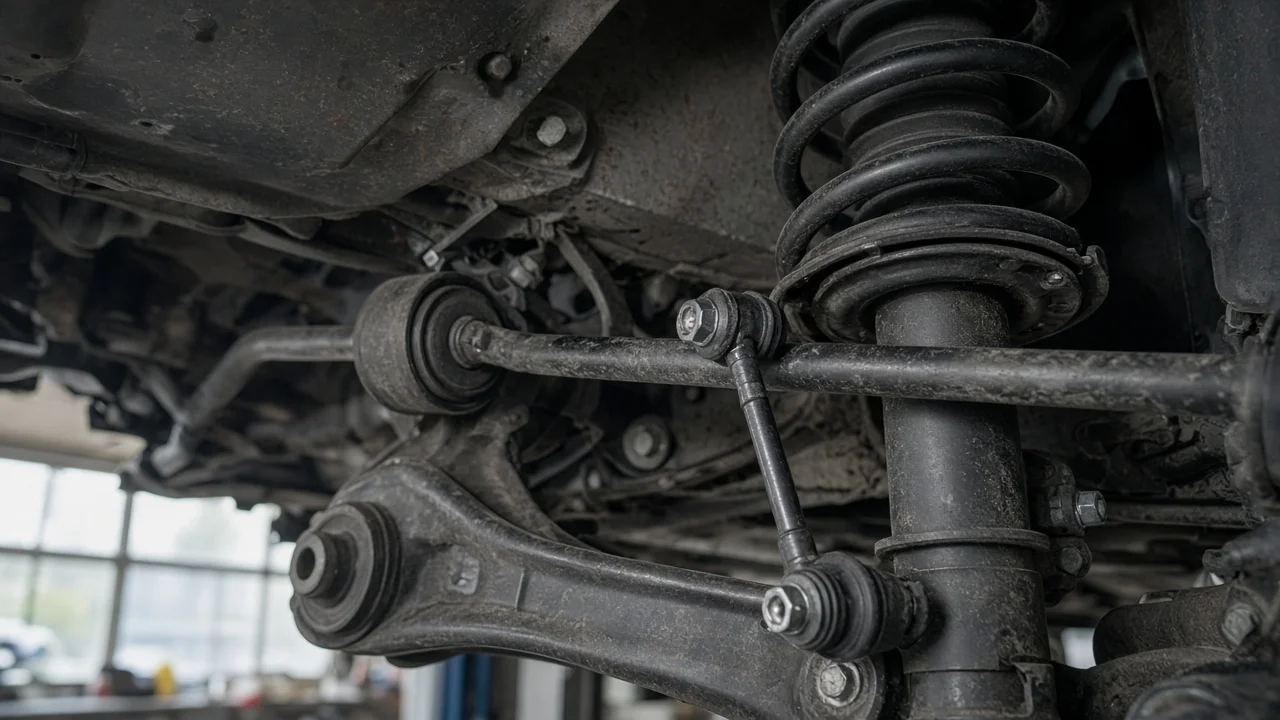
Struts and sway bar links work side by side in many front suspensions, and on a large share of vehicles the link bolts directly to the strut body. That connection explains why a clunk can be hard to pin down, why one part often has to be disconnected to service the other, and why reinstallation details matter. Here is how the two parts relate, what varies between vehicles, and what an owner can safely check.
The short answer
Struts and sway bar links are separate components with separate jobs, but they often share a load path. A strut combines a damper with a spring seat, and on MacPherson designs it also locates the wheel and carries vehicle weight. A sway bar link connects the end of the anti-roll bar to the suspension so the bar can resist body lean in turns. On many MacPherson strut vehicles the link attaches to a bracket on the strut housing. On others it attaches to the lower control arm or knuckle. When the link is strut-mounted, it pushes and pulls on the strut every time the body leans, so removing a strut usually means disconnecting the link first. A worn link is not usually the direct cause of a worn strut, or the reverse, but both can produce similar knocking noises. For that reason, inspect both whenever either one is replaced.
How the strut and link share the load
When the vehicle travels straight over even pavement, both sides of the suspension move together and the sway bar barely twists. In a turn, the outside wheel compresses while the inside wheel extends. The bar resists that difference by twisting, and the end links transmit the twisting force into the suspension. With a strut-mounted link, that force passes through the bracket into the strut housing, then down through the knuckle to the wheel.
Links come in two common styles. One is a short rod with a ball stud at each end. The other is a bolt-through design with rubber or polyurethane bushings stacked on a long bolt. Ball-stud links accommodate the angle changes that occur as the strut moves and the wheel steers. Bushing links rely on rubber flex instead. With either style, the bar should sit near neutral at normal ride height. Some designs end up preloaded if the link is tightened while the suspension hangs at full extension. That preload can make handling differ from side to side or shorten bushing life.
What changes the answer for your vehicle
The biggest variable is where the link mounts. Strut-mounted links are common on front MacPherson designs. Double-wishbone, multilink and many truck front ends attach the link to a control arm or knuckle, so strut work may not involve the link at all. Rear suspensions vary just as widely. The only reliable way to know is to look at the parts or consult the service information for the exact model.
Replacement parts matter too. An aftermarket strut or complete strut assembly must place the link bracket in the same position and orientation as the original. A misplaced bracket can force the link to a bad angle or let it contact the spring or tire. A raised or lowered ride height changes the link angle and may call for adjustable or different-length links to keep the bar near neutral. Age and climate also change the job. In rust-prone areas, link nuts often seize and the stud spins in its socket during removal, which is one reason many strut jobs end with new links as well.
Wheel alignment is another distinction. Replacing a sway bar link alone does not normally change alignment. Replacing a strut can, because on many vehicles the strut-to-knuckle bolts influence camber. An alignment check after strut replacement is common practice, but follow what the service information for your vehicle calls for rather than assuming either way.
What the owner can check and do
Start with observation. A clunk or rattle over small, uneven bumps at low speed, often louder on one side, is a classic link symptom. Other symptoms point more toward the strut, its upper mount or its bearing: a knock on larger bumps, bouncing that continues after a dip, fluid on the strut body, or noise when you turn the steering wheel at a standstill. Treat these as clues rather than a diagnosis, because worn control arm bushings, ball joints and tie rod ends can sound much the same.
For a hands-on check, park on level ground, set the parking brake and chock the wheels. If you lift the vehicle, use the jack only to raise it. Then support the vehicle on jack stands placed at the manufacturer's specified lift points. Never work under a vehicle held up only by a jack. Lifting one side twists the sway bar, so for checking joint play it helps to support both sides at the same height or leave the vehicle on its wheels or on ramps. Grip each link and try to move it. Look for free play or clunking at the ball studs, torn boots, cracked bushings, a bent link, and a damaged strut bracket. On the strut itself, look for leaks, a dented body and a worn upper mount.
If you replace a link yourself, hold the ball stud with the hex or Torx socket in its end while turning the nut. Use new nuts where the manufacturer specifies them, and tighten to the fastener specification in the service information for your exact vehicle. Some manufacturers require final tightening with the suspension at ride height. Strut replacement is a larger job. Coil springs store enough energy to cause serious injury, so use a spring compressor suited to the task or install a complete pre-assembled strut assembly.
Limitations and when to get professional help
Diagnosing noise by ear has real limits, and this overview cannot tell you which part on your vehicle is worn or how long it can safely stay in service. Torque values, tightening sequence, whether a nut is single-use, and whether final tightening must happen at ride height all differ by model, so take them from the manufacturer's service information. The same applies to alignment settings after strut work.
Have a qualified technician inspect the vehicle if you notice any of these: heavy clunking, a broken or disconnected link, a separated strut mount, a damaged spring, steering pull or uneven tire wear. Do the same if you lack the equipment to support the vehicle and compress springs safely. A shop can check joint play under the correct load, confirm the mounting points are intact, and perform an alignment when the work requires one. A broken link mainly reduces roll control, but it changes how the vehicle responds in sudden maneuvers, and loose parts can strike nearby components, so do not postpone the repair.