Strut Replacement Cost
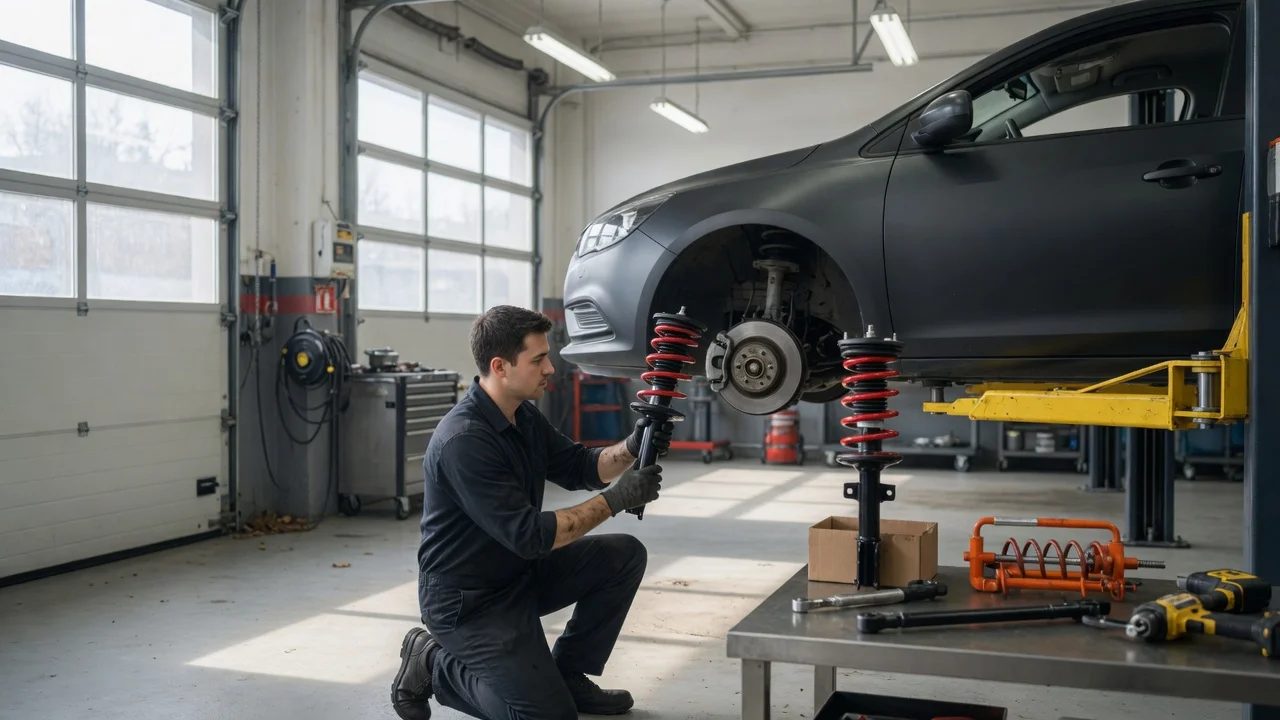
What front strut replacement typically costs
There is no single price for front strut replacement. The total depends on the vehicle’s year, make, model, trim and powertrain, whether one strut or both fronts are replaced, whether the shop installs a complete strut assembly or a bare strut, local labor rates, and whether a wheel alignment is included. Specific dollar amounts, shop averages and parts list prices are not supplied here, so treat any quote as vehicle- and location-specific rather than a national figure.
A front strut, often a MacPherson strut, is a suspension member that damps bumps and also locates the steering knuckle. It is not only a shock absorber. Wear shows up as bounce after dips, nose dive under braking, clunks over rough pavement, or uneven front tire wear. Because the part is structural, replacement is a safety and handling job, not a cosmetic one.
What the job usually includes
A typical front-strut job covers the strut unit itself and the labor to disconnect it from the knuckle, swap it, and torque the hardware to spec. Many shops install a complete, or loaded, assembly that already combines the damper, coil spring, top mount, bearing, boot and bump stop. Others install a bare strut and reuse the original spring and mount if those parts are still sound. After the swap, a front-end or four-wheel alignment is normally required because camber and related angles often change when the strut is removed.
Related parts found worn on inspection, such as strut mounts, sway-bar links, ball joints or control-arm bushings, may be quoted as extras if they are replaced at the same time. Those add-ons change the bill and should appear as separate line items.
Conditions that change the price
A complete assembly usually costs more in parts and less in labor because the shop does not have to compress the spring and transfer it onto a new damper. A bare strut is often cheaper as a part and more expensive in labor, and it is only a good fit when the spring, mount and hardware are still serviceable. Replacing both front struts is common on higher-mileage cars because the remaining side is often similarly worn; a one-side repair can leave a mismatch in damping and ride height.
Luxury, performance, European and some all-wheel-drive models can need costlier parts or extra labor. Dealer and independent shop rates differ, as do labor rates by region. Original-equipment parts and aftermarket units are not interchangeable in quality or price without checking fitment for that exact model year, market, trim and powertrain. If those details are unresolved, the quote is incomplete.
How to choose a next step
Ask for a written estimate that names the vehicle, states one side or both, and lists the part type (complete assembly or bare strut), brand or OEM versus aftermarket, whether new mounts and hardware are included, labor hours, and whether alignment is in the total. Compare those line items across shops rather than the bottom line alone. If a shop cannot price the job without seeing the car, an inspection is the practical next step, especially if there is a clunk, a leaking damper, or a broken spring.
Until a shop prices your year, make, model and local labor, the honest answer is a range that has to be quoted, not a fixed number. Use the estimate to decide whether to replace one strut or both, and whether a loaded assembly or a bare strut is the better trade-off for that vehicle.