Strut Repair Cost
What you should expect to pay
There is no single strut repair price. The bill depends on the vehicle, which strut or struts are being serviced, whether the shop is replacing the complete strut assembly or only selected parts, and how much related hardware must come off to do the job. On most modern cars and light trucks, shops replace a worn strut rather than rebuild it, so the quote you receive is usually a replacement quote even when it is labeled as repair.
A useful estimate needs at least the model year, market, trim, and powertrain, plus whether the work is front, rear, or both sides. Unresolved differences between those details can change the part number, labor time, and whether extra components such as electronic dampers, ride-height sensors, or air-spring hardware are involved.
What a strut is, and what “repair” usually means
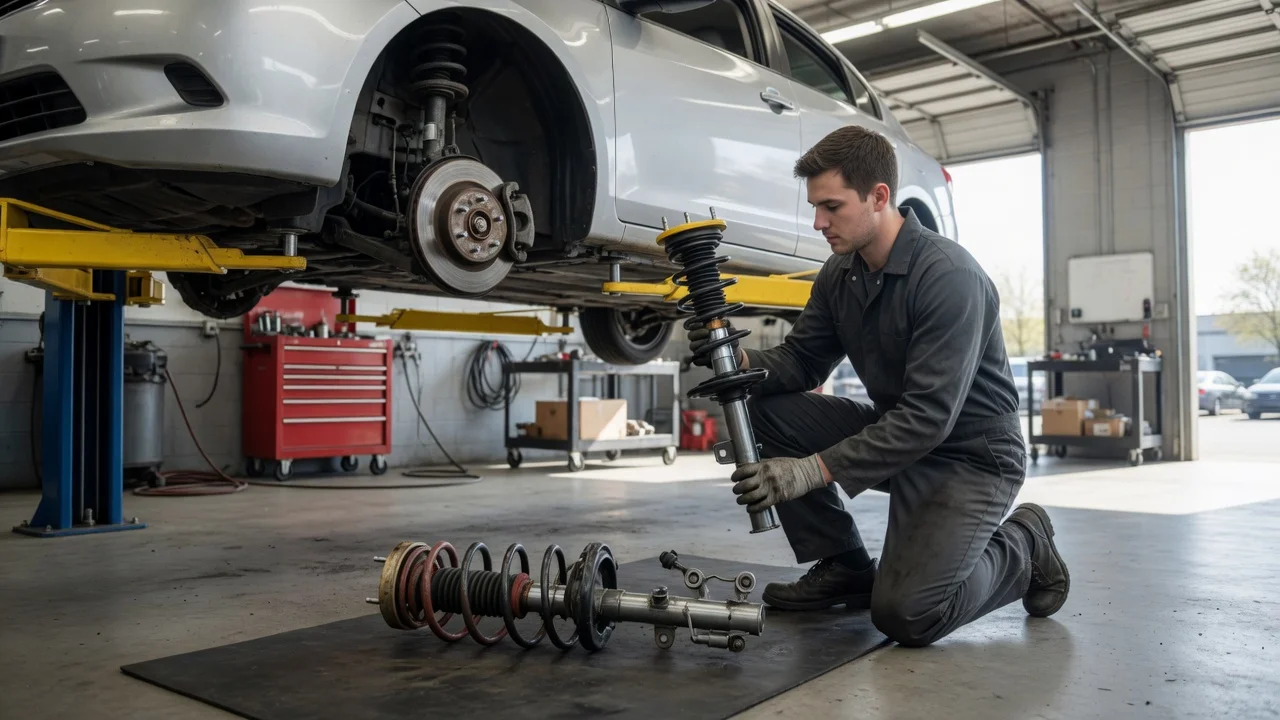
A strut is a suspension member that combines a damper with structural support for the spring and, at the front of many vehicles, steering and alignment geometry. When the damper leaks, the ride becomes harsh or bouncy, or a mount or bearing fails, the assembly is typically removed as a unit. True in-place repair of the damper itself is uncommon; the usual paths are a complete strut assembly (strut, spring, and mount already together) or a bare strut that is assembled with the existing or new spring and mount in a spring compressor.
That distinction matters for cost. A complete assembly is often faster to install and may include a new spring and mount. A bare strut can look cheaper on the parts line but add labor and extra parts if the spring, insulator, mount, or bearing also need replacement. Ask the shop which of those two methods is in the quote and which related parts are included.
What actually drives the cost
Vehicle application: year, make, model, trim, engine, and whether the vehicle is front-wheel, rear-wheel, or all-wheel drive, because strut design and access time differ. Position: front struts often take more labor than rears because of steering knuckles, brake hoses, ABS sensors, and alignment. Rear struts can still be expensive if interior trim, trailing arms, or a subframe must be disturbed. One side versus a pair: many shops recommend replacing struts in axle pairs so damping stays even side to side. Doing one side only can lower the immediate bill and leave a later repeat of similar labor. Assembly versus component job: complete strut assemblies versus a bare strut plus separately priced spring, mount, bearing, boot, and insulator. Related parts that only show up after disassembly: seized fasteners, torn dust boots, broken spring insulators, or a damaged control-arm bushing or sway-bar link. Alignment: a front-strut job normally needs a wheel alignment afterward; some rear-strut designs do as well. Alignment is often a separate line on the invoice. Shop type and parts grade: dealer, independent, or mobile technician, and original-equipment versus aftermarket parts, including whether the damper is conventional or electronically controlled.
Parts, labor, and extras that change the quote
Labor is a large share of the job because the strut is a load-bearing part of the suspension. Time goes up when rusted hardware breaks, when electronic connectors or ride-height sensors must be handled, or when the spring must be compressed and transferred onto a new strut. Parts cost jumps when the vehicle uses an electronic or adaptive damper, an air strut, or a magnetically controlled unit, because those assemblies are application-specific and are not interchangeable with a conventional hydraulic strut.
Ask for a written breakdown that separates the strut or assembly, mount and bearing if sold apart, hardware, alignment, and shop supplies. Confirm whether both sides of the same axle are included, whether the springs are new or reused, and whether the quote assumes the existing fasteners come off cleanly. If the vehicle has adaptive suspension, confirm that the replacement part matches that system; a conventional strut is not a substitute unless the manufacturer documents that conversion.
Conditions that materially change the answer
Luxury, performance, and some crossover models with adaptive or air suspension: parts are typically much more expensive and may require scan-tool calibration after installation. High-mileage or rust-belt vehicles: labor can rise if bolts snap or if a knuckle, hub, or brake hose is damaged during removal. Warranty, recall, or extended-coverage situations: some strut or mount failures may be covered; that can remove or reduce the owner-paid portion. Inspection-only findings: a leaking strut is a clearer replacement case than a noise that might be a mount, sway-bar link, or spring insulator. Replacing the strut without confirming the failed part can spend money on the wrong item.
How to get a quote you can compare
Give every shop the same vehicle identifiers: year, make, model, trim, engine, drivetrain, and VIN if you have it. State which corner is in question and whether you want an axle pair. Ask each quote to specify complete assembly or bare strut, which related parts are included, whether an alignment is included, and whether adaptive-damper programming is required. Compare those line items rather than a single total, because two shops can quote different jobs under the same “strut repair” label.
If you do not yet have a diagnosis, start with an inspection rather than authorizing replacement. A visual check for oil on the strut body, a collapsed or broken spring, a torn mount, and uneven tire wear is more useful than a price alone. Specific dollar figures, typical ranges, and local availability cannot be stated here without the vehicle and the exact parts list; those belong on a written estimate for your car.
A practical next step
If ride quality, a clunk over bumps, or a leaking damper already points to the strut, request a pair of itemized estimates for the affected axle and plan on an alignment after front work. If the only issue is a noise or a warning light, have the shop identify the failed part first so the quote matches the actual repair. Once you have year, trim, powertrain, and a parts list, you can judge whether the job is a conventional strut replacement or a higher-cost electronic or air-suspension repair, and choose the shop and parts grade that fit that job.