Strut Mount Replacement Cost: Parts and Labor
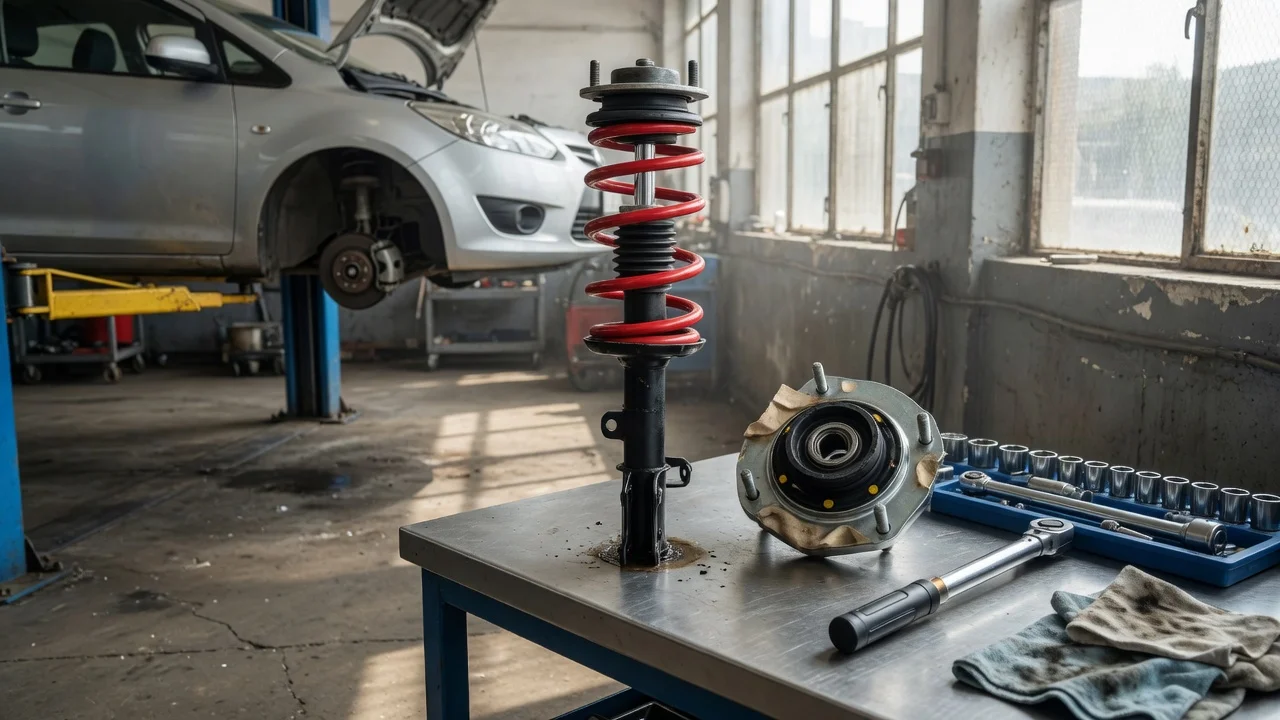
What strut mount replacement costs
There is no single price for strut mount replacement. The bill is the sum of the mount (and any parts replaced with it) plus shop labor, and both vary by vehicle, whether the job is one corner or a pair, and whether the strut assembly is serviced or swapped as a unit. A useful quote is always tied to a specific model year, trim, and powertrain, plus whether related wear items are included. National averages and a parts-versus-labor split in dollars are not available from the evidence used for this article, so treat any round number you see elsewhere as a starting point until a shop prices your car.
What a strut mount is
A strut mount sits at the top of a MacPherson strut, where the assembly bolts to the body. It carries spring load, locates the strut, and usually includes a bearing so the front strut can turn with the steering. When the rubber insulator tears, the bearing seizes, or the mount itself cracks, you may hear clunks over bumps, feel vibration through the steering wheel, or notice the car sitting slightly off-level at that corner. The mount is a wear item; it is not the damper, the coil spring, or the entire strut, though shops often replace those together because the same disassembly is required.
How parts and labor are billed
Parts are the mount itself, plus whatever else the shop installs while the strut is apart. Labor is the time to support the vehicle, disconnect the strut, compress the spring if the original strut is being rebuilt, swap the mount, reassemble, and set ride height and alignment. Front mounts that include a bearing are typically more involved than rear mounts that do not steer. Many estimates also include a four-wheel alignment after the job, because ride height and camber can change once a worn mount is replaced.
Parts line: the mount, and often a bearing, insulator, or dust boot if they are sold separately or packaged as a kit. Labor line: spring compression and reassembly if the original strut is reused, or a shorter R&R if a complete strut assembly is installed. Related parts: strut, spring, or bump stop when those are worn, recalled, or cheaper to replace while the assembly is already off the car. Shop extras: alignment, disposal, and shop supplies, which may appear as separate lines.
Conditions that change the quote
Cost moves with how the car is built and how the shop chooses to do the work. A compact car with an accessible front strut is a different job from a luxury crossover with electronic dampers, air springs, or a tightly packaged engine bay. Complete strut assemblies (mount, spring, and damper already assembled) raise the parts total and usually lower labor because the shop does not compress the original spring. Reusing the original strut and replacing only the mount does the opposite: cheaper parts, more labor, and a requirement that the remaining damper and spring are still serviceable. Replacing mounts in pairs on an axle is common because the opposite side is often similarly aged; that doubles parts and much of the labor, and it is the condition that most often turns a small estimate into a large one.
Vehicle: model year, market, trim, and powertrain change mount design, fastener access, and whether an electronic or air strut is involved. Differences between trims are unresolved until the VIN or build sheet is checked. Side and axle: one corner versus both fronts, or fronts plus rears. Method: mount-only with spring compressor versus complete strut assembly. Condition of related parts: a rusted spring perch, seized bearing, or leaking damper can force extra parts onto the same ticket. Shop type: dealer, independent, or mobile tech, plus whether an alignment is done in-house.
What to put on the estimate so you can compare shops
Ask for a written estimate that names the vehicle, the corners being serviced, and whether the line item is a mount kit or a complete strut. Have the shop state whether the opposite-side mount is recommended, whether the original damper and spring will be reused, and whether alignment is included. If the car has electronic or air suspension, confirm that the replacement parts match that system; a conventional strut is not a substitute. Compatibility of aftermarket mounts with a given year, trim, and powertrain is not settled in generic catalogs, so match the part to the VIN or to the OEM number on the existing mount.
A practical next step
If the car already clunks, binds in the steering, or sits unevenly, get the strut mounts inspected and a firm quote for the corners that failed, with a line for the matching side if the shop recommends pairing them. If you are planning the job ahead of symptoms, price both a mount-only repair and a complete strut assembly for your specific vehicle and compare the parts-plus-labor totals, including alignment. Do not treat a number from another car, another region, or an unspecified national average as your cost until it is tied to your model year, trim, powertrain, and the exact parts on the ticket.